Kularatna Sanjeewa, Hettiarachchi Ruvini, Senanayake Sameera, Murphy Ciara, Donovan Caroline, March Sonja
Australian Centre for Health Services Innovation (AusHSI) and Centre for Healthcare Transformation, School of Public Health & Social Work, Queensland University of Technology (QUT), Brisbane, Australia.
School of Applied Psychology, Griffith University, Brisbane, Australia.
BMC Health Serv Res. 2022 Apr 22;22(1):542. doi: 10.1186/s12913-022-07939-x.
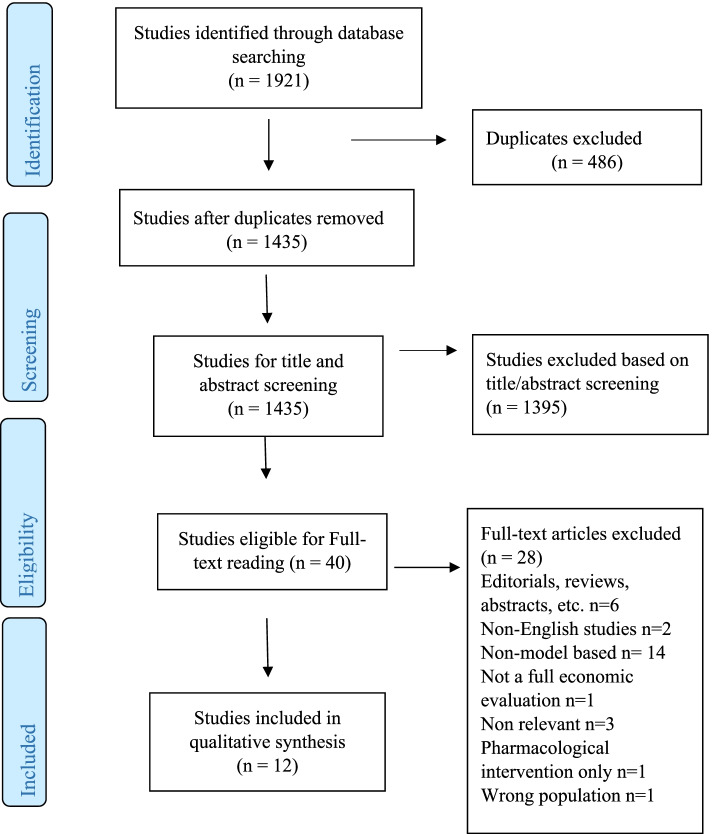
Mental health disorders among children and youth are causing significant burden on health care systems. Hence, identifying cost-effective interventions is important for effective mental health care allocation. Although model-based economic evaluations are an essential component of assessing cost-effectiveness, evidence are limited in the context of child and youth mental health care. The objective was to systematically review the model-based economic evaluations of mental health interventions for children and youth.MethodsFour databases (MEDLINE, EMBASE, PsycINFO and Web of Science) were searched using appropriate search terms to retrieve model-based economic evaluations of mental health interventions for children and youth. The reporting quality of the included studies were appraised using the Consolidated health economic evaluation reporting standards (CHEERS) checklist.ResultsThe database search yielded 1921 records. Of the 12 selected for review, 66% were published after year 2015. Most of the studies were related to anxiety and post-traumatic stress disorder. There were eight cost-utility studies, three cost-effectiveness studies, and one study using both forms of analysis. Six studies used Markov models, three used decision trees, and three studies used both types of models. However, the model structure, health states, time horizon, and economic perspective showed wide variation. The reporting quality of the included studies varied from 91 to 96%.ConclusionModel based mental health economic evaluations among children and youth are increasingly being reported in recent research. The included studies used Markov models and decision trees, either alone or in combination, and the majority of the articles were of good reporting quality.
儿童和青少年的心理健康障碍给医疗保健系统带来了沉重负担。因此,确定具有成本效益的干预措施对于有效分配心理健康护理资源很重要。尽管基于模型的经济评估是评估成本效益的重要组成部分,但在儿童和青少年心理健康护理方面的证据有限。目的是系统回顾针对儿童和青少年心理健康干预措施的基于模型的经济评估。
方法
使用适当的检索词搜索四个数据库(MEDLINE、EMBASE、PsycINFO和Web of Science),以检索针对儿童和青少年心理健康干预措施的基于模型的经济评估。使用综合卫生经济评估报告标准(CHEERS)清单评估纳入研究的报告质量。
结果
数据库搜索产生了1921条记录。在选定进行综述的12项研究中,66%是2015年后发表的。大多数研究与焦虑症和创伤后应激障碍有关。有八项成本效用研究、三项成本效益研究和一项同时使用两种分析形式 的研究。六项研究使用了马尔可夫模型,三项使用了决策树,三项研究同时使用了这两种模型。然而,模型结构、健康状态、时间范围和经济视角存在很大差异。纳入研究的报告质量从91%到96%不等。
结论
近年来的研究越来越多地报告了基于模型的儿童和青少年心理健康经济评估。纳入的研究单独或联合使用了马尔可夫模型和决策树,大多数文章的报告质量良好。