Department of Internal Medicine I, Hematology, Oncology and Stem Cell Transplantation, University Medical Center Freiburg, University Hospital Freiburg, 79106, Freiburg, Germany.
Int J Hematol. 2022 Sep;116(3):341-350. doi: 10.1007/s12185-022-03352-6. Epub 2022 Apr 23.
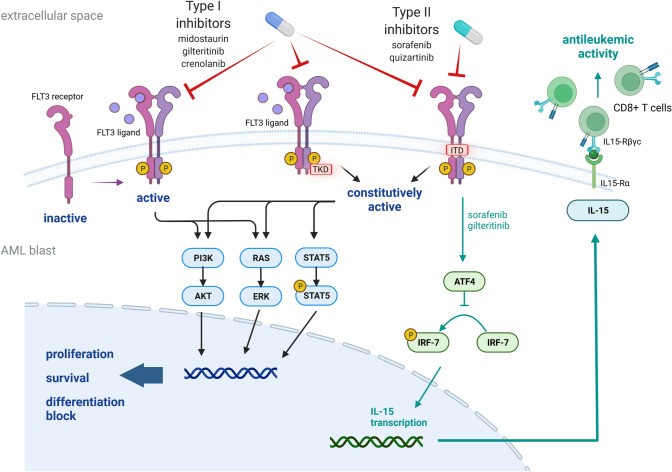
The curative potential of allogeneic hematopoietic cell transplantation (allo-HCT) for acute myeloid leukemia (AML) relies on the graft-versus-leukemia (GVL)-effect. Relapse after allo-HCT occurs in a considerable proportion of patients, and has a dismal prognosis with very limited curative potential, especially for patients with FLT-ITD-mutated AML. Since the first description of sorafenib for treatment of FLT3-ITD-mutated AML, several clinical trials have tried to determine the efficacy of FLT3 inhibitors for preventing and treating AML relapse after allo-HSCT, but many questions regarding differences among compounds and mechanisms of action remain unanswered. This review provides an overview on the established and evolving use of FLT3 inhibitors to prevent or treat relapse of AML in the context of allo-HCT, focusing on the recently discovered immunogenic potential of some FLT3 inhibitors and addressing the possible mechanisms of leukemia drug-escape.
异基因造血细胞移植(allo-HCT)治疗急性髓系白血病(AML)的疗效依赖于移植物抗白血病(GVL)效应。相当一部分 allo-HCT 后患者会发生复发,且预后极差,几乎没有治愈的可能,尤其是伴有 FLT-ITD 突变的 AML 患者。自索拉非尼首次被描述用于治疗 FLT3-ITD 突变的 AML 以来,多项临床试验尝试确定 FLT3 抑制剂在预防和治疗 allo-HSCT 后 AML 复发方面的疗效,但关于化合物之间的差异和作用机制仍有许多问题尚未得到解答。本综述概述了 FLT3 抑制剂在 allo-HCT 背景下用于预防或治疗 AML 复发的既定和不断发展的应用,重点介绍了一些 FLT3 抑制剂最近发现的免疫原性潜力,并探讨了白血病药物逃逸的可能机制。