Ruiz-Falcó Rojas María Luz, Feucht Martha, Macaya Alfons, Wilken Bernd, Hahn Andreas, Maamari Ricardo, Hirschberg Yulia, Ridolfi Antonia, Kingswood John Chris
Hospital Infantil Universitario Nino Jesus, Madrid, Spain.
Universitäts-Klinik für Kinder-und Jugendheilkunde Wien, Vienna, Austria.
Front Pharmacol. 2022 Apr 8;13:802334. doi: 10.3389/fphar.2022.802334. eCollection 2022.
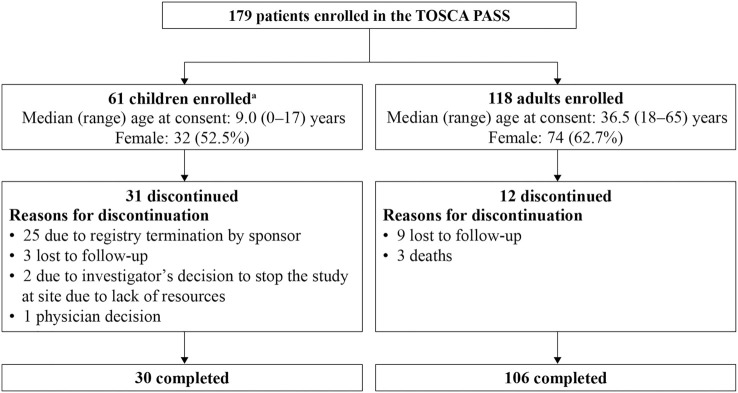
The TuberOus SClerosis registry to increase disease Awareness (TOSCA) Post-Authorization Safety Study (PASS) was a non-interventional, multicenter, safety substudy that assessed the long-term safety of everolimus in patients with tuberous sclerosis complex (TSC) receiving everolimus for its licensed indications in the European Union (EU). This substudy also aimed to address TSC-associated neuropsychiatric disorders (TAND), sexual development, and male infertility. Eligible patients were enrolled from 39 sites across 11 countries in the EU. Outcomes of interest included the incidence of adverse events (AEs), serious adverse events (SAEs), treatment-related AEs (TRAEs), AEs leading to everolimus discontinuation, AEs of special interest (AESIs), the observed relationship between everolimus blood levels and incidence of AESIs, TAND, and reproductive clinical features. Herein, we present the final analysis results from this substudy (data cutoff date: 22 January 2020). At data cutoff, 179 patients were enrolled (female, 59.2%; age ≥18 years, 65.9%), of which the majority completed the study (76%). Overall, 121 patients (67.6%) had AEs regardless of causality. The most frequent TRAEs (≥5%) were stomatitis (7.8%), aphthous ulcer (6.7%), and hypercholesterolemia (6.1%). The most common treatment-related SAEs (>1%) were pneumonia (3.4%), influenza, pyelonephritis, aphthous ulcer, stomatitis, dyslipidemia, and hypercholesterolemia (1.1% each). Ten patients (5.6%) reported AEs leading to everolimus discontinuation. The common psychiatric disorders ( = 179) were autism spectrum disorder (21.8%), anxiety disorder (12.8%), "other" psychiatric disorders (8.9%), attention-deficit hyperactivity disorder, and depressive disorder (7.8% each). Of 179 patients, 88 (49.2%) had ≥1 behavioral problem. Of these ( = 88), the most common (>20%) were sleep difficulties (47.7%), anxiety (43.2%), mood swings (37.5%), depression mood (35.2%), impulsivity (30.7%), severe aggression (23.9%), and overactivity (22.7%). Of 179 patients, four (2.2%) reported abnormal puberty onset, and three (1.7%) reported other reproductive disorders. Of 106 females, 23 (21.7%) reported menstrual cycle disorders and 10 (9.4%) reported amenorrhea. Available data did not show delays in sexual maturation or an association between sexual development and infertility. The results demonstrate that everolimus has a manageable long-term safety profile in the TSC treatment setting. No new safety signals emerged. This substudy also contributed to the mapping of TAND and reproductive clinical features in patients with TSC.
结节性硬化症提高疾病认知注册研究(TOSCA)上市后安全性研究(PASS)是一项非干预性、多中心安全性子研究,评估了依维莫司在欧盟(EU)因有许可适应症而接受依维莫司治疗的结节性硬化症(TSC)患者中的长期安全性。该子研究还旨在解决TSC相关的神经精神障碍(TAND)、性发育和男性不育问题。符合条件的患者来自欧盟11个国家的39个地点。感兴趣的结果包括不良事件(AE)、严重不良事件(SAE)、治疗相关不良事件(TRAE)、导致依维莫司停药的AE、特殊关注的AE(AESI)、依维莫司血药浓度与AESI发生率之间观察到的关系、TAND和生殖临床特征。在此,我们展示了该子研究的最终分析结果(数据截止日期:2020年1月22日)。在数据截止时,共纳入179例患者(女性占59.2%;年龄≥18岁占65.9%),其中大多数患者完成了研究(76%)。总体而言,121例患者(67.6%)发生了AE,无论因果关系如何。最常见的TRAE(≥5%)为口腔炎(7.8%)、口腔溃疡(6.7%)和高胆固醇血症(6.1%)。最常见的治疗相关SAE(>1%)为肺炎(3.4%)、流感、肾盂肾炎、口腔溃疡、口腔炎、血脂异常和高胆固醇血症(各1.1%)。10例患者(5.6%)报告了导致依维莫司停药的AE。常见的精神障碍(n = 179)为自闭症谱系障碍(21.8%)、焦虑症(12.8%)、“其他”精神障碍(8.9%)、注意力缺陷多动障碍和抑郁症(各7.8%)。在179例患者中,88例(49.2%)有≥1种行为问题。其中(n = 88),最常见的(>20%)是睡眠困难(47.7%)、焦虑(43.2%)、情绪波动(37.5%)、抑郁情绪(35.2%)、冲动(30.7%)、严重攻击行为(23.9%)和多动(22.7%)。在179例患者中,4例(2.2%)报告青春期开始异常,3例(1.7%)报告其他生殖系统疾病。在106例女性中呢,23例(21.7%)报告月经周期紊乱,10例(9.4%)报告闭经。现有数据未显示性成熟延迟或性发育与不育之间的关联。结果表明,依维莫司在TSC治疗环境中具有可管理的长期安全性。未出现新的安全信号。该子研究还为绘制TSC患者的TAND和生殖临床特征做出了贡献。