
1.5T磁共振直线加速器上鼻咽癌放疗的磁共振引导在线自适应计划的剂量学准确性
Dosimetric Accuracy of MR-Guided Online Adaptive Planning for Nasopharyngeal Carcinoma Radiotherapy on 1.5 T MR-Linac.
作者信息
Ding Shouliang, Liu Hongdong, Li Yongbao, Wang Bin, Li Rui, Huang Xiaoyan
机构信息
State Key Laboratory of Oncology in South China, Collaborative Innovation Center for Cancer Medicine, Sun Yat-sen University Cancer Center, Guangzhou, China.
出版信息
Front Oncol. 2022 Apr 7;12:858076. doi: 10.3389/fonc.2022.858076. eCollection 2022.
PURPOSE
The aim of this study is to evaluate the dose accuracy of bulk relative electron density (rED) approach for application in 1.5 T MR-Linac and assess the reliability of this approach in the case of online adaptive MR-guided radiotherapy for nasopharyngeal carcinoma (NPC) patients.
METHODS
Ten NPC patients formerly treated on conventional linac were included in this study, with their original planning CT and MRI collected. For each patient, structures such as the targets, organs at risk, bone, and air regions were delineated on the original CT in the Monaco system (v5.40.02). To simulate the online adaptive workflow, firstly all contours were transferred to MRI from the original CT using rigid registration in the Monaco system. Based on the structures, three different types of synthetic CT (sCT) were generated from MRI using the bulk rED assignment approach: the sCT uses the rED values recommended by ICRU46, the sCT uses the patient-specific mean rED values, and the sCT uses homogeneous water equivalent values. The same treatment plan was calculated on the three sCTs and the original CT. Dose calculation accuracy was investigated in terms of gamma analysis, point dose comparison, and dose volume histogram (DVH) parameters.
RESULTS
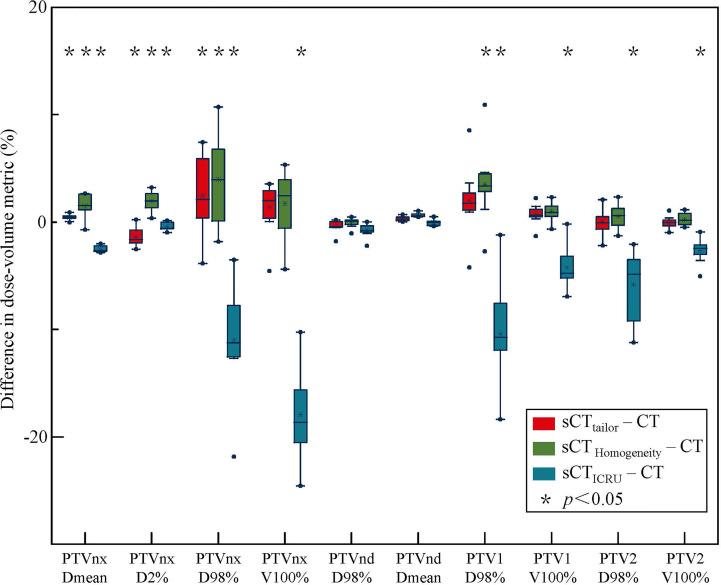
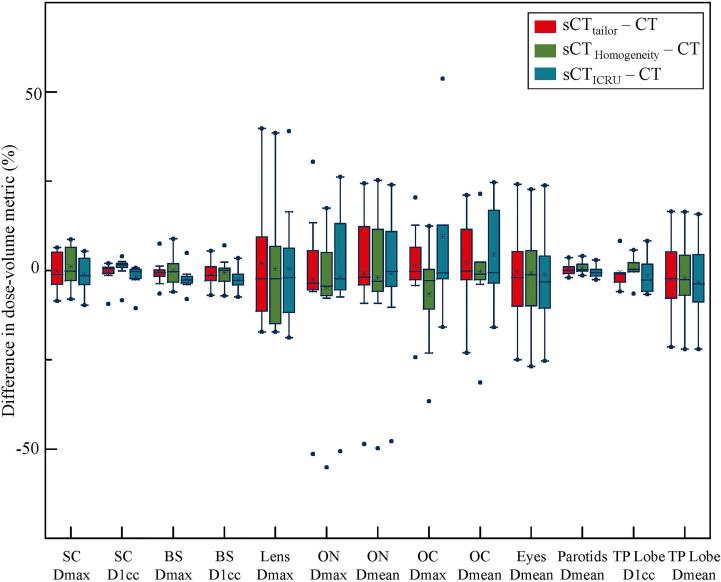
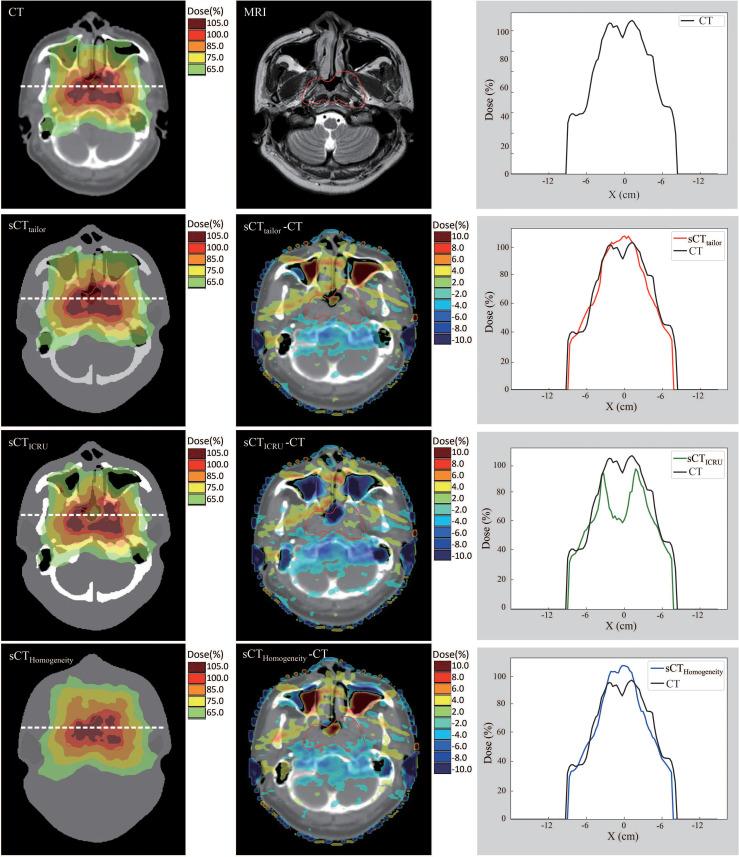
Good agreement of dose distribution was observed between sCT and the original CT, with a gamma passing rate (3%/3 mm) of 97.81% ± 1.06%, higher than that of sCT (94.27% ± 1.48%, = 0.005) and sCT (96.50% ± 1.02%, = 0.005). For stricter criteria 1%/1 mm, gamma passing rates for plans on sCT, sCT, and sCT were 86.79% ± 4.31%, 79.81% ± 3.63%, and 77.56% ± 4.64%, respectively. The mean point dose difference in PTV between sCT and planning CT was -0.14% ± 1.44%, much lower than that calculated on sCT (-8.77% ± 2.33%) and sCT (1.65% ± 2.57%), all with < 0.05. The DVH differences for the plan based on sCT were much smaller than sCT and sCT.
CONCLUSIONS
The bulk rED-assigned sCT by adopting the patient-specific rED values can achieve a clinically acceptable level of dose calculation accuracy in the presence of a 1.5 T magnetic field, making it suitable for online adaptive MR-guided radiotherapy for NPC patients.
目的
本研究旨在评估在1.5T MR直线加速器中应用的体素相对电子密度(rED)方法的剂量准确性,并评估该方法在鼻咽癌(NPC)患者在线自适应MR引导放疗情况下的可靠性。
方法
本研究纳入了10例曾在传统直线加速器上接受治疗的NPC患者,并收集了他们原来的计划CT和MRI。对于每位患者,在Monaco系统(v5.40.02)中的原始CT上勾勒出靶区、危及器官、骨骼和空气区域等结构。为了模拟在线自适应工作流程,首先在Monaco系统中使用刚性配准将所有轮廓从原始CT转移到MRI上。基于这些结构,使用体素rED赋值方法从MRI生成三种不同类型的合成CT(sCT):sCT使用ICRU46推荐的rED值,sCT使用患者特定的平均rED值,sCT使用均匀水等效值。在这三种sCT和原始CT上计算相同的治疗计划。通过伽马分析、点剂量比较和剂量体积直方图(DVH)参数研究剂量计算准确性。
结果
观察到sCT与原始CT之间的剂量分布具有良好的一致性,伽马通过率(3%/3mm)为97.81%±1.06%,高于sCT(94.27%±1.48%,P = 0.005)和sCT(96.50%±1.02%,P = 0.005)。对于更严格的标准1%/1mm,sCT、sCT和sCT上计划的伽马通过率分别为86.79%±4.31%、79.81%±3.63%和77.56%±4.64%。sCT与计划CT之间PTV中的平均点剂量差异为-0.14%±1.44%,远低于在sCT(-8.77%±2.33%)和sCT(1.65%±2.57%)上计算的值,均P < 0.05。基于sCT的计划的DVH差异远小于sCT和sCT。
结论
通过采用患者特定的rED值的体素rED赋值sCT在存在1.5T磁场的情况下可以达到临床上可接受的剂量计算准确性水平,使其适用于NPC患者的在线自适应MR引导放疗。


 Zotero 插件