Azzollini Jacopo, Vingiani Andrea, Agnelli Luca, Tamborini Elena, Perrone Federica, Conca Elena, Capone Iolanda, Busico Adele, Peissel Bernard, Rosina Erica, Ducceschi Monika, Mantiero Mara, Lopez Salvatore, Raspagliesi Francesco, Niger Monica, Duca Matteo, Damian Silvia, Proto Claudia, de Braud Filippo, Pruneri Giancarlo, Manoukian Siranoush
Unit of Medical Genetics, Department of Medical Oncology and Hematology, Fondazione IRCCS Istituto Nazionale dei Tumori, Milan, Italy.
Department of Pathology and Laboratory Medicine, Fondazione IRCCS Istituto Nazionale dei Tumori, Milan, Italy.
Front Oncol. 2022 Apr 8;12:857515. doi: 10.3389/fonc.2022.857515. eCollection 2022.
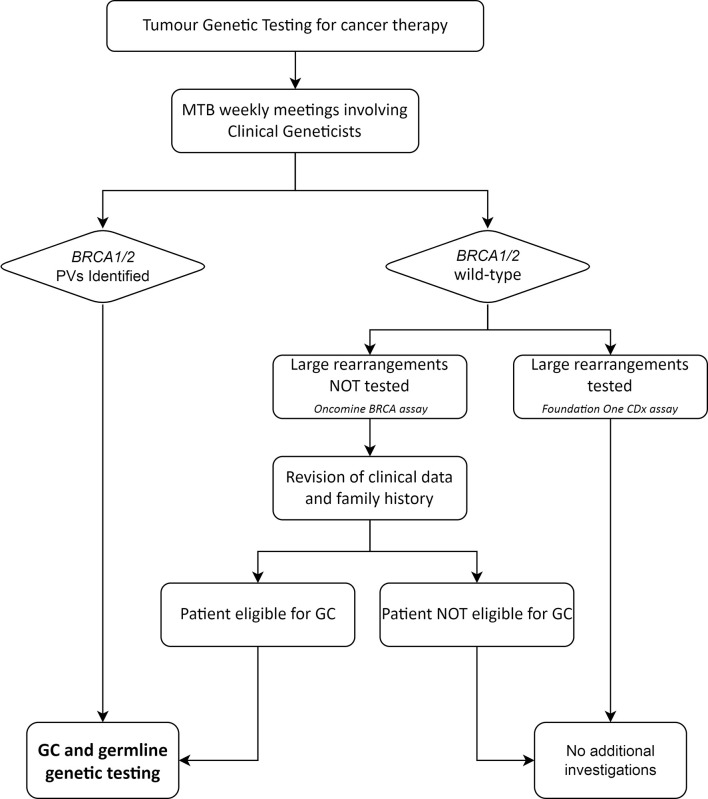
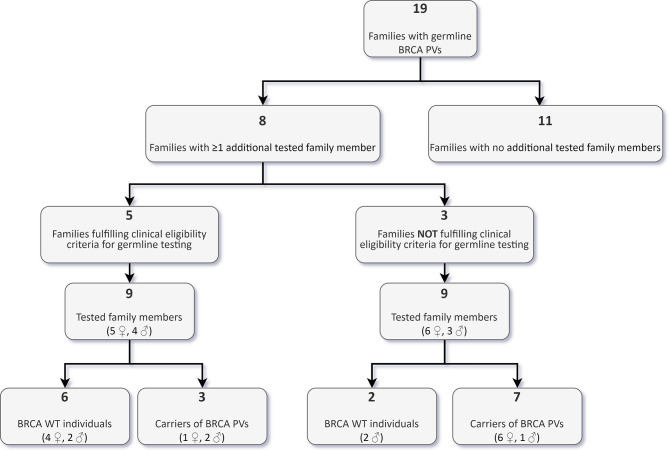
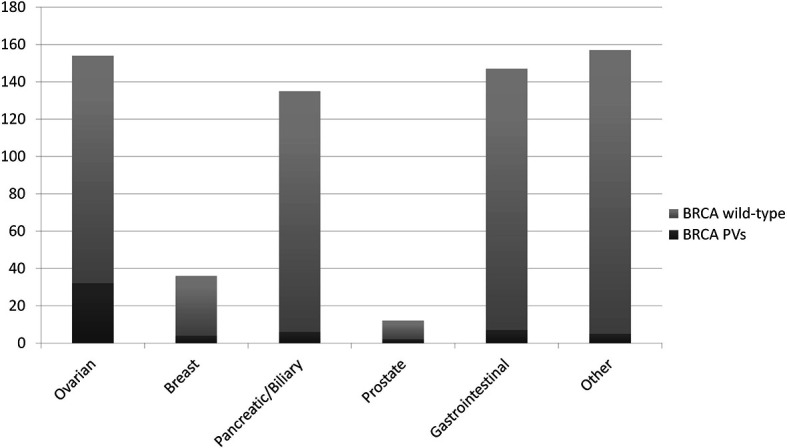
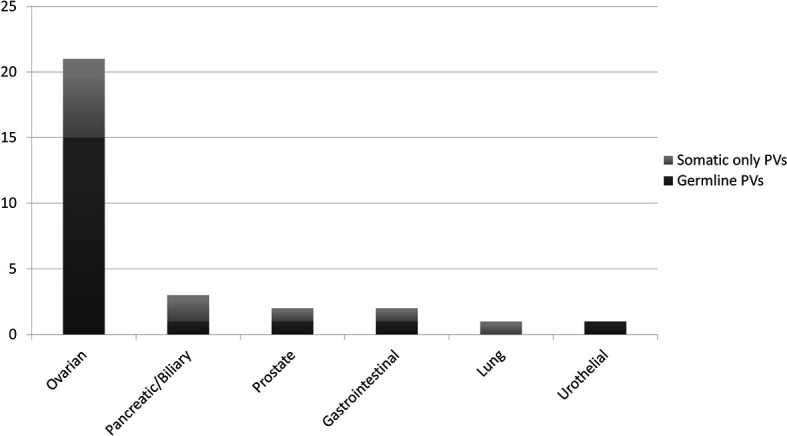
Tumour testing of the genes is routinely performed in patients with different cancer histological subtypes. To accurately identify patients with tumour-detected germline pathogenic variants (PVs) is a relevant issue currently under investigation. This study aims at evaluating the performance of the tumour-to-germline diagnostic flowchart model defined at our Institutional Molecular Tumour Board (MTB). Results from tumour BRCA sequencing of 641 consecutive unselected cancer patients were discussed during weekly MTB meetings with the early involvement of clinical geneticists for appropriate referral to genetic counselling. The overall tumour detection rate of PVs was 8.7% (56/641), ranging from 24.4% (31/127) in high-grade ovarian cancer to 3.9% (12/304) in tumours not associated with germline PVs. Thirty-seven patients with PVs (66%) were evaluated by a clinical geneticist, and in 24 of them (64.9%), germline testing confirmed the presence of the PV in blood. Nine of these patients (37.5%) were not eligible for germline testing according to the criteria in use at our institution. Cascade testing was subsequently performed on 18 relatives. The tumour-to-germline diagnostic pipeline, developed in the framework of our institutional MTB, compared with guideline-based germline testing following genetic counselling, proved to be effective in identifying a higher number of germline BRCA PVs carriers.
对不同癌症组织学亚型的患者常规进行基因的肿瘤检测。准确识别肿瘤检测到的种系致病变异(PVs)患者是目前正在研究的一个相关问题。本研究旨在评估在我们机构分子肿瘤委员会(MTB)定义的肿瘤到种系诊断流程图模型的性能。在每周的MTB会议上讨论了641例连续未选择的癌症患者的肿瘤BRCA测序结果,临床遗传学家早期参与以便适当转诊进行遗传咨询。PVs的总体肿瘤检出率为8.7%(56/641),范围从高级别卵巢癌中的24.4%(31/127)到与种系PVs无关的肿瘤中的3.9%(12/304)。37例有PVs的患者(66%)由临床遗传学家进行了评估,其中24例(64.9%)种系检测证实血液中存在PV。根据我们机构使用的标准,这些患者中有9例(37.5%)不符合种系检测条件。随后对18名亲属进行了级联检测。在我们机构MTB框架内开发的肿瘤到种系诊断流程,与遗传咨询后基于指南的种系检测相比,被证明在识别更多种系BRCA PVs携带者方面是有效的。