Department of Biophysical Chemistry, Kyoto Pharmaceutical University, 5 Misasagi-Nakauchi-cho, Yamashina-ku, Kyoto, 607-8414, Japan.
Graduate School of Environmental and Life Science, Okayama University, Okayama, 700-8530, Japan.
Sci Rep. 2022 Apr 26;12(1):6770. doi: 10.1038/s41598-022-10789-6.
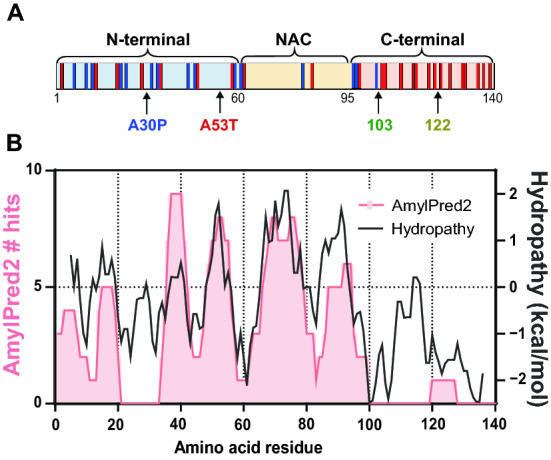
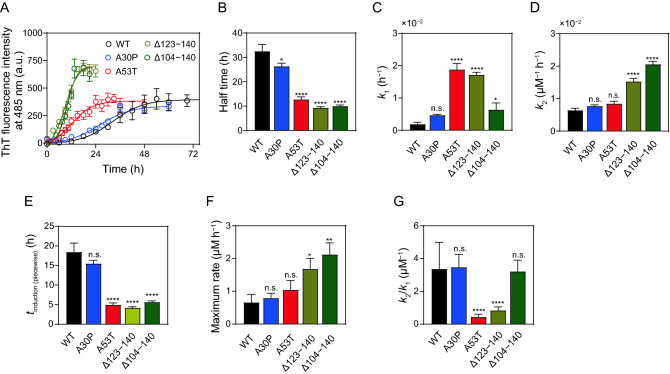
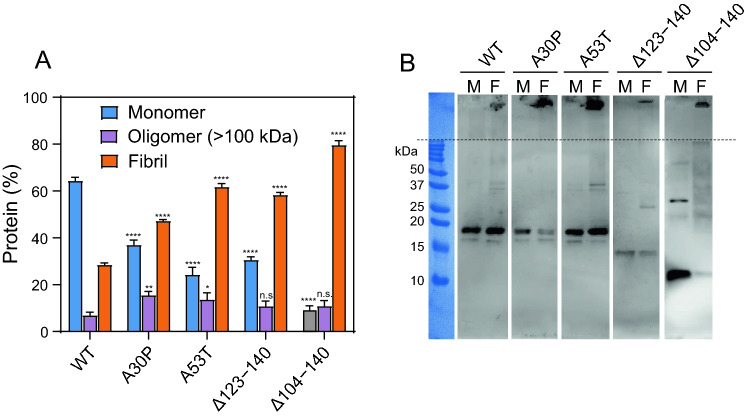
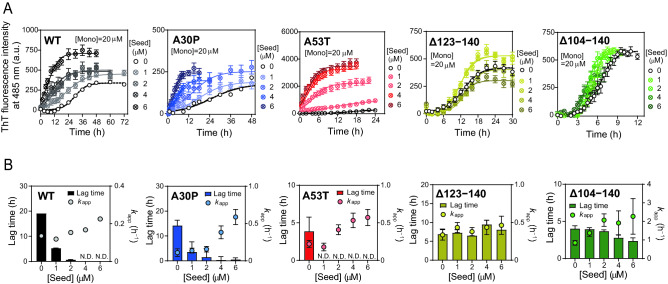
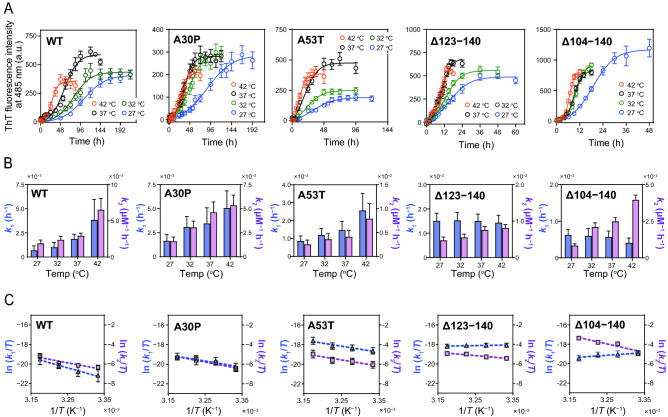
Aggregation of α-synuclein (α-syn) into amyloid fibrils is closely associated with Parkinson's disease (PD). Familial mutations or posttranslational truncations in α-syn are known as risk factor for PD. Here, we examined the effects of the PD-related A30P or A53T point mutation and C-terminal 123-140 or 104-140 truncation on the aggregating property of α-syn based on the kinetic and thermodynamic analyses. Thioflavin T fluorescence measurements indicated that A53T, Δ123‒140, and Δ104-140 variants aggregated faster than WT α-syn, in which the A53T mutation markedly increases nucleation rate whereas the Δ123‒140 or Δ104‒140 truncation significantly increases both nucleation and fibril elongation rates. Ultracentrifugation and western blotting analyses demonstrated that these mutations or truncations promote the conversion of monomer to aggregated forms of α-syn. Analysis of the dependence of aggregation reaction of α-syn variants on the monomer concentration suggested that the A53T mutation enhances conversion of monomers to amyloid nuclei whereas the C-terminal truncations, especially the Δ104-140, enhance autocatalytic aggregation on existing fibrils. In addition, thermodynamic analysis of the kinetics of nucleation and fibril elongation of α-syn variants indicated that both nucleation and fibril elongation of WT α-syn are enthalpically and entropically unfavorable. Interestingly, the unfavorable activation enthalpy of nucleation greatly decreases for the A53T and becomes reversed in sign for the C-terminally truncated variants. Taken together, our results indicate that the A53T mutation and the C-terminal truncation enhance α-syn aggregation by reducing unfavorable activation enthalpy of nucleation, and the C-terminal truncation further triggers the autocatalytic fibril elongation on the fibril surfaces.
α-突触核蛋白(α-syn)的聚集与帕金森病(PD)密切相关。α-syn 的家族突变或翻译后截断被认为是 PD 的风险因素。在这里,我们通过动力学和热力学分析,研究了 PD 相关的 A30P 或 A53T 点突变以及 C 端 123-140 或 104-140 截断对 α-syn 聚集特性的影响。硫黄素 T 荧光测量表明,A53T、Δ123-140 和 Δ104-140 变体比 WT α-syn 聚集得更快,其中 A53T 突变明显增加了成核速率,而 Δ123-140 或 Δ104-140 截断则显著增加了成核和原纤维延伸速率。超速离心和 Western blot 分析表明,这些突变或截断促进了单体向 α-syn 聚集形式的转化。分析 α-syn 变体的聚合反应对单体浓度的依赖性表明,A53T 突变增强了单体向淀粉样核的转化,而 C 端截断,特别是 Δ104-140,增强了现有原纤维上的自动催化聚合。此外,对 α-syn 变体成核和原纤维延伸动力学的热力学分析表明,WT α-syn 的成核和原纤维延伸都是焓和熵不利的。有趣的是,A53T 和 C 端截断变体的成核不利活化焓大大降低,并且符号发生反转。总之,我们的结果表明,A53T 突变和 C 端截断通过降低成核不利活化焓来增强 α-syn 聚集,并且 C 端截断进一步触发了原纤维表面上的自动催化原纤维延伸。