Department of Cardiology, Shanghai Institute of Cardiovascular Diseases, Zhongshan Hospital, Fudan University, 180 Fenglin Road, Shanghai, 200032, China.
National Clinical Research Center for Interventional Medicine, Shanghai, China.
ESC Heart Fail. 2022 Aug;9(4):2325-2335. doi: 10.1002/ehf2.13918. Epub 2022 Apr 26.
Right ventricular pacing (RVP) dependence could impair left ventricular ejection fraction (LVEF). This study aimed to illuminate the relationship between RVP proportion and LVEF, as well as disclosing independent predictors of RVP dependence.
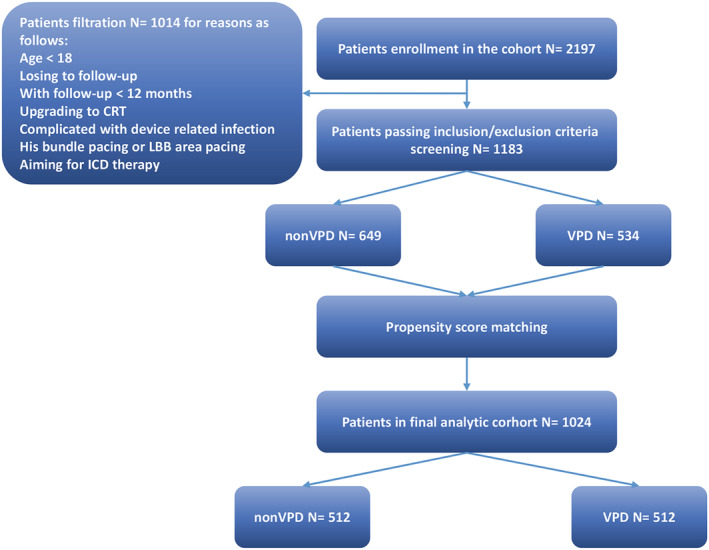
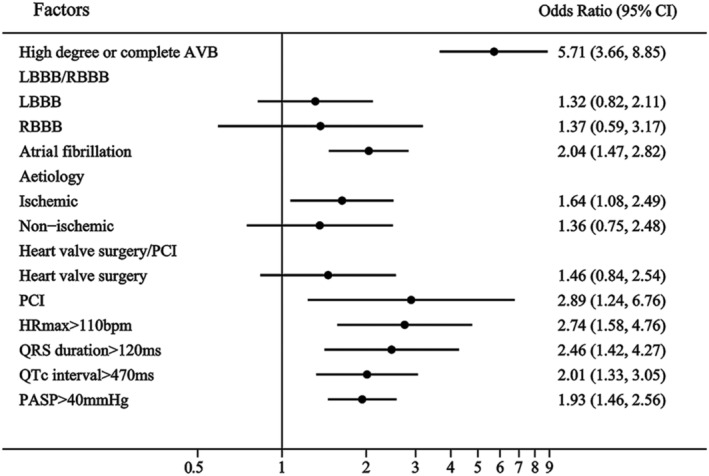
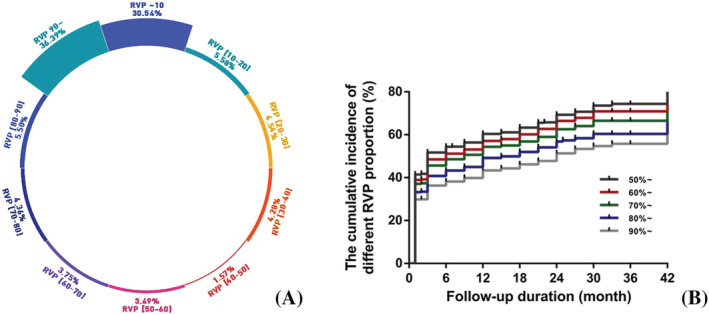
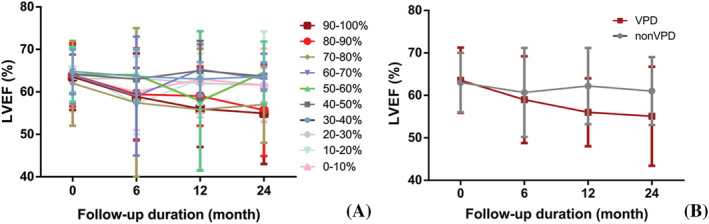
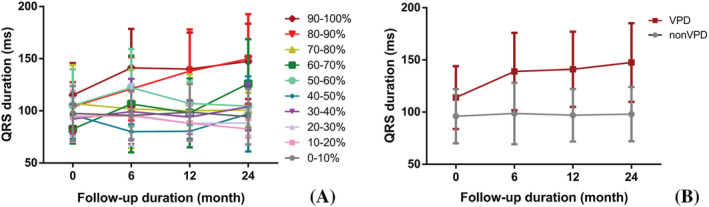
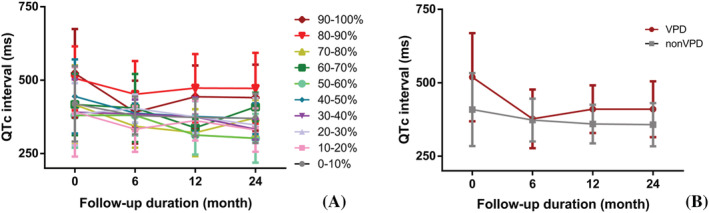
Patients indicated for permanent pacemaker implantation were included (2016-2020). The ventricular pacing lead was placed in right ventricular apex or septum. Pacing mode programming followed universal standard. Electrocardiographic, echocardiographic, and serological parameters were collected. RVP dependence was defined according to its influence on LVEF. This study was of case-control design. Included patients were matched by potentially confounding factors through propensity score matching. A total of 1183 patients were included, and the mean duration of follow-up was 24 months. Percentage of RVP < 80% hardly influenced LVEF; however, LVEF tended to decrease with higher RVP proportion. High degree/complete atrioventricular block (AVB) [odds ratio (OR) = 5.71, 95% confidence interval (CI): 3.66-8.85], atrial fibrillation (AF) (OR = 2.04, 95% CI: 1.47-2.82), percutaneous coronary intervention (PCI) (OR = 2.89, 95% CI: 1.24-6.76), maximum heart rate (HR ) < 110 b.p.m. (OR = 2.74, 95% CI: 1.58-4.76), QRS duration > 120 ms (OR = 2.46, 95% CI: 1.42-4.27), QTc interval > 470 ms (OR = 2.01, 95% CI: 1.33-3.05), and pulmonary artery systolic pressure (PASP) > 40 mmHg (OR = 1.93, 95% CI: 1.46-2.56) were proved to predict RVP dependence.
High RVP percentage (>80%) indicating RVP dependence significantly correlates with poor prognosis of cardiac function. High degree/complete AVB, AF, ischaemic aetiology, PCI history, HR < 110 b.p.m., QRS duration > 120 ms, QTc interval > 470 ms, and PASP > 40 mmHg were verified as independent risk factors of RVP dependence.
右心室起搏(RVP)依赖可能会损害左心室射血分数(LVEF)。本研究旨在阐明 RVP 比例与 LVEF 之间的关系,并揭示 RVP 依赖的独立预测因素。
纳入需要永久性起搏器植入的患者(2016-2020 年)。心室起搏导线置于右心室心尖或室间隔。起搏模式编程遵循通用标准。收集心电图、超声心动图和血清学参数。根据 RVP 对 LVEF 的影响定义 RVP 依赖。本研究为病例对照设计。通过倾向评分匹配,根据潜在混杂因素对纳入患者进行匹配。共纳入 1183 例患者,平均随访时间为 24 个月。RVP<80%的比例几乎不会影响 LVEF;然而,随着 RVP 比例的增加,LVEF 趋于下降。高度/完全房室传导阻滞(AVB)(比值比 [OR] = 5.71,95%置信区间 [CI]:3.66-8.85)、心房颤动(AF)(OR = 2.04,95%CI:1.47-2.82)、经皮冠状动脉介入治疗(PCI)(OR = 2.89,95%CI:1.24-6.76)、最大心率(HR)<110 b.p.m.(OR = 2.74,95%CI:1.58-4.76)、QRS 持续时间>120ms(OR = 2.46,95%CI:1.42-4.27)、QTc 间期>470ms(OR = 2.01,95%CI:1.33-3.05)和肺动脉收缩压(PASP)>40mmHg(OR = 1.93,95%CI:1.46-2.56)被证明可预测 RVP 依赖。
高 RVP 百分比(>80%)表明 RVP 依赖与心脏功能不良预后显著相关。高度/完全性 AVB、AF、缺血性病因、PCI 史、HR<110 b.p.m.、QRS 持续时间>120ms、QTc 间期>470ms 和 PASP>40mmHg 被证实为 RVP 依赖的独立危险因素。