Department of Trauma, Hand, Plastic and Reconstructive Surgery, Julius-Maximilians-University Wuerzburg, Oberduerrbacher Straße 6, 97080, Wuerzburg, Germany.
Department of Traumatology, Hand Surgery and Sports Medicine, St. Vincentius Clinic, Teaching Hospital Albert-Ludwigs-University Freiburg, Karlsruhe, Germany.
BMC Musculoskelet Disord. 2022 Apr 27;23(1):396. doi: 10.1186/s12891-022-05338-1.
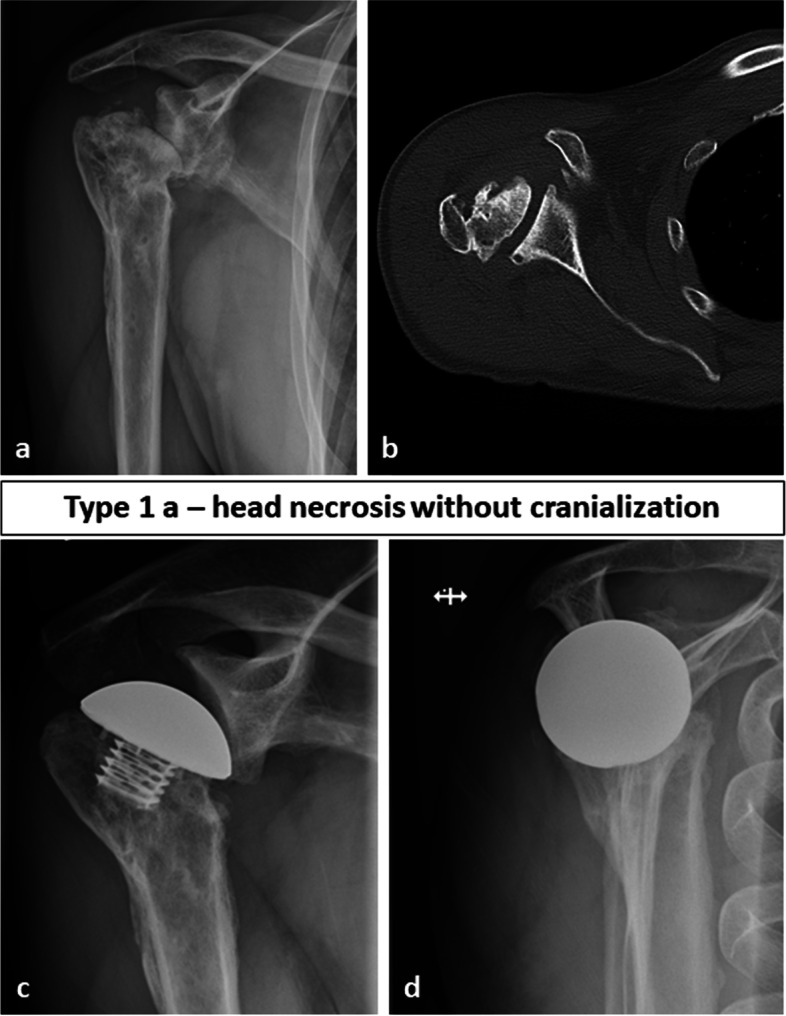
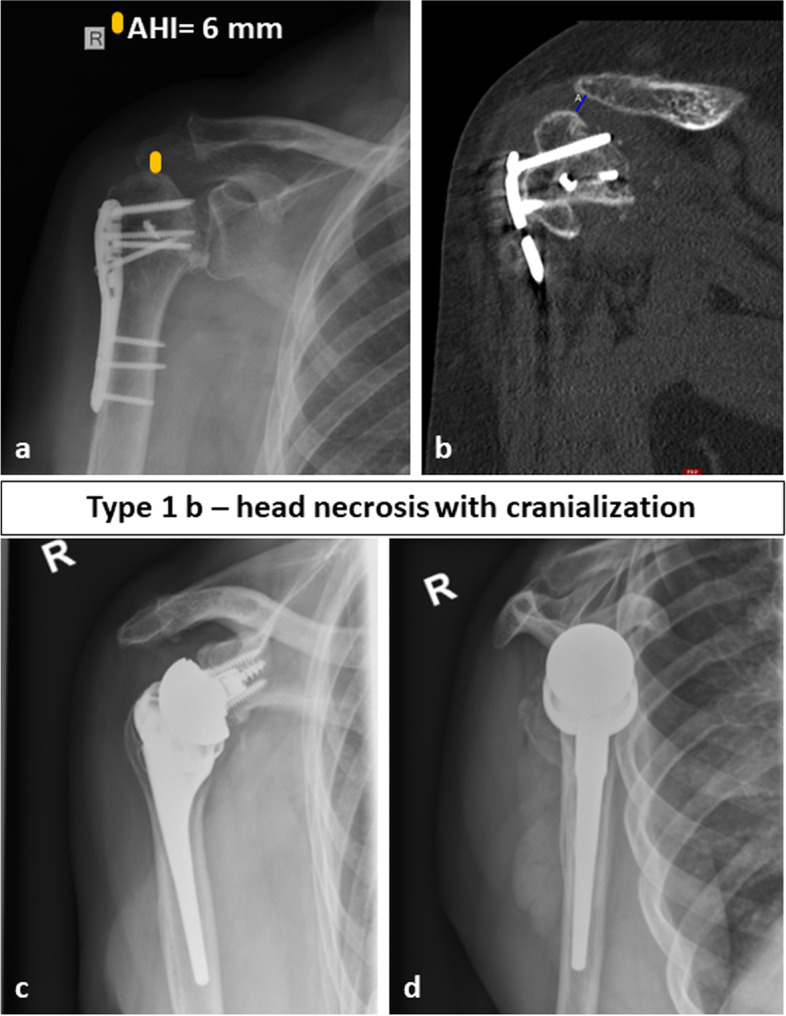
Avascular necrosis of the humeral head after proximal humeral fracture i.e. type 1 fracture sequelae (FS) according to the Boileau classification is a rare, often painful condition and treatment still remains a challenge. This study evaluates the treatment of FS type 1 with anatomic and reverse shoulder arthroplasty and a new subclassification is proposed.
This single-center, retrospective, comparative study, included all consecutive patients with a proximal humeral FS type 1 treated surgically in a four-year period. All patients were classified according to the proposed 3 different subtypes. Constant score (CS), Quick DASH score, subjective shoulder value (SSV) as well as revision and complication rate were analyzed. In the preoperative radiographs the acromio-humeral interval (AHI) and greater tuberosity resorption were examined.
Of 27 with a FS type 1, 17 patients (63%) with a mean age of 64 ± 11 years were available for follow-up at 24 ± 10 months. 7 patients were treated with anatomic and 10 with reverse shoulder arthroplasty. CS improved significantly from 16 ± 7 points to 61 ± 19 points (p < 0.0001). At final follow-up the mean Quick DASH Score was 21 ± 21 and the mean SSV was 73 ± 21 points. The mean preoperative AHI was 9 ± 3 mm, however, 8 cases presented an AHI < 7 mm. 4 cases had complete greater tuberosity resorption. The complication and revision rate was 19%; implant survival was 88%.
By using the adequate surgical technique good clinical short-term results with a relatively low complication rate can be achieved in FS type 1. The Boileau classification should be extended for fracture sequelae type 1 and the general recommendation for treatment with hemiarthroplasty or total shoulder arthroplasty has to be relativized. Special attention should be paid to a decreased AHI and/or resorption of the greater tuberosity as indirect signs for dysfunction of the rotator cuff. To facilitate the choice of the adequate prosthetic treatment method the suggested subclassification system should be applied.
肱骨头近端骨折后发生的缺血性坏死,即 Boileau 分类中的 1 型骨折后遗症(FS),是一种罕见的、常引起疼痛的病症,治疗仍然是一个挑战。本研究评估了解剖型和反式肩关节置换术治疗 1 型 FS 的效果,并提出了一种新的分类。
这是一项单中心、回顾性、对照研究,纳入了四年间接受手术治疗的所有连续的 1 型 FS 患者。所有患者均根据提出的 3 种不同亚型进行分类。分析Constant 评分(CS)、快速 Disabilities of the Arm, Shoulder and Hand(DASH)评分、肩关节主观评分(SSV)以及翻修率和并发症发生率。在术前 X 线片上,检查肩肱间隙(AHI)和大结节吸收情况。
27 例 FS 1 型患者中,17 例(63%)患者得到随访,平均年龄 64±11 岁,随访时间为 24±10 个月。7 例患者接受解剖型手术,10 例患者接受反式肩关节置换术。CS 从 16±7 分显著改善至 61±19 分(p<0.0001)。末次随访时,平均快速 DASH 评分为 21±21 分,平均 SSV 为 73±21 分。术前平均 AHI 为 9±3mm,但 8 例 AHI<7mm。4 例出现完全大结节吸收。并发症和翻修率为 19%;假体生存率为 88%。
通过使用适当的手术技术,1 型 FS 可获得良好的短期临床效果,且并发症发生率相对较低。Boileau 分类应扩展至 1 型骨折后遗症,并应相对化治疗 1 型 FS 的半肩置换术或全肩关节置换术的一般建议。应特别注意 AHI 降低和/或大结节吸收,这是肩袖功能障碍的间接征象。为了方便选择合适的假体治疗方法,应应用提出的分类系统。