
-(噻唑-2-基)苯磺酰胺与细胞穿透性八聚精氨酸联合的紧急抗菌活性
Emergent antibacterial activity of -(thiazol-2-yl)benzenesulfonamides in conjunction with cell-penetrating octaarginine.
作者信息
Ratrey Poonam, Das Mahapatra Amarjyoti, Pandit Shiny, Hadianawala Murtuza, Majhi Sasmita, Mishra Abhijit, Datta Bhaskar
机构信息
Department of Materials Science and Engineering, Indian Institute of Technology Gandhinagar Gujarat India.
Department of Chemistry, Indian Institute of Technology Gandhinagar Gujarat India
出版信息
RSC Adv. 2021 Aug 25;11(46):28581-28592. doi: 10.1039/d1ra03882f. eCollection 2021 Aug 23.
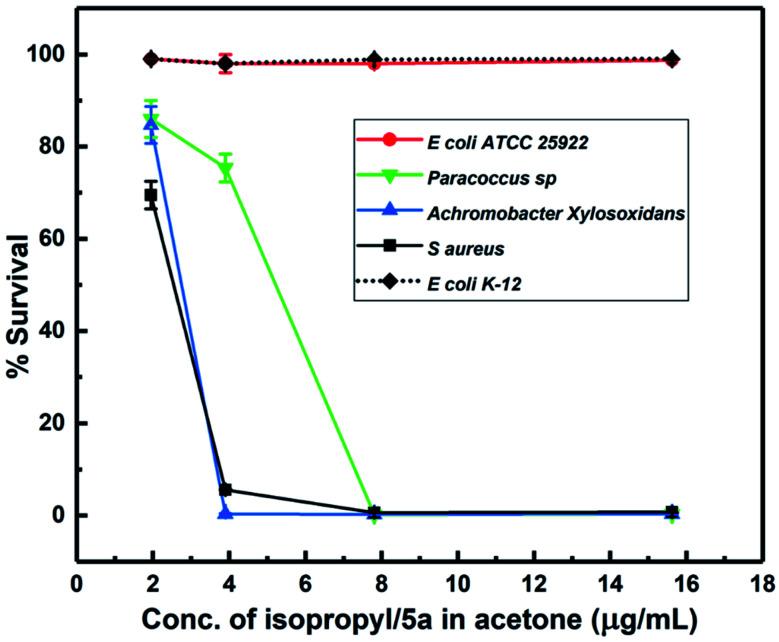
Hybrid antimicrobials that combine the effect of two or more agents represent a promising antibacterial therapeutic strategy. In this work, we have synthesized -(4-(4-(methylsulfonyl)phenyl)-5-phenylthiazol-2-yl)benzenesulfonamide derivatives that combine thiazole and sulfonamide, groups with known antibacterial activity. These molecules are investigated for their antibacterial activity, in isolation and in complex with the cell-penetrating peptide octaarginine. Several of the synthesized compounds display potent antibacterial activity against both Gram-negative and Gram-positive bacteria. Compounds with 4--butyl and 4-isopropyl substitutions exhibit attractive antibacterial activity against multiple strains. The isopropyl substituted derivative displays low MIC of 3.9 μg mL against and . The comparative antibacterial behaviour of drug-peptide complex, drug alone and peptide alone indicates a distinctive mode of action of the drug-peptide complex, that is not the simple sum total of its constituent components. Specificity of the drug-peptide complex is evident from comparison of antibacterial behaviour with a synthetic intermediate-peptide complex. The octaarginine-drug complex displays faster killing-kinetics towards bacterial cells, creates pores in the bacterial cell membranes and shows negligible haemolytic activity towards human RBCs. Our results demonstrate that mere attachment of a hydrophobic moiety to a cell penetrating peptide does not impart antibacterial activity to the resultant complex. Conversely, the work suggests distinctive modes of antibiotic activity of small molecules when used in conjunction with a cell penetrating peptide.
结合两种或多种药物作用的杂化抗菌剂是一种很有前景的抗菌治疗策略。在这项工作中,我们合成了-(4-(4-(甲基磺酰基)phenyl)-5-phenylthiazol-2-yl)苯磺酰胺衍生物,该衍生物将噻唑和磺酰胺基团结合在一起,这些基团具有已知的抗菌活性。对这些分子的抗菌活性进行了单独研究,并研究了它们与细胞穿透肽八聚精氨酸形成的复合物的抗菌活性。几种合成化合物对革兰氏阴性菌和革兰氏阳性菌均显示出强效抗菌活性。具有4-丁基和4-异丙基取代基的化合物对多种菌株表现出有吸引力的抗菌活性。异丙基取代的衍生物对 和 的最低抑菌浓度低至3.9 μg/mL。药物-肽复合物、单独的药物和单独的肽的比较抗菌行为表明,药物-肽复合物具有独特的作用模式,并非其组成成分的简单加和。通过与合成中间体-肽复合物的抗菌行为比较,药物-肽复合物的特异性显而易见。八聚精氨酸-药物复合物对细菌细胞显示出更快的杀菌动力学,在细菌细胞膜上形成孔道,并且对人红细胞的溶血活性可忽略不计。我们的结果表明,仅仅将疏水部分连接到细胞穿透肽上并不能赋予所得复合物抗菌活性。相反,这项工作表明小分子与细胞穿透肽联合使用时具有独特的抗生素活性模式。




 Zotero 插件