Department of Pharmacy & Pharmaceutical Sciences, Faculty of Medicine and Health Sciences, University of Zimbabwe, Mazowe Street, Parirenyatwa Complex, P.O Box A178, Avondale, Harare, Zimbabwe.
World Health Organization, Health Products Policy and Standards, Access to Medicines and Health Products Division, 20 Appia Avenue, Geneva, Switzerland.
BMC Health Serv Res. 2022 Apr 28;22(1):570. doi: 10.1186/s12913-022-07995-3.
The purpose of the study was to assess the requirements for approval of the importation of unregistered medicines for use in the public sector in the Southern African Development Community (SADC) countries.
The study reviewed the legal provisions and requirements to be fulfilled when importing unregistered medicines for the public sector in SADC countries relative to two comparators drawn from countries with stringent regulatory systems through extant document analysis. The relative implementation index score was calculated and used to measure the level of implementing legal provisions and requirements to be fulfilled. Analysis was performed using the STATA software package.
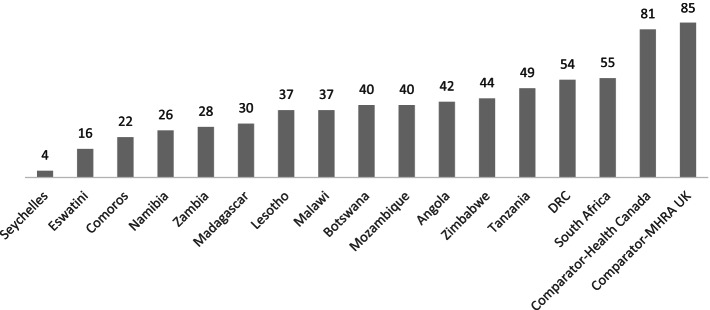
Approximately 13 out of 16 SADC countries had a relative implementation index below 50%. The aggregated implementation index across all SADC countries was 44%, ranging from 4 to 54%, while the two comparators had a relative implementation index of 81% and 85%, respectively.
Implementing the minimum requirements for importing unregistered medicines for the public sector was deficient compared to the jurisdictions with stringent regulatory systems, and wide implementation gaps also existed within the SADC region.
本研究旨在评估南部非洲发展共同体(SADC)国家进口未注册药品供公共部门使用的批准要求。
本研究通过现有文件分析,审查了 SADC 国家进口未注册药品供公共部门使用的法律规定和要求,相对于从监管制度严格的国家中选取的两个对照国。计算了相对实施指数得分,用于衡量履行法律规定和要求的程度。使用 STATA 软件包进行了分析。
大约 16 个 SADC 国家中有 13 个国家的相对实施指数低于 50%。所有 SADC 国家的综合实施指数为 44%,范围为 4%至 54%,而两个对照国的相对实施指数分别为 81%和 85%。
与监管制度严格的司法管辖区相比,执行进口未注册药品供公共部门使用的最低要求存在缺陷,而且 SADC 区域内也存在广泛的实施差距。