School of Health and Rehabilitation Sciences, The University of Queensland, Queensland, Australia.
RECOVER Injury Research Centre, The University of Queensland, Queensland, Australia.
Phys Ther. 2022 Jun 3;102(6). doi: 10.1093/ptj/pzac050.
Given the economic burden of work-related neck pain and disability, it is important to understand its time course and associated risk factors to direct better management strategies. This study aimed to identify the 1-year trajectories of work-related neck disability in a high-risk occupation group such as sonography and to investigate which baseline biopsychosocial factors are associated with the identified trajectories.
A longitudinal study was conducted among 92 sonographers with neck disability assessed at 3 time points-baseline, 6 months, and 12 months-using the Neck Disability Index. Baseline biopsychosocial measures included individual characteristics (demographics and physical activity levels), work-related physical and psychosocial factors (eg, ergonomic risk, workplace social support, job satisfaction), general psychological features (depression, anxiety, pain catastrophizing, and fear-avoidance beliefs), and quantitative sensory testing of somatosensory function (cold and pressure pain thresholds at neck and tibialis anterior, and temporal summation).
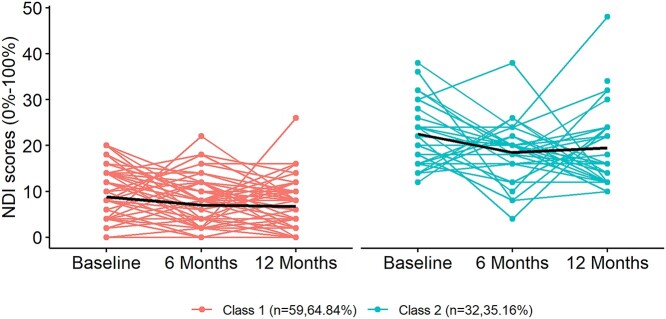
Two distinct trajectories of neck disability were identified, including a "low-resolving disability" trajectory showing slow improvement toward no disability (64.8%) and a "moderate-fluctuating disability" trajectory characterized by persistent moderate disability with a small fluctuation across time (35.2%). The trajectory of moderate-fluctuating disability was associated with more severe symptoms, lower vigorous physical activity, higher ergonomic risk, remote cold hyperalgesia, widespread mechanical hyperalgesia, heightened pain facilitation, and several psychosocial factors such as anxiety, depression, lower job satisfaction, and lower workplace social support at baseline.
Over one-third of sonographers were at risk of developing a moderate-fluctuating disability trajectory. This unfavorable trajectory was associated with low physical activity level, poor ergonomics, psychosocial distress, and central sensitization at baseline.
This study has important implications for the management of neck disability in workers. Addressing modifiable factors including low vigorous physical activity, poor ergonomics, anxiety, depression, and lack of workplace social support may improve the trajectory of work-related neck disability.
鉴于与工作相关的颈部疼痛和残疾带来的经济负担,了解其时间进程和相关的危险因素对于指导更好的管理策略非常重要。本研究旨在确定在超声科等高风险职业群体中与工作相关的颈部残疾的 1 年轨迹,并研究哪些基线生物心理社会因素与确定的轨迹相关。
对 92 名颈部残疾的超声科人员进行了一项纵向研究,这些人员在基线、6 个月和 12 个月时使用颈部残疾指数进行了 3 次评估。基线的生物心理社会测量包括个体特征(人口统计学和身体活动水平)、与工作相关的身体和心理社会因素(例如,工效学风险、工作场所社会支持、工作满意度)、一般心理特征(抑郁、焦虑、疼痛灾难化和回避信念)以及躯体感觉功能的定量感觉测试(颈部和胫骨前肌的冷觉和压痛阈值以及时间总和)。
确定了两种不同的颈部残疾轨迹,包括“低缓解残疾”轨迹,表现为向无残疾方向缓慢改善(64.8%)和“中度波动残疾”轨迹,其特征是持续中度残疾,随时间略有波动(35.2%)。中度波动残疾轨迹与更严重的症状、较低的剧烈体力活动、较高的工效学风险、远程冷觉过敏、广泛的机械性痛觉过敏、疼痛增强以及基线时的一些心理社会因素(焦虑、抑郁、较低的工作满意度和较低的工作场所社会支持)相关。
超过三分之一的超声科人员有发展为中度波动残疾轨迹的风险。这种不利的轨迹与基线时的低体力活动水平、工效学不佳、心理困扰和中枢敏化有关。
这项研究对工人颈部残疾的管理具有重要意义。解决可改变的因素,包括剧烈的体力活动水平低、工效学不佳、焦虑、抑郁和缺乏工作场所社会支持,可能会改善与工作相关的颈部残疾的轨迹。