Department of Radiology, Faculty of Medicine, Khon Kaen University, Khon Kaen, Thailand.
Department of Radiology, Institute of medicine Suranaree University of Technology, Nakhon Ratchasima, Thailand.
Asian Pac J Cancer Prev. 2022 Apr 1;23(4):1193-1197. doi: 10.31557/APJCP.2022.23.4.1193.
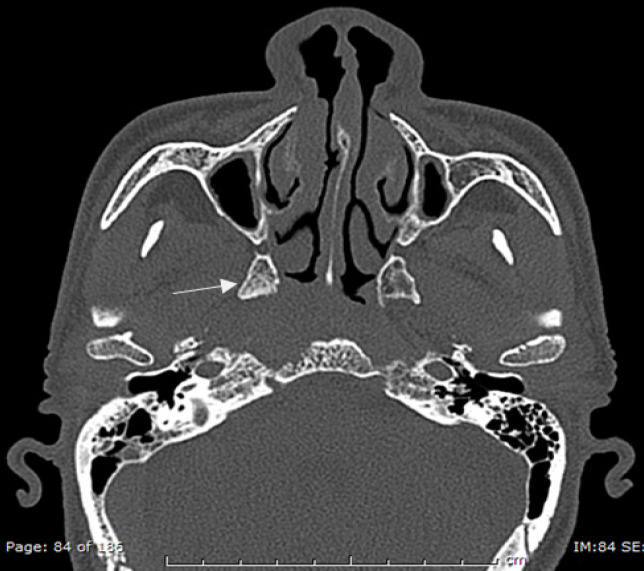
The objective of our study was to determine the prevalence of sclerotic pterygoid plate in pretreatment CT of nasopharyngeal carcinoma compared with the control group.
A total of 51 nasopharyngeal carcinoma patients (37 men, 14 women) with a mean age of 51.94±13 years, and 51 controls (30 men, 21 women) with a mean age, 49.31±15 years were included in this study in a retrospective fashion. All computed tomographic (CT) images were evaluated by two neuroradiologists. Sclerosis of pterygoid plate and other findings included pterygoid plate erosion, adjacent tumor enhancement, and parapharyngeal extension which were assessed. MRI findings were also recorded. The prevalence of pterygoid plate sclerosis was compared using Chi-square statistical tests. Imaging findings were analyzed by binary logistic regression analyses.
The prevalence of pterygoid plate sclerosis in nasopharyngeal carcinoma was 53.9% compared to the control group (16.7%) and the difference was statistically significant (P-value< 0.001). In nasopharyngeal carcinoma, the prevalence of tumor adjacent to the pterygoid plate, parapharyngeal extension and pterygoid plate erosion were 69.6%, 81.4%, 38.2%, respectively. No erosion of pterygoid plate was detected in the control group. The odds of adjacent tumor enhancement and pterygoid plate erosion was 7.29 and 20.56 times higher in the sclerotic pterygoid plate (p-values of 0.019 and 0.000, respectively). MRI was available for four nasopharyngeal carcinoma cases with five sclerotic pterygoid plates, where two showed enhancements. All non-sclerotic pterygoid plates showed no enhancement on MRI.
The prevalence of sclerotic pterygoid plate is significantly higher in patients with nasopharyngeal carcinoma with a considerably higher chance of adjacent tumor enhancement and pterygoid plate erosion.
本研究旨在比较鼻咽癌患者与对照组患者治疗前 CT 中硬化性蝶骨翼板的发生率。
本回顾性研究共纳入 51 例鼻咽癌患者(男 37 例,女 14 例),平均年龄为 51.94±13 岁,以及 51 例对照组患者(男 30 例,女 21 例),平均年龄为 49.31±15 岁。由两位神经放射科医生对所有 CT 图像进行评估。评估了蝶骨翼板的硬化和其他发现,包括蝶骨翼板侵蚀、相邻肿瘤强化和咽旁延伸。还记录了 MRI 发现。使用卡方统计检验比较了蝶骨翼板硬化的发生率。使用二项逻辑回归分析对影像学表现进行了分析。
与对照组(16.7%)相比,鼻咽癌患者蝶骨翼板硬化的发生率为 53.9%,差异具有统计学意义(P 值<0.001)。在鼻咽癌中,与蝶骨翼板相邻的肿瘤、咽旁延伸和蝶骨翼板侵蚀的发生率分别为 69.6%、81.4%和 38.2%。对照组未发现蝶骨翼板侵蚀。在硬化性蝶骨翼板中,相邻肿瘤强化和蝶骨翼板侵蚀的可能性分别增加了 7.29 倍和 20.56 倍(P 值分别为 0.019 和 0.000)。4 例鼻咽癌患者有 5 例硬化性蝶骨翼板,其中 2 例显示强化。所有非硬化性蝶骨翼板在 MRI 上均无强化。
鼻咽癌患者中硬化性蝶骨翼板的发生率明显更高,且相邻肿瘤强化和蝶骨翼板侵蚀的可能性也更高。