Prati Sebastian, Grabner Daniel S, Pfeifer Svenja M, Lorenz Armin W, Sures Bernd
Aquatic Ecology and Centre for Water and Environmental Research, University of Duisburg-Essen, Universitaetsstr. 5, 45141 Essen, Germany.
Parasitology. 2022 Apr 8;149(7):1-10. doi: 10.1017/S0031182022000452.
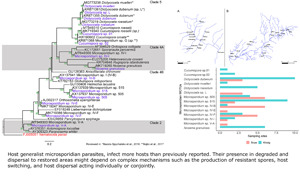
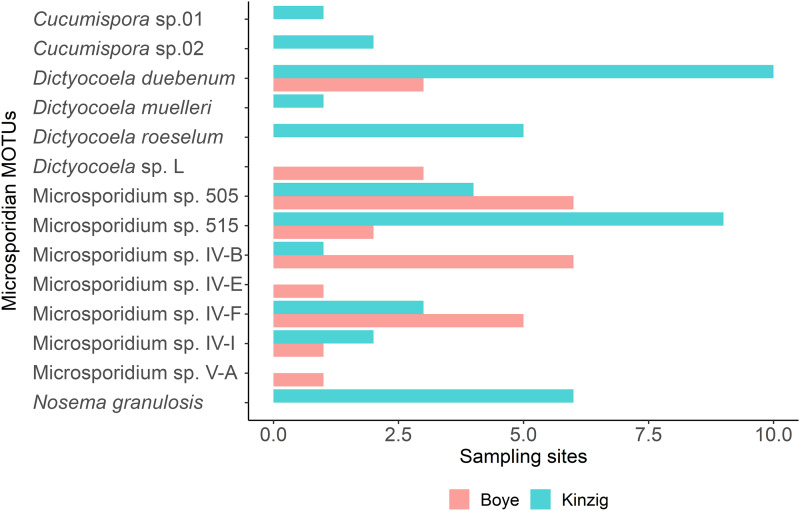
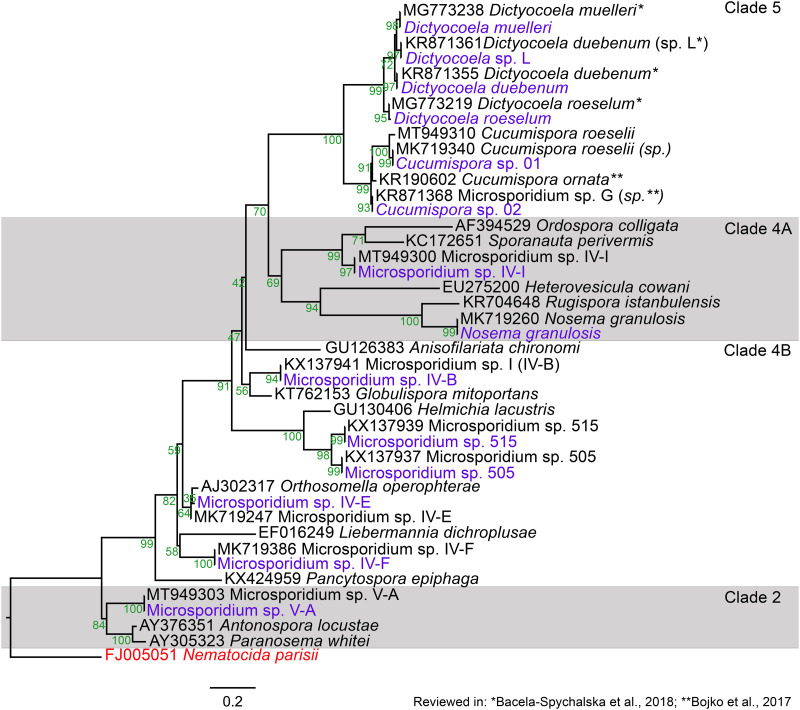
The present study provides new insight into suitable microsporidian–host associations. It relates regional and continental-wide host specialization in microsporidians infecting amphipods to degraded and recovering habitats across 2 German river catchments. It provides a unique opportunity to infer the persistence of parasites following anthropogenic disturbance and their establishment in restored rivers. Amphipods were collected in 31 sampling sites with differing degradation and restoration gradients. Specimens were morphologically (hosts) and molecularly identified (host and parasites). Amphipod diversity and abundance, microsporidian diversity, host phylogenetic specificity and continental-wide β-specificity were investigated and related to each other and/or environmental variables. Fourteen microsporidian molecular operational taxonomic units (MOTUs), mainly generalist parasites, infecting 6 amphipod MOTUs were detected, expanding the current knowledge on the host range by 17 interactions. There was no difference in microsporidian diversity and host specificity among restored and near-natural streams (Boye) or between those located in urban and rural areas (Kinzig). Similarly, microsporidian diversity was generally not influenced by water parameters. In the Boye catchment, host densities did not influence microsporidian MOTU richness across restored and near-natural sites. High host turnover across the geographical range suggests that neither environmental conditions nor host diversity plays a significant role in the establishment into restored areas. Host diversity and environmental parameters do not indicate the persistence and dispersal of phylogenetic host generalist microsporidians in environments that experienced anthropogenic disturbance. Instead, these might depend on more complex mechanisms such as the production of resistant spores, host switching and host dispersal acting individually or conjointly.
本研究为合适的微孢子虫 - 宿主关联提供了新的见解。它将感染双足类动物的微孢子虫在区域和大陆范围内的宿主特异性与德国2个河流流域的退化和恢复中的栖息地联系起来。它提供了一个独特的机会来推断人为干扰后寄生虫的持久性及其在恢复河流中的定殖情况。在31个具有不同退化和恢复梯度的采样点收集了双足类动物。对标本进行了形态学(宿主)和分子鉴定(宿主和寄生虫)。研究了双足类动物的多样性和丰度、微孢子虫的多样性、宿主系统发育特异性和大陆范围内的β特异性,并将它们相互关联以及与环境变量相关联。检测到14个微孢子虫分子操作分类单元(MOTUs),主要是泛寄生物,感染6个双足类动物MOTUs,通过17种相互作用扩展了目前关于宿主范围的知识。在恢复的和近自然的溪流(博耶河)之间或城市和农村地区的溪流(金齐格河)之间,微孢子虫多样性和宿主特异性没有差异。同样,微孢子虫多样性一般不受水参数的影响。在博耶河流域,宿主密度在恢复的和近自然的地点对微孢子虫MOTU丰富度没有影响。地理范围内高的宿主周转率表明,环境条件和宿主多样性在定殖到恢复区域中都没有发挥重要作用。宿主多样性和环境参数并未表明系统发育宿主泛寄生物微孢子虫在经历人为干扰的环境中的持久性和扩散情况。相反,这些可能取决于更复杂的机制,例如抗性孢子的产生、宿主转换和宿主扩散单独或共同起作用。