Department of Psychology, University of Oslo, Postboks 1094, Blindern, 0317 Oslo, Norway.
Department of Psychology, University of Oslo, Postboks 1094, Blindern, 0317 Oslo, Norway.
Curr Opin Psychol. 2022 Aug;46:101346. doi: 10.1016/j.copsyc.2022.101346. Epub 2022 Apr 4.
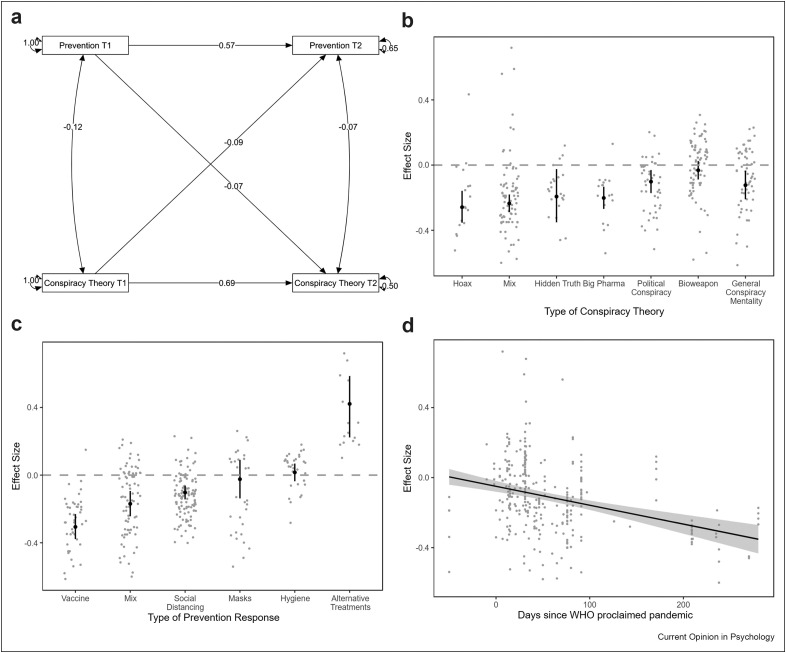
While conspiracy theories about COVID-19 are proliferating, their impact on health-related responses during the present pandemic is not yet fully understood. We meta-analyzed correlational and longitudinal evidence from 53 studies (N = 78,625) conducted in 2020 and 2021. Conspiracy beliefs were weakly associated with more reluctance toward prevention measures both cross-sectionally and over time. They explained lower vaccination and social distancing responses but were unrelated to mask wearing and hygiene responses. Conspiracy beliefs showed an increasing association with prevention responses as the pandemic progressed and explained support for alternative treatments lacking scientific bases (e.g., chloroquine treatment, complementary medicine). Despite small and heterogenous effects, at a large scale, conspiracy beliefs are a non-negligible threat to public health.
虽然关于 COVID-19 的阴谋论正在泛滥,但它们对当前大流行期间与健康相关的反应的影响尚未被完全理解。我们对 2020 年和 2021 年进行的 53 项研究(N=78625)的相关和纵向证据进行了荟萃分析。阴谋信念与预防措施的抵触程度在横断面和随时间推移均呈弱相关。它们解释了较低的疫苗接种和社会隔离反应,但与戴口罩和卫生习惯反应无关。随着大流行的发展,阴谋信念与预防反应的关联度逐渐增加,并解释了对缺乏科学依据的替代疗法的支持(例如氯喹治疗、补充医学)。尽管影响较小且存在异质性,但在大规模情况下,阴谋信念对公共卫生构成了不可忽视的威胁。