Department of Public Health, Erasmus University Medical Center, Rotterdam, The Netherlands.
Department of Public Health, Erasmus University Medical Center, Rotterdam, The Netherlands
BMJ Open. 2022 Apr 29;12(4):e058574. doi: 10.1136/bmjopen-2021-058574.
This study assessed the associations of (1) within-individual improvements and (2) within-individual deteriorations in working conditions, health behaviour and body mass index (BMI) with changes in work ability and self-rated health among workers.
Prospective cohort study.
The Netherlands.
Persons in paid employment, aged 45-64 years, who participated in the Dutch Study on Transitions in Employment, Ability and Motivation (STREAM) between 2010 and 2017, and improved or deteriorated at least once with respect to working conditions (psychological and emotional job demands, autonomy, social support, physical workload), health behaviour (moderate and vigorous physical activity, smoking status), or BMI between any of two consecutive measurements during the 7-year follow-up.
Changes in self-reported work ability on a scale from 0 to 10 (1st item of the work ability index) and self-rated health on a scale from 1 to 5 (SF-12).
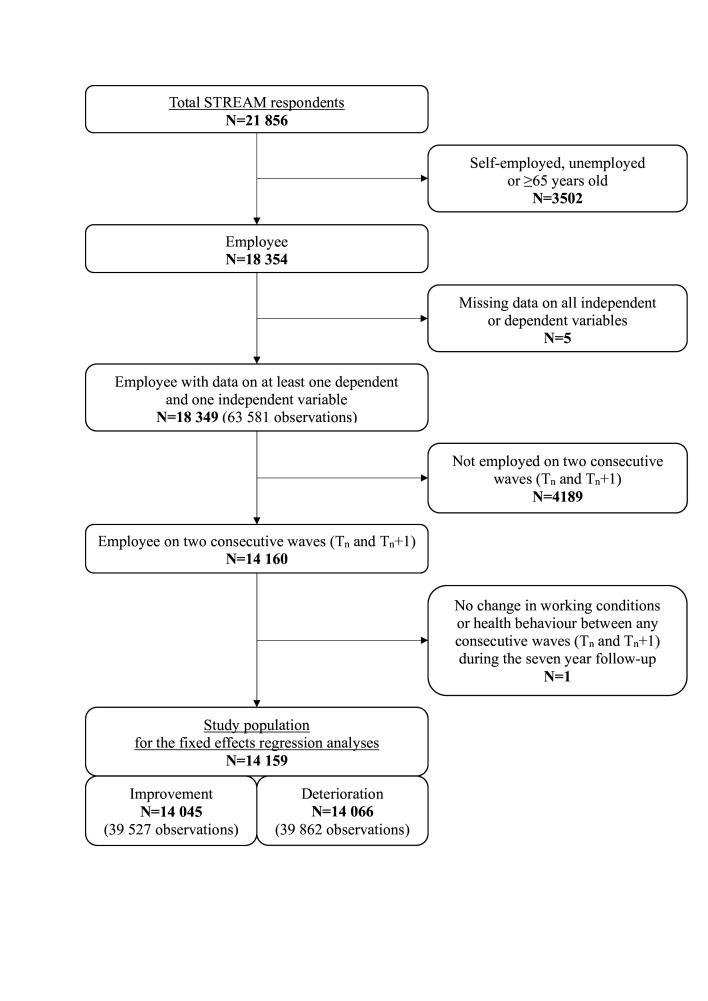
Of the 21 856 STREAM participants, ultimately 14 159 workers were included in the fixed effects analyses on improvements (N=14 045) and deteriorations (N=14 066). Workers with deteriorated working conditions decreased in work ability (β's: -0.21 (95% CI: -0.25 to -0.18) to -0.28 (95% CI: -0.33 to -0.24)) and health (β's: -0.07 (95% CI: -0.09 to -0.06) to -0.10 (95% CI: -0.12 to -0.08)), whereas improvements were to a lesser extent associated with increased work ability (β's: 0.06 (95% CI: 0.02 to 0.09) to 0.11 (95% CI: 0.06 to 0.16)) and health (β's: 0.02 (95% CI: 0.00 to 0.03) to 0.04 (95% CI: 0.02 to 0.06)). Workers with increased BMI or decreased physical activity reduced in work ability and health. Likewise, decreased BMI or increased vigorous physical activity was associated with improved health. An increase in moderate or vigorous physical activity was modestly associated with a reduced work ability. Quitting smoking was associated with reduced work ability and health.
Compared with improvements, preventing deteriorations in working conditions, health behaviour and BMI, might be more beneficial for work ability and workers' health.
本研究评估了(1)个体工作条件、健康行为和体重指数(BMI)的改善和(2)个体工作条件、健康行为和 BMI 的恶化与工人工作能力和自我评估健康变化之间的关联。
前瞻性队列研究。
荷兰。
2010 年至 2017 年间参加荷兰工作转型、能力和激励研究(STREAM)的处于带薪就业状态、年龄在 45-64 岁之间的人群,在 7 年的随访期间,他们的工作条件(心理和情绪工作要求、自主性、社会支持、体力工作负荷)、健康行为(中等和剧烈体力活动、吸烟状况)或 BMI 至少有两次连续测量发生一次改善或恶化。
自我报告的工作能力变化,范围为 0 到 10(工作能力指数的第一项)和自我评估的健康变化,范围为 1 到 5(SF-12)。
在 21856 名 STREAM 参与者中,最终有 14159 名工人被纳入关于改善的固定效应分析(N=14045)和恶化的固定效应分析(N=14066)。工作条件恶化的工人工作能力下降(β值:-0.21(95%CI:-0.25 至-0.18)至-0.28(95%CI:-0.33 至-0.24))和健康(β值:-0.07(95%CI:-0.09 至-0.06)至-0.10(95%CI:-0.12 至-0.08)),而改善则与工作能力的增加(β值:0.06(95%CI:0.02 至 0.09)至 0.11(95%CI:0.06 至 0.16))和健康(β值:0.02(95%CI:0.00 至 0.03)至 0.04(95%CI:0.02 至 0.06))的关联较小。BMI 增加或体力活动减少与工作能力和健康下降有关。同样,BMI 减少或剧烈体力活动增加与健康改善有关。中等或剧烈体力活动的增加与工作能力的适度下降有关。戒烟与工作能力和健康下降有关。
与改善相比,预防工作条件、健康行为和 BMI 的恶化可能对工作能力和工人健康更有益。