One Health Research Group, Universidad de Las Américas, Quito, Ecuador
Department of Cell Biology, Physiology and Immunology, Universitat de Barcelona, Barcelona, Spain.
BMJ Open. 2022 Apr 29;12(4):e051777. doi: 10.1136/bmjopen-2021-051777.
About 5.7% of the world population resides above 1500 m. It has been hypothesised that acute exposure to high-altitude locations can increase stroke risk, while chronic hypoxia can reduce stroke-related mortality.
This review aims to provide an overview of the available evidence on the association between long-term high-altitude exposure and ischaemic stroke.
A systematic review was performed from 1 January 1960 to 1 December 2021 to assess the possible link between high-altitude exposure and ischaemic stroke. The AMED, EMBASE, Cochrane Library, PubMed, MEDLINE, the Europe PubMed Central and the Latin-American bibliographic database Scielo were accessed using the University of Southampton library tool Delphis. In this review, we included population and individual-based observational studies, including cross-sectional and longitudinal studies except for those merely descriptive individual-based case reports. Studies were limited to humans living or visiting high-altitude locations for at least 28 days as a cut-off point for chronic exposure.
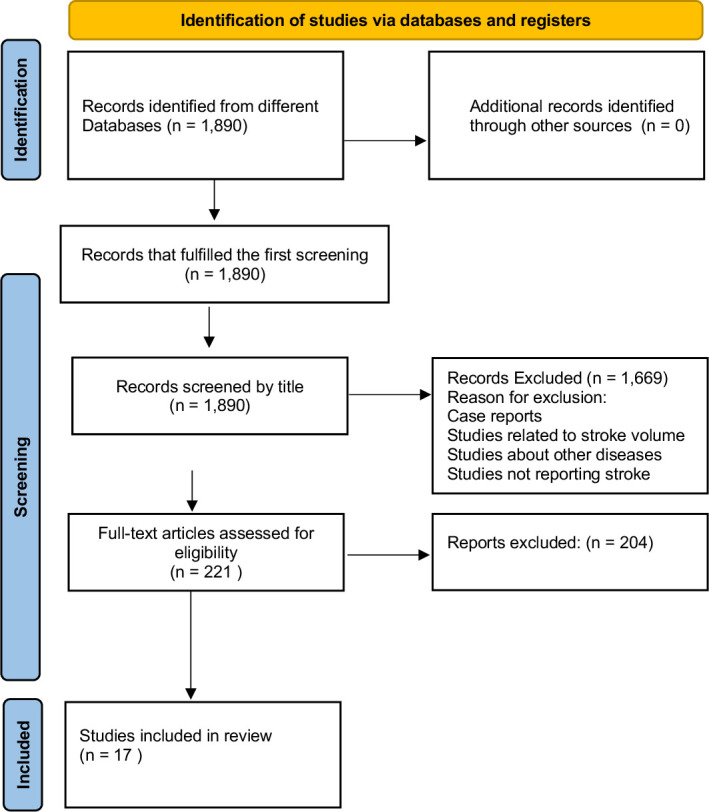
We reviewed a total of 1890 abstracts retrieved during the first step of the literature review process. The authors acquired in full text as potentially relevant 204 studies. Only 17 documents met the inclusion criteria and were finally included. Ten studies clearly suggest that living at high altitudes may be associated with an increased risk of stroke; however, five studies suggest that altitude may act as a protective factor for the development of stroke, while two studies report ambiguous results.
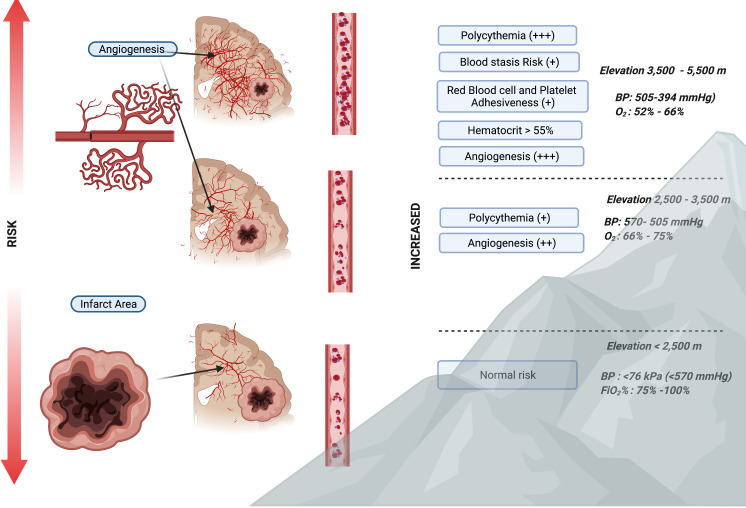
This review suggests that the most robust studies are more likely to find that prolonged living at higher altitudes reduces the risk of developing stroke or dying from it. Increased irrigation due to angiogenesis and increased vascular perfusion might be the reason behind improved survival profiles among those living within this altitude range. In contrast, residing above 3500 m seems to be associated with an apparent increased risk of developing stroke, probably linked to the presence of polycythaemia and other associated factors such as increased blood viscosity.
全球约有 5.7%的人口居住在海拔 1500 米以上的地区。有人假设,急性暴露在高海拔地区会增加中风风险,而慢性缺氧会降低与中风相关的死亡率。
本综述旨在提供有关长期高海拔暴露与缺血性中风之间关联的现有证据概述。
从 1960 年 1 月 1 日至 2021 年 12 月 1 日进行了系统综述,以评估高海拔暴露与缺血性中风之间可能存在的联系。使用南安普顿大学图书馆的 Delphis 工具,检索了 AMED、EMBASE、Cochrane 图书馆、PubMed、MEDLINE、欧洲 PubMed 中心和拉丁美洲文献数据库 Scielo 中的文献。在本综述中,我们纳入了基于人群和个体的观察性研究,包括横断面和纵向研究,但不包括仅为描述性的基于个体的病例报告。研究将居住或访问高海拔地区至少 28 天的人群作为慢性暴露的截止点。
我们总共审查了文献综述过程第一步中检索到的 1890 篇摘要。作者获取了 204 篇可能相关的全文研究。只有 17 份文件符合纳入标准并最终被纳入。有 10 项研究明确表明,生活在高海拔地区可能与中风风险增加有关;然而,有 5 项研究表明,海拔可能是中风发生的保护因素,而有 2 项研究报告了结果不明确。
本综述表明,最有力的研究更有可能发现,长时间生活在较高海拔地区可降低患中风或因中风而死亡的风险。由于血管生成和血管灌注增加而增加的灌溉可能是生活在这一海拔范围内的人的生存状况改善的原因。相比之下,居住在海拔 3500 米以上似乎与中风发病风险明显增加有关,这可能与红细胞增多症和其他相关因素(如血液黏度增加)有关。