Department of Medicine, Faculty of Medicine Siriraj Hospital, Mahidol University, Bangkok, Thailand.
Division of Cardiology, Department of Medicine, Siriraj Hospital, Mahidol University, 2 Wanglang Road Bangkoknoi, Bangkok, 10700, Thailand.
BMC Cardiovasc Disord. 2022 Apr 29;22(1):203. doi: 10.1186/s12872-022-02629-2.
There are limited data on the burden, characteristics, and outcomes of hospitalized heart failure (HF) patients in Thailand. The aim of this study was to investigate national trend in HF hospitalization rate, in-hospital and 1-year mortality rate, and rehospitalization rate in Thailand.
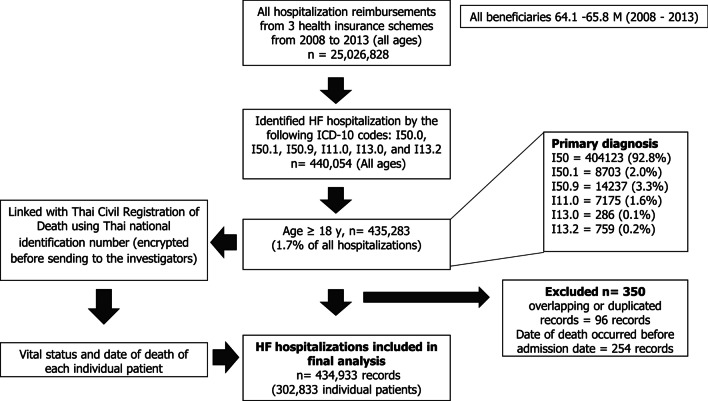
We analyzed the claims data of hospitalized patients obtained from the three major Thailand public health reimbursement systems between 2008 and 2013. Patients aged ≥ 18 years with a principal diagnosis of HF by the International Classification of Diseases, Tenth Revision, Thai modification were included. Comorbidities were identified by secondary diagnosis codes. The annual rate of HF hospitalization was calculated per 100,000 beneficiaries. Records of subsequent hospitalization of discharged patients were retrieved. For 1-year mortality rate, vital status of each patient was obtained from Thai Civil Registration of Death database. All outcomes were tested for linear trends across calendar years.
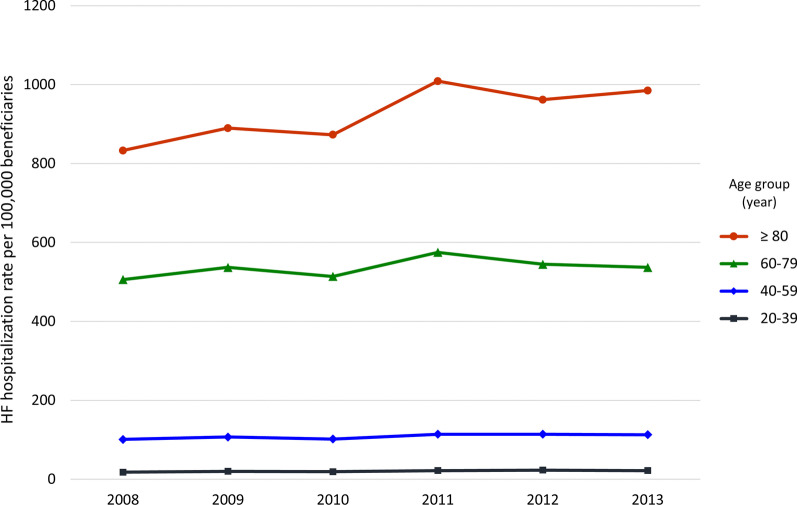
Between 2008 and 2013, 434,933 HF hospitalizations were identified. The mean age was 65.3 years (SD 14.6), and 58.1% were female. The HF hospitalization rate increased from 138 in 2008 to 168 per 100,000 beneficiaries in 2013 (P for trend < 0.001). Nearly half (47.4%) had had a prior HF admission within 1 year. A small proportion of patients (7.4%) received echocardiography during hospitalization. The median length of hospital stay was 3 days. In-hospital mortality declined from 4.4 to 3.8% (P for trend < 0.001). The overall 30-day and 1-year rehospitalization rates were 34 and 73%, respectively, without significant trends over the study period. Most common cause of 30-day rehospitalization was HF (42%). One-year mortality decreased from 31.8% in 2008 to 28.5% in 2012 (P for trend < 0.001).
Between 2008 and 2013, HF hospitalization rate in Thailand increased. The in-hospital and 1-year mortality rates decreased slightly. However, the rehospitalization rate remained high mainly due to recurrent HF hospitalization.
泰国有关住院心力衰竭(HF)患者负担、特征和结局的数据有限。本研究旨在调查泰国 HF 住院率、住院和 1 年死亡率以及再住院率的全国趋势。
我们分析了 2008 年至 2013 年期间从泰国三大公共卫生报销系统中获得的住院患者索赔数据。纳入年龄≥18 岁且由国际疾病分类、第十次修订版、泰国修正版主要诊断为 HF 的患者。合并症通过次要诊断代码确定。HF 住院率按每 10 万受益人的比例计算。检索出院患者的后续住院记录。对于 1 年死亡率,从泰国公民登记死亡数据库中获取每位患者的存活状况。对所有结局进行线性趋势检验。
2008 年至 2013 年间,共确定了 434933 例 HF 住院患者。平均年龄为 65.3 岁(SD 14.6),58.1%为女性。HF 住院率从 2008 年的 138 例增至 2013 年的 168 例/10 万受益人(趋势 P<0.001)。近一半(47.4%)的患者在 1 年内有过 HF 入院史。只有一小部分患者(7.4%)在住院期间接受了超声心动图检查。住院中位时间为 3 天。住院期间死亡率从 4.4%降至 3.8%(趋势 P<0.001)。总的 30 天和 1 年再住院率分别为 34%和 73%,研究期间无显著趋势。30 天再住院的最常见原因是 HF(42%)。1 年死亡率从 2008 年的 31.8%降至 2012 年的 28.5%(趋势 P<0.001)。
2008 年至 2013 年期间,泰国 HF 住院率上升。住院和 1 年死亡率略有下降。然而,再住院率仍然很高,主要是由于 HF 反复发作住院。