Department of Medical Oncology, Sun Yat-sen University Cancer Center, Guangzhou, State Key Laboratory of Oncology in Southern China, and Collaborative Innovation Center of Cancer Medicine, Guangzhou, China.
Department of Senior and Phase I Clinical Trial Ward, Sichuan Cancer Hospital & Institute, Sichuan Cancer Center, School of Medicine University of Electronic Science & Technology of China, Sichuan, Province, Chengdu, China.
Cancer Med. 2022 Sep;11(18):3407-3416. doi: 10.1002/cam4.4702. Epub 2022 Apr 29.
The aim of this study was to explore predictors and construct a nomogram for risk stratification in primary extragastric mucosa-associated lymphoid tissue (MALT) lymphoma.
Extragastric MALT lymphoma cases newly diagnosed between November 2010 and April 2020 were assessed to construct a progression-free survival (PFS)-related nomogram. We also performed external validation of the nomogram in an independent cohort.
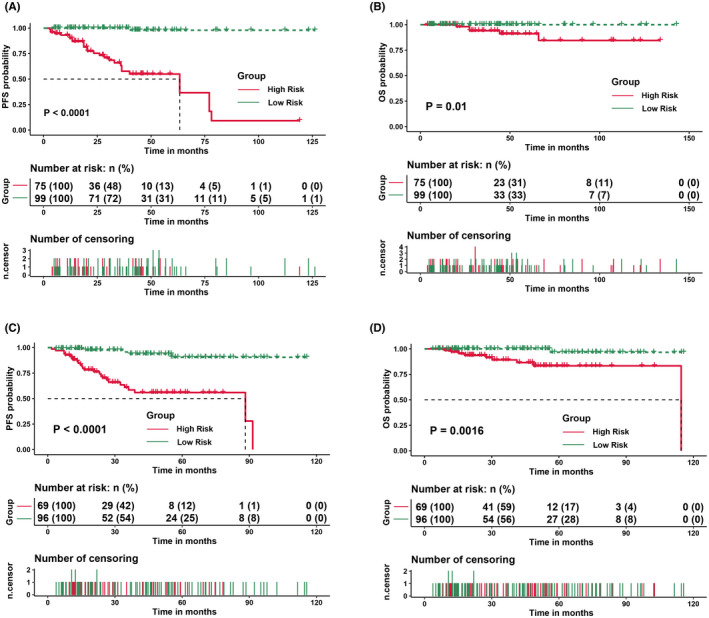
We performed multivariate analyses of 174 patients from 3 hospitals who were included in the training cohort. Stage, hepatitis B virus surface antigen (HBsAg) status, and Ki67 expression were significantly associated with PFS. These three factors were used to construct a nomogram, which was shown to have a C-index of 0.89. Two risk groups (low risk and high risk) were identified by the prognostic model. The 5-year PFS was 98.9% for the low-risk group and 69.3% for the high-risk group (p < 0.001). The overall survival (OS) could also be effectively distinguished by the nomogram, resulting in an OS of 100% for the low-risk group and 94.6% for the high-risk group (p = 0.01). These results were validated and confirmed in an independent cohort with 165 patients from another three hospitals. The 5-year PFS rates were 94.8% and 66.7% for the low-risk and high-risk groups, respectively (p < 0.001). The 5-year OS rates were 97.9% and 88.4%, respectively (p = 0.016).
The nomogram could well distinguish the prognosis of low- and high-risk patients with extragastric MALT lymphoma and is thus recommended for clinical use.
本研究旨在探讨原发性胃外黏膜相关淋巴组织(MALT)淋巴瘤的风险分层预测因素,并构建一个列线图。
评估了 2010 年 11 月至 2020 年 4 月期间新诊断的胃外 MALT 淋巴瘤病例,以构建无进展生存(PFS)相关列线图。我们还在一个独立的队列中对该列线图进行了外部验证。
我们对来自 3 家医院的 174 例患者进行了多变量分析,这些患者被纳入了训练队列。分期、乙型肝炎病毒表面抗原(HBsAg)状态和 Ki67 表达与 PFS 显著相关。这三个因素被用于构建一个列线图,该列线图的 C 指数为 0.89。通过该预后模型,我们确定了两个风险组(低危组和高危组)。低危组的 5 年 PFS 为 98.9%,高危组为 69.3%(p<0.001)。该列线图还可以有效地区分总生存(OS),低危组的 OS 为 100%,高危组为 94.6%(p=0.01)。这些结果在来自另外 3 家医院的 165 例患者的独立队列中得到了验证和确认。低危组和高危组的 5 年 PFS 率分别为 94.8%和 66.7%(p<0.001)。5 年 OS 率分别为 97.9%和 88.4%(p=0.016)。
该列线图可以很好地区分低危和高危胃外 MALT 淋巴瘤患者的预后,因此推荐用于临床使用。