Nomura Takashi, Minami Eiji, Kawamoto Haruo
Graduate School of Energy Science, Kyoto University Yoshida-honmachi, Sakyo-ku Kyoto 606-8501 Japan
RSC Adv. 2020 Feb 19;10(13):7460-7467. doi: 10.1039/c9ra09435k. eCollection 2020 Feb 18.
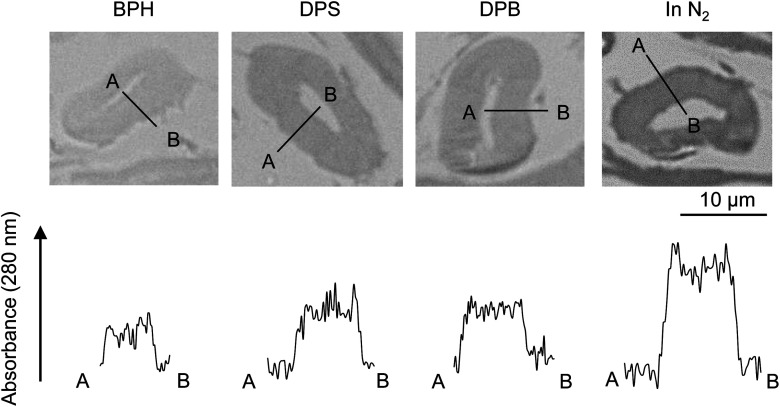
This is the first study of cellulose carbonization in the interior of cell walls. Cotton cellulose was pyrolyzed under nitrogen or in aromatic solvents (benzophenone, diphenyl sulfide, and 1,3-diphenoxybenzene) at 280 °C, and cross sections of the cell walls were examined using ultraviolet (UV) microscopy. After pyrolysis under nitrogen, UV absorption caused by carbonization appeared inside the cell walls. The absorptivity of the cell interiors was homogeneous and slightly lower than that of the cell surfaces. The UV spectra had maximal absorption at 250 nm. The spectra of model compounds and Py-GC/MS analysis data suggested that furanic and polycyclic aromatic structures were present in the carbonized products. The use of aromatic solvents decreased the yields of solid carbonized products and the UV absorptivity, which remained homogeneous throughout the cross sections. The mechanism of cellulose carbonization in cell walls is discussed along with the influence of aromatic solvents.
这是关于细胞壁内部纤维素碳化的首次研究。棉纤维素在氮气氛围下或在芳香溶剂(二苯甲酮、二苯硫醚和1,3 - 二苯氧基苯)中于280°C进行热解,然后使用紫外(UV)显微镜检查细胞壁的横截面。在氮气氛围下热解后,细胞壁内部出现了由碳化引起的紫外吸收。细胞内部的吸收率是均匀的,且略低于细胞表面的吸收率。紫外光谱在250 nm处有最大吸收。模型化合物的光谱和热解气相色谱/质谱(Py - GC/MS)分析数据表明,碳化产物中存在呋喃类和多环芳烃结构。使用芳香溶剂降低了固体碳化产物的产率和紫外吸收率,且整个横截面的紫外吸收率保持均匀。本文讨论了细胞壁中纤维素碳化的机制以及芳香溶剂的影响。