French Susannah S, Webb Alison C, Wilcoxen Travis E, Iverson John B, DeNardo Dale F, Lewis Erin L, Knapp Charles R
Department of Biology, Utah State University, Logan, UT 84322, USA.
Biology Department, Millikin University, Decatur, IL 62522, USA.
Conserv Physiol. 2022 Feb 5;10(1):coac001. doi: 10.1093/conphys/coac001. eCollection 2022.
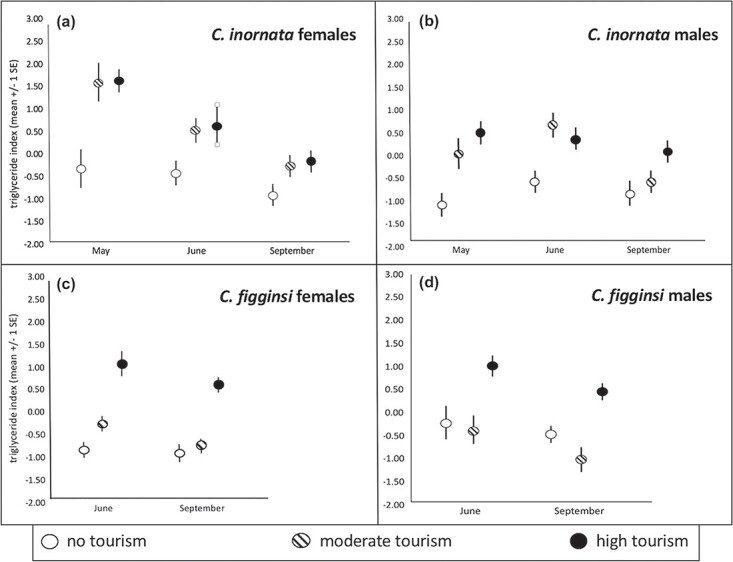
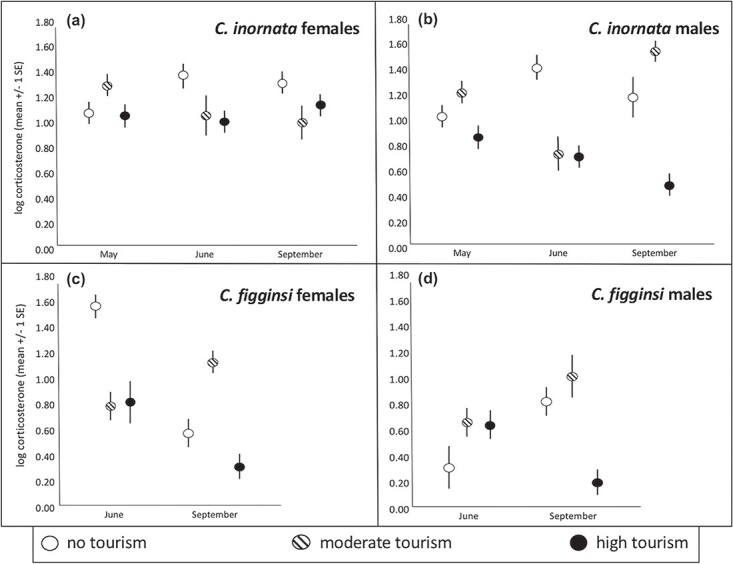
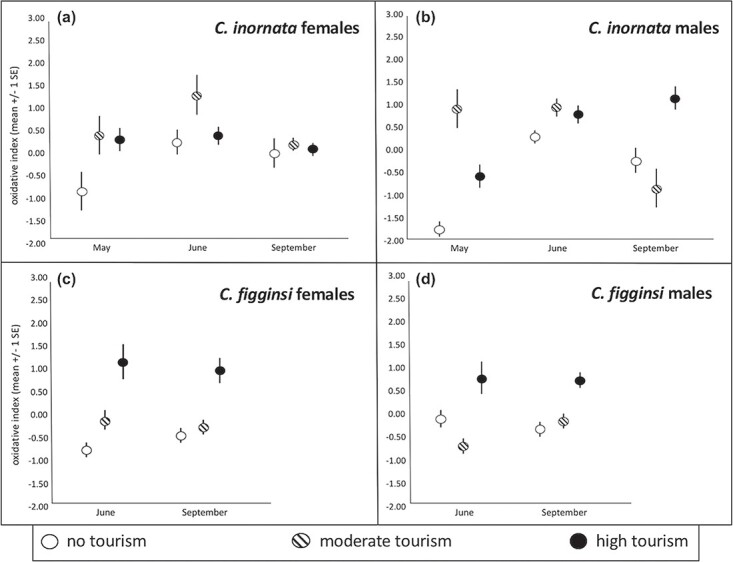
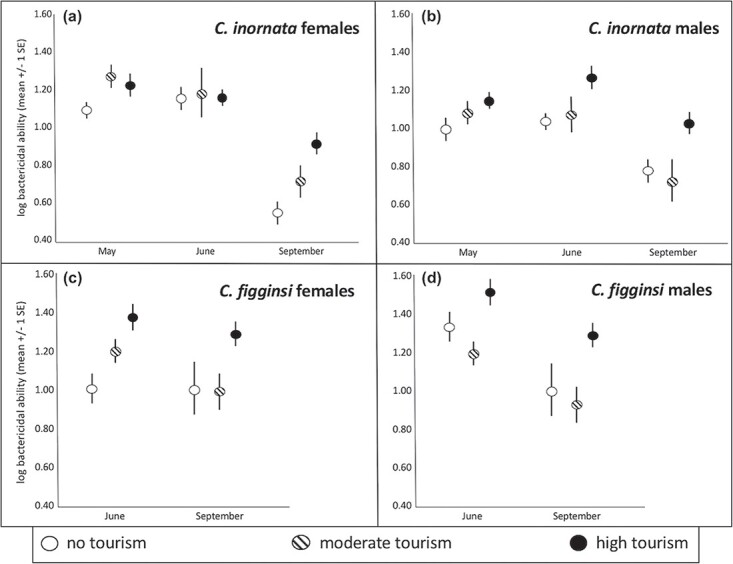
To promote survival and fitness, organisms use a suite of physiological systems to respond to both predictable and unpredictable changes in the environment. These physiological responses are also influenced by changes in life history state. The continued activation of physiological systems stemming from persistent environmental perturbations enable animals to cope with these challenges but may over time lead to significant effects on the health of wildlife. In the present study, we tested how varying environmental perturbations driven by tourism and associated supplemental feeding affects the energetics, corticosterone and immunity of six discrete populations of the northern Bahamian rock iguana ( and ). We studied populations within and outside the reproductive season and quantified tourist numbers during sample collection. Specifically, we measured clutch size, body condition, plasma energy metabolites, reactive oxygen species, baseline corticosterone concentrations and immune function of male and female iguanas from each population to address whether (i) disparate physiologies are emerging across a gradient of tourism and feeding, (ii) both subspecies respond similarly and (iii) responses vary with season/reproductive condition. We found significant effects of tourism level, season and their interaction on the physiology of both and , supporting the idea that tourism is leading to the divergence of phenotypes. Specifically, we found elevated plasma energy metabolites, oxidative stress and a measure of innate immunity (bactericidal ability), but reduced corticosterone concentrations with increasing tourism in both subspecies of rock iguanas. These physiological metrics differ according to the level of tourism in both subspecies and persist across seasons despite variation with natural seasonal and reproductive changes. These findings suggest that anthropogenic disturbance results in disparate physiologies in northern Bahamian rock iguanas.
为了促进生存和适应性,生物体利用一系列生理系统来应对环境中可预测和不可预测的变化。这些生理反应也受到生活史状态变化的影响。持续的环境扰动导致生理系统持续激活,使动物能够应对这些挑战,但随着时间的推移,可能会对野生动物的健康产生重大影响。在本研究中,我们测试了由旅游和相关补充投喂引起的不同环境扰动如何影响巴哈马北部岩鬣蜥六个不同种群的能量代谢、皮质酮和免疫功能。我们研究了繁殖季节内外的种群,并在样本采集期间对游客数量进行了量化。具体而言,我们测量了每个种群中雄性和雌性鬣蜥的窝卵数、身体状况、血浆能量代谢物、活性氧、基础皮质酮浓度和免疫功能,以探讨:(i)在旅游和投喂梯度上是否出现了不同的生理特征;(ii)两个亚种的反应是否相似;(iii)反应是否随季节/繁殖状况而变化。我们发现旅游水平、季节及其相互作用对两个亚种的生理特征均有显著影响,这支持了旅游导致表型分化的观点。具体而言,我们发现随着岩鬣蜥两个亚种旅游活动的增加,血浆能量代谢物升高、氧化应激增加以及一种先天免疫指标(杀菌能力)增强,但皮质酮浓度降低。这些生理指标因两个亚种的旅游水平而异,尽管会随着自然季节和繁殖变化而有所不同,但在不同季节中都持续存在。这些发现表明,人为干扰导致巴哈马北部岩鬣蜥出现不同的生理特征。