Bertero Edoardo, Robusto Fabio, Rulli Eliana, D'Ettorre Antonio, Bisceglia Lucia, Staszewsky Lidia, Maack Christoph, Lepore Vito, Latini Roberto, Ameri Pietro
Cardiovascular Disease Unit, IRCCS Ospedale Policlinico San Martino, Italian IRCCS Cardiology Network, Genoa, Italy.
Department of Internal Medicine, University of Genoa, Genoa, Italy.
JACC CardioOncol. 2022 Jan 18;4(1):98-109. doi: 10.1016/j.jaccao.2021.11.007. eCollection 2022 Mar.
Studies assessing whether heart failure (HF) is associated with cancer and cancer-related mortality have yielded conflicting results.
This study assessed cancer incidence and mortality according to pre-existing HF in a community-based cohort.
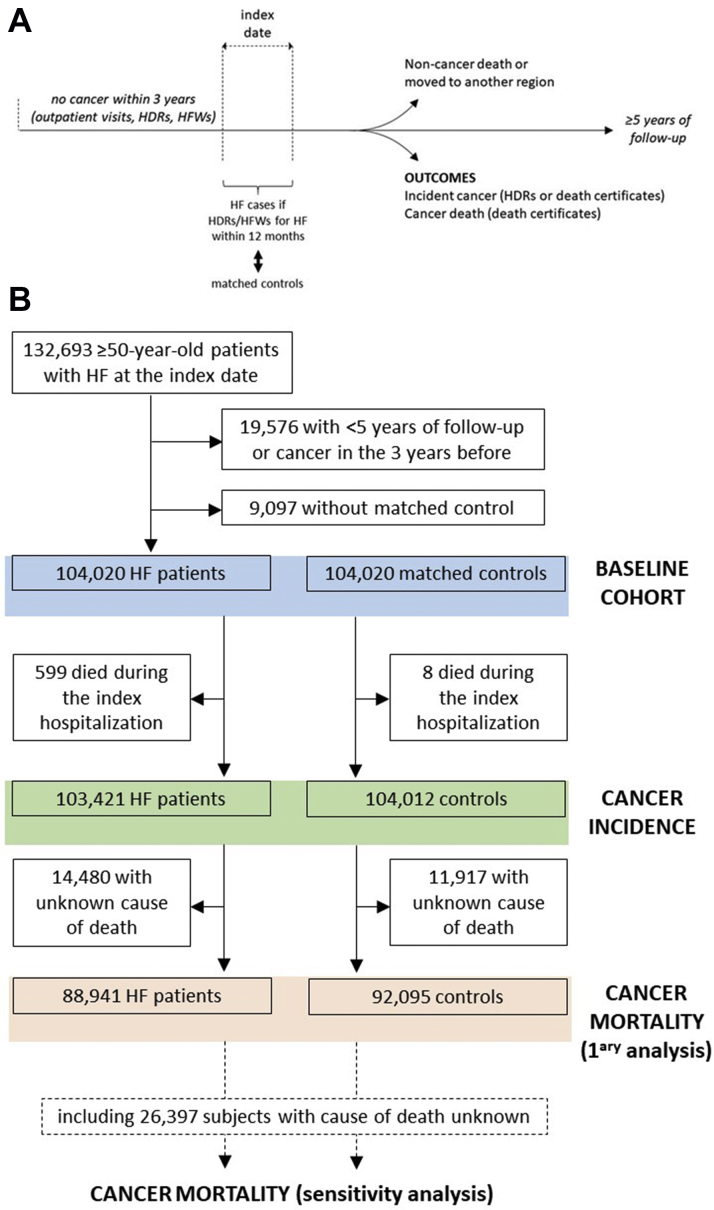
Among individuals ≥50 years of age from the Puglia region in Italy with administrative health data from 2002 to 2018, no cancer within 3 years before the baseline evaluation, and ≥5-year follow-up, the study matched 104,020 subjects with HF at baseline with 104,020 control subjects according to age, sex, drug-derived complexity index, Charlson comorbidity index, and follow-up duration. Cancer incidence and mortality were defined based on International Classification of Diseases-Ninth Revision codes in hospitalization records or death certificates.
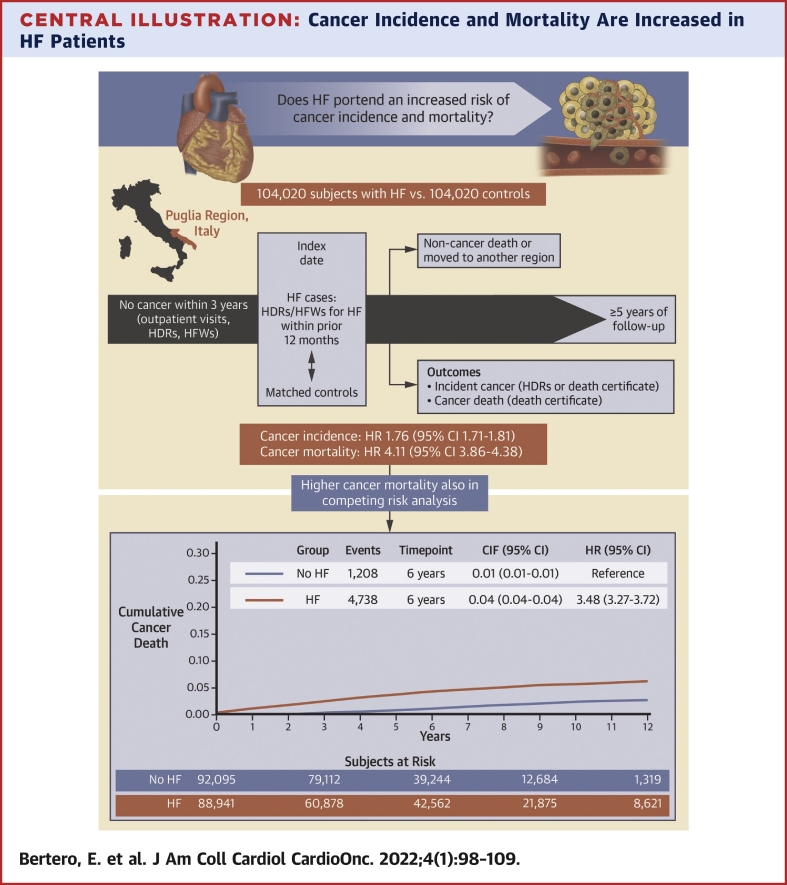
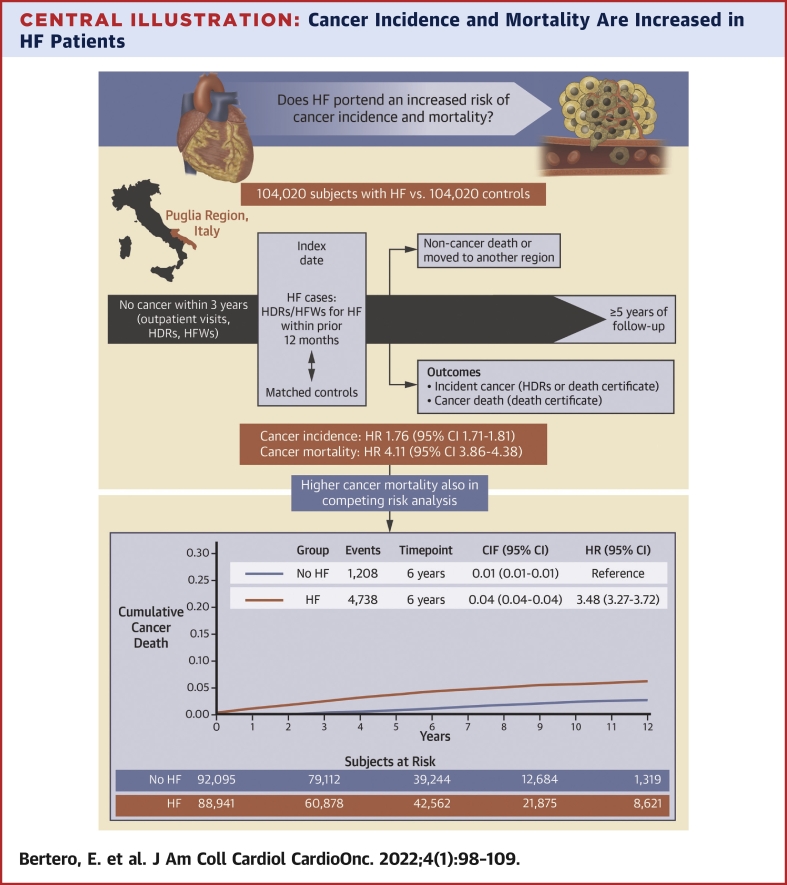
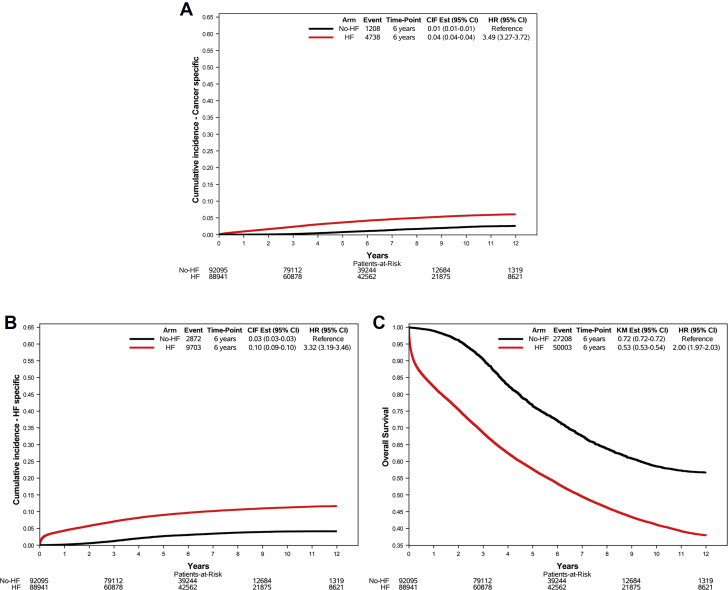
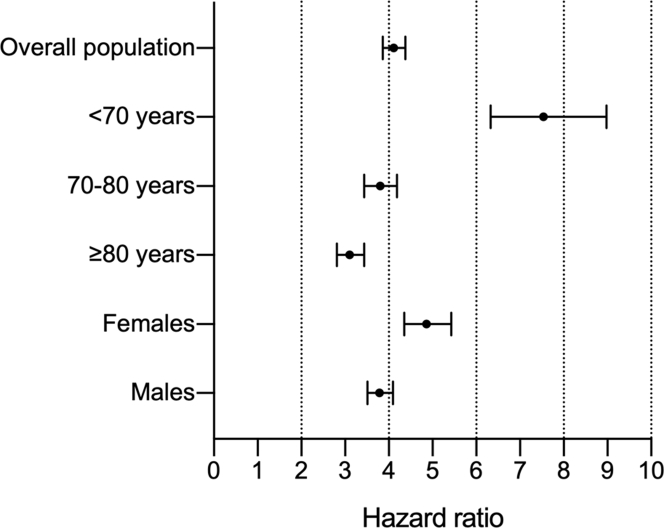
The incidence rate of cancer in HF patients and control subjects was 21.36 (95% CI: 20.98-21.74) and 12.42 (95% CI: 12.14-12.72) per 1000 person-years, respectively, with the HR being 1.76 (95% CI: 1.71-1.81). Cancer mortality was also higher in HF patients than control subjects (HR: 4.11; 95% CI: 3.86-4.38), especially in those <70 years of age (HR: 7.54; 95% CI: 6.33-8.98 vs HR: 3.80; 95% CI: 3.44-4.19 for 70-79 years of age; and HR: 3.10; 95% CI: 2.81-3.43 for ≥80 years of age). The association between HF and cancer mortality was confirmed in a competing risk analysis (subdistribution HR: 3.48; 95% CI: 3.27-3.72). The HF-related excess risk applied to the majority of cancer types. Among HF patients, prescription of high-dose loop diuretic was associated with higher cancer incidence (HR: 1.11; 95% CI: 1.03-1.21) and mortality (HR: 1.35; 95% CI: 1.19-1.53).
HF is associated with an increased risk of cancer and cancer-related mortality, which may be heightened in decompensated states.
评估心力衰竭(HF)是否与癌症及癌症相关死亡率相关的研究结果相互矛盾。
本研究在一个基于社区的队列中,根据既往存在的HF评估癌症发病率和死亡率。
在意大利普利亚地区年龄≥50岁、有2002年至2018年行政健康数据、基线评估前3年内无癌症且随访≥5年的个体中,该研究根据年龄、性别、药物衍生复杂性指数、Charlson合并症指数和随访持续时间,将104,020名基线时患有HF的受试者与104,020名对照受试者进行匹配。癌症发病率和死亡率根据住院记录或死亡证明中的国际疾病分类第九版编码确定。
HF患者和对照受试者的癌症发病率分别为每1000人年21.36(95%CI:20.98 - 21.74)和12.42(95%CI:12.14 - 12.72),风险比(HR)为1.76(95%CI:1.71 - 1.81)。HF患者的癌症死亡率也高于对照受试者(HR:4.11;95%CI:3.86 - 4.38),尤其是在年龄<70岁的患者中(HR:7.54;95%CI:6.33 - 8.98,而70 - 79岁患者的HR为3.80;95%CI:3.44 - 4.19;≥80岁患者的HR为3.10;95%CI:2.81 - 3.43)。在竞争风险分析中证实了HF与癌症死亡率之间的关联(亚分布HR:3.48;95%CI:3.27 - 3.72)。HF相关的额外风险适用于大多数癌症类型。在HF患者中,高剂量袢利尿剂的处方与较高的癌症发病率(HR:1.11;95%CI:1.03 - 1.21)和死亡率(HR:1.35;95%CI:1.19 - 1.53)相关。
HF与癌症及癌症相关死亡率的风险增加相关,在失代偿状态下可能会更高。