Jia Wei, Zhou Lingren, Jiang Ming, Du Jiang, Zhang Mengying, Han Enlin, Niu Hongqing, Wu Dezhen
State Key Laboratory of Chemical Resource Engineering, College of Materials Science and Engineering, Beijing University of Chemical Technology Beijing 100029 China
Jiangsu Shino New Material and Technology Co., Ltd Changzhou 213000 China.
RSC Adv. 2021 Oct 4;11(52):32647-32653. doi: 10.1039/d1ra05044c.
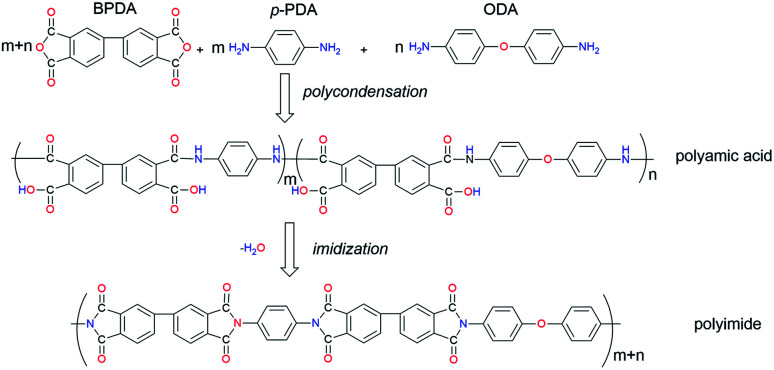
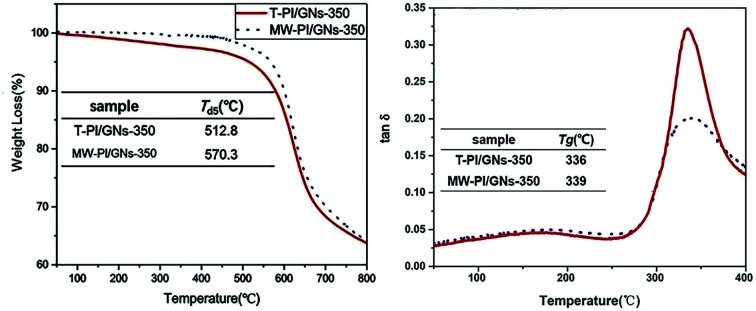
Here, a rapid and efficient strategy was introduced to prepare polyimide/graphene nanosheet (PI/GN) composite fibers by microwave-assisted imidization. The mechanical properties of the PI/GNs (1 wt%) fibers treated by microwave-assisted imidization were apparently improved with the tensile strength of 1.12 GPa at 350 °C, which was approximately 1.7 times as much as those treated with traditional thermal imidization. The PI/GNs (1 wt%) fibers heated by the microwave-assisted imidization method exhibited excellent thermal stabilities of up to 570.3 °C in nitrogen for a 5% weight loss, and a glass transition temperature above 339 °C. The results of the infrared spectrum and thermal properties indicated that the microwave-assisted treatment could promote the imidization degree of the PI/GN fibers prominently. Meanwhile, as a microwave absorber, graphene nanosheets (GNs) could also promote the imidization process by converting microwave energy into thermal energy. The microwave-polyimide/graphene nanosheet (MW-PI/GN) fibers possessed an optimum tensile strength of 1.38 GPa and modulus of 56.82 GPa at the GN content of 0.25 wt%. The 5% weight loss temperature in nitrogen ranged from 520.9 °C to 570.3 °C, and the glass transition temperature was increased from 305.7 °C to 339.1 °C with increasing the GN content.
在此,引入了一种快速有效的策略,通过微波辅助亚胺化来制备聚酰亚胺/石墨烯纳米片(PI/GN)复合纤维。经微波辅助亚胺化处理的PI/GNs(1 wt%)纤维的力学性能明显提高,在350℃时的拉伸强度为1.12 GPa,约为传统热亚胺化处理纤维的1.7倍。采用微波辅助亚胺化方法加热的PI/GNs(1 wt%)纤维在氮气中表现出优异的热稳定性,5%失重温度高达570.3℃,玻璃化转变温度高于339℃。红外光谱和热性能结果表明,微波辅助处理可显著提高PI/GN纤维的亚胺化程度。同时,作为微波吸收剂,石墨烯纳米片(GNs)还可通过将微波能量转化为热能来促进亚胺化过程。在GN含量为0.25 wt%时,微波-聚酰亚胺/石墨烯纳米片(MW-PI/GN)纤维的最佳拉伸强度为1.38 GPa,模量为56.82 GPa。在氮气中5%失重温度范围为520.9℃至570.3℃,随着GN含量的增加,玻璃化转变温度从305.7℃升高到339.1℃。