Wu Anette, Choi Edward, Diderich Mariette, Shamim Abrar, Rahhal Zacharie, Mitchell Madeleine, Leask Betty, DeWit Hans
Departments of Medicine, Pathology and Cell Biology, Vagelos College of Physicians and Surgeons, Columbia University, 650 W 168th St, New York, NY 10032 USA.
Underwood International College, Yonsei University, Seoul, Republic of Korea.
Med Sci Educ. 2022 Apr 27;32(3):733-745. doi: 10.1007/s40670-022-01553-6. eCollection 2022 Jun.
The COVID-19 pandemic has demonstrated the importance for medical professionals to engage in work transcending national borders and to deeply understand perspectives of health in other countries. Internationalization of medical education can play a key role to that end, by preparing culturally competent and globally conscious medical healthcare professionals.The aim of this scoping review is to identify current practices and formats in internationalization in medical education, which to date has received sparse academic attention. The need for this review is heightened amid COVID-19 where a clearer understanding of current internationalization efforts can inform more effective practice. We also explore if the motivations driving internationalization activities in medicine align with current practice and formats based on a framework of thematic categories found in the field of international higher education. In addition, we identify gaps in existing research.
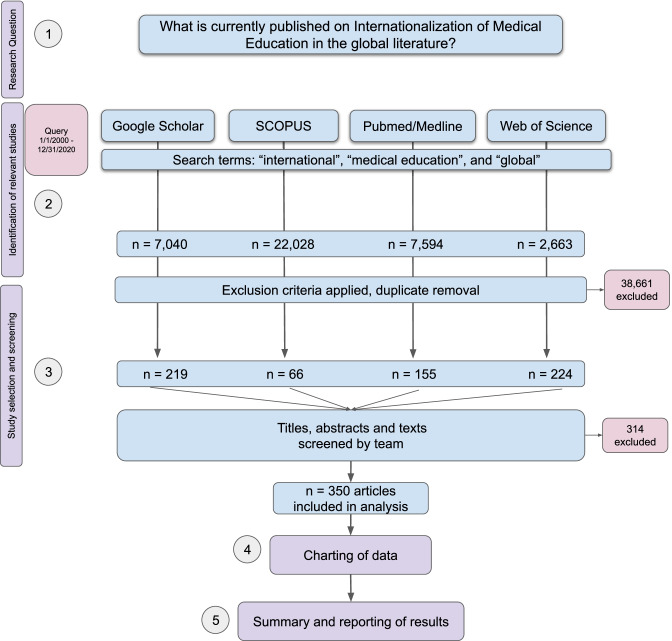
Using a scoping review, an international and interdisciplinary research team employed a comprehensive search strategy to identify publications on existing efforts in IoME, published from January 1, 2000, to December 31, 2020, in Scopus, PubMed/Medline, Google Scholar, and Web of Science. Inclusion/exclusion criteria were applied to identify relevant data from publication titles, abstracts, and main texts, which were subsequently summarized. Coding schemes were developed based on models for comprehensive internationalization in higher education.
350 articles met the inclusion criteria. Most articles originated from the high-income countries of the Global North and accounted for a literature base favoring perspectives and understandings that were typically representative of this region. Whereas motivations for internationalizing medical curricula in high-income countries were generally rooted in a model of social transformation/justice/health equity, drivers relating to competition and workforce preparation were common in the low- and middle-income countries.Importantly, the motivations driving internationalization activities generally did not align well with reported internationalization formats, which included student mobility, international curricula at home, and global partnerships. There was a disconnect between what medical curricula/professionals hope to accomplish and the reality of practice on the ground.
There is a need for a common definition of internationalization of medical education and a more balanced and unbiased literature base, capturing the full spectrum of internationalization activities existing in both the Global North and South. International partnership frameworks need to equally benefit institutions of both the Global North and Global South. Currently, institutions in the low- and middle-income countries generally cater to the needs and interests of their high-income counterparts. There are concerns about student mobility from high-income countries to low- and middle-income countries. Finally, medical education should be more inclusive and all medical students should gain access to international perspectives and experiences.
The online version contains supplementary material available at 10.1007/s40670-022-01553-6.
新冠疫情凸显了医学专业人员开展跨国界工作以及深入理解其他国家健康观念的重要性。医学教育国际化能够培养具有文化胜任力和全球意识的医疗保健专业人员,从而在这方面发挥关键作用。本综述的目的是确定医学教育国际化的当前实践和形式,而这一领域迄今为止在学术上受到的关注较少。在新冠疫情期间,对这一综述的需求更加迫切,因为更清晰地了解当前的国际化努力有助于形成更有效的实践。我们还基于国际高等教育领域的主题类别框架,探讨推动医学国际化活动的动机是否与当前的实践和形式相一致。此外,我们还找出了现有研究中的空白。
一个国际跨学科研究团队采用综述方法,运用全面的检索策略,在Scopus、PubMed/Medline、谷歌学术和科学网中查找2000年1月1日至2020年12月31日期间发表的关于医学教育国际化现有努力的文献。通过纳入/排除标准,从文献标题、摘要和正文识别相关数据,并随后进行总结。基于高等教育全面国际化模型制定编码方案。
350篇文章符合纳入标准。大多数文章来自全球北方的高收入国家,形成了一个偏向该地区典型观点和理解的文献库。高收入国家医学课程国际化的动机通常源于社会转型/正义/健康公平模式,而低收入和中等收入国家与竞争和劳动力培养相关的驱动因素较为常见。重要的是,推动国际化活动的动机通常与所报告的国际化形式不太一致,这些形式包括学生流动、国内国际课程以及全球伙伴关系。医学课程/专业人员希望实现的目标与实际的实践情况之间存在脱节。
需要对医学教育国际化有一个共同的定义,以及一个更平衡、无偏见的文献库,涵盖全球北方和南方存在的所有国际化活动。国际伙伴关系框架需要使全球北方和南方的机构都能平等受益。目前,低收入和中等收入国家的机构通常迎合高收入国家同行的需求和利益。人们对高收入国家学生流向低收入和中等收入国家存在担忧。最后,医学教育应更具包容性,所有医学生都应能接触到国际观点和经验。
在线版本包含可在10.1007/s40670-022-01553-6获取的补充材料。
