Wang Xuanbing, Xu Ruidong, Feng Suyang, Yu Bohao, Chen Buming
State Key Laboratory of Complex Nonferrous Metal Resources Clean Utilization, Kunming University of Science and Technology Kunming 650093 China
Faculty of Metallurgical and Energy Engineering, Kunming University of Science and Technology Kunming 650093 China.
RSC Adv. 2020 Jan 7;10(3):1351-1360. doi: 10.1039/c9ra08032e.
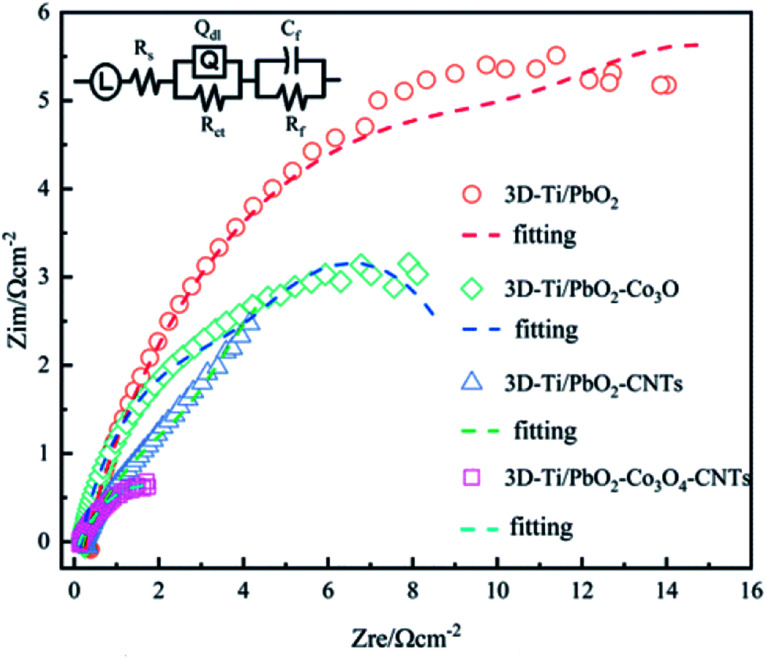
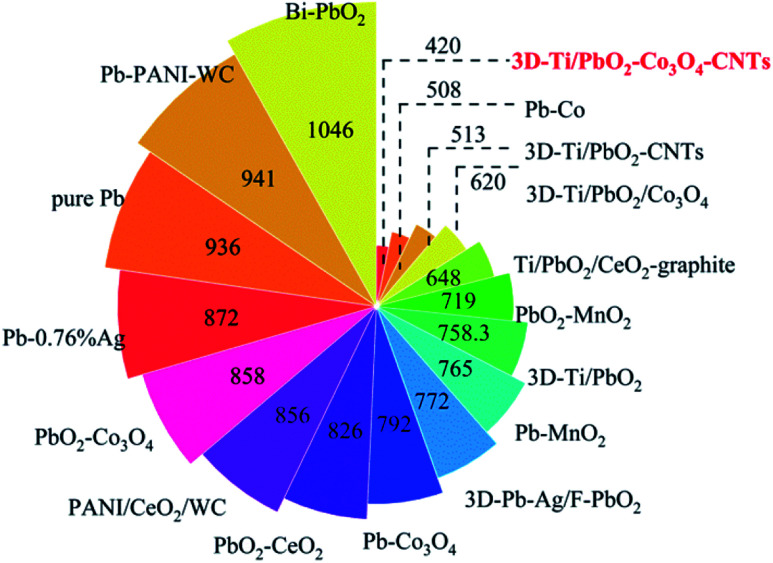
The high energy consumption during zinc electrowinning is mainly caused by the high overpotential of the oxygen evolution for Pb-Ag alloys with strong polarization. The preparation of new active energy-saving materials has become a very active research field, depending on the synergistic effects of active particles and active oxides. In this research, a composite material, α(β)-PbO, doped with CoO and CNTs on the porous Ti substrate was prepared one-step electrochemical deposition and the corresponding electrochemical performance was investigated in simulated zinc electrowinning solution. The composite material showed a porous structure, finer grain size and larger electrochemical surface area (ECSA), which indicated excellent electrocatalytic activity. Compared with the Pb-0.76 wt% Ag alloy, the overpotential of oxygen evolution for the 3D-Ti/PbO/CoO-CNTs composite material was decreased by about 452 mV under the current density of 500 A m in the simulated zinc electrowinning solution. The decrease in the overpotential of oxygen evolution was mainly ascribed to the higher ECSA and lower charger transfer resistance. Moreover, it showed the lowest self-corrosion current density of 1.156 × 10 A cm and may be an ideal material for use in zinc electrowinning.
锌电积过程中的高能耗主要是由具有强极化作用的铅银合金析氧过电位高所致。基于活性颗粒与活性氧化物的协同效应,制备新型活性节能材料已成为一个非常活跃的研究领域。本研究通过一步电化学沉积法在多孔钛基底上制备了掺杂CoO和碳纳米管的复合材料α(β)-PbO,并在模拟锌电积溶液中研究了其相应的电化学性能。该复合材料呈现出多孔结构、更细的晶粒尺寸和更大的电化学表面积(ECSA),这表明其具有优异的电催化活性。在模拟锌电积溶液中,在500 A/m²的电流密度下,与Pb-0.76 wt% Ag合金相比,3D-Ti/PbO/CoO-CNTs复合材料的析氧过电位降低了约452 mV。析氧过电位的降低主要归因于更高的ECSA和更低的电荷转移电阻。此外,它的自腐蚀电流密度最低,为1.156×10⁻⁶ A/cm²,可能是锌电积中理想的使用材料。