Kadnur Harshith B, Aggarwal Anivita, Soneja Manish, Singh Komal, Mittal Ankit, Nischal Neeraj, Tirlangi Praveen, Khan Adil Rashid, Desai Devashish, Gupta Ankesh, Kumar Arvind, Jorwal Pankaj, Biswas Ashutosh, Pandey Ravindra Mohan, Wig Naveet, Guleria Randeep
Department of Medicine, All India Institute of Medical Sciences, New Delhi, India.
Department of Biostatistics, All India Institute of Medical Sciences, New Delhi, India.
J Family Med Prim Care. 2022 Mar;11(3):1140-1145. doi: 10.4103/jfmpc.jfmpc_1177_21. Epub 2022 Mar 10.
Hydroxychloroquine (HCQ) had generated considerable interest for coronavirus disease 2019 (COVID-19) prophylaxis. We conducted a prospective observational study at a tertiary care hospital in India, with dedicated COVID-19 care facilities.
Primary objective was incidence of adverse effects, secondary objective being efficacy in preventing COVID-19.
Healthcare workers were recruited and grouped based on voluntary HCQ prophylaxis as per national guidelines. Side effects in HCQ group were graded in accordance with national cancer institute-common terminology criteria for adverse events (NCI-CTCAE) version 5.0. At 3-7-week follow-up, groups were compared for COVID-19 exposure, symptoms development and severe acute respiratory syndrome coronavirus 2 (SARS-CoV-2) RT-PCR results.
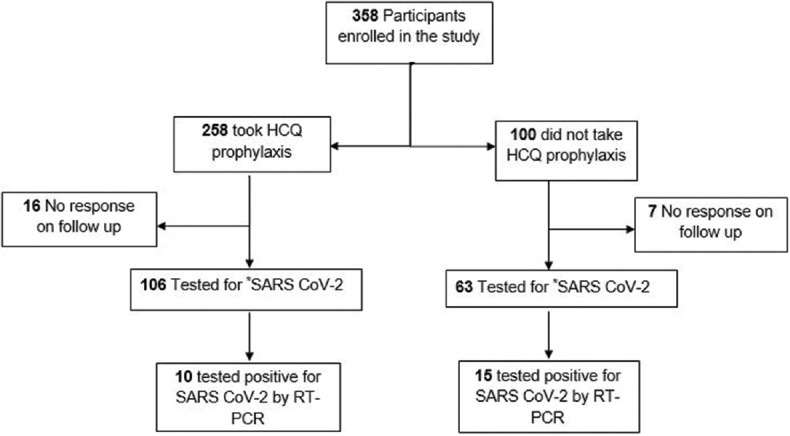
Among 358 participants recruited, 216 (60.3%) were males and mean age was 31.2 ± 6.6 years. Chemoprophylaxis was initiated by 258 (72%) participants. After loading dose, 7 (2.7%) reported grade 2 and 1 (0.4%) grade 3 adverse effects. Discontinuation of HCQ due to side effects was reported in 11 (4.3%) participants. Electrocardiogram was done by 50 (19.4%) participants on HCQ; no abnormalities were noted. A total of 106 (41%) among those taking and 63 (63%) among those not taking HCQ were tested for SARS-CoV-2 due to influenza-like illness or significant exposure. Among all participants, 25 (6.9%, 95% confidence interval [CI] 4.3-9.6) developed COVID-19 during the study period. In the group taking HCQ, 10 (3.9%) tested positive compared to 15 (15%) in the group not taking HCQ ( < 0.001). Odds ratio with HCQ intake was 0.34 (95% CI 0.13-0.83, = 0.01) and the number needed to treat was 12.
HCQ is safe at the recommended dose for pre-exposure prophylaxis of COVID-19.
羟氯喹(HCQ)已引起人们对2019冠状病毒病(COVID-19)预防的极大关注。我们在印度一家拥有专门COVID-19护理设施的三级护理医院进行了一项前瞻性观察研究。
主要目标是不良反应的发生率,次要目标是预防COVID-19的疗效。
根据国家指南,招募医护人员并根据自愿进行的HCQ预防进行分组。HCQ组的副作用按照国家癌症研究所不良事件通用术语标准(NCI-CTCAE)第5.0版进行分级。在3至7周的随访中,比较各组的COVID-19暴露情况、症状发展以及严重急性呼吸综合征冠状病毒2(SARS-CoV-2)逆转录聚合酶链反应(RT-PCR)结果。
在招募的358名参与者中,216名(60.3%)为男性,平均年龄为31.2±6.6岁。258名(72%)参与者开始进行化学预防。在负荷剂量后,7名(2.7%)报告有2级不良反应,1名(0.4%)报告有3级不良反应。11名(4.3%)参与者因副作用而停用HCQ。50名(19.4%)服用HCQ的参与者进行了心电图检查;未发现异常。因流感样疾病或密切接触,服用HCQ的参与者中有106名(41%)、未服用HCQ的参与者中有63名(63%)接受了SARS-CoV-2检测。在所有参与者中,25名(6.9%,95%置信区间[CI]4.3 - 9.6)在研究期间感染了COVID-19。在服用HCQ的组中,10名(3.9%)检测呈阳性,而未服用HCQ的组中有15名(15%)检测呈阳性(P<0.001)。服用HCQ的比值比为0.34(95%CI 0.13 - 0.83,P = 0.01),所需治疗人数为12。
对于COVID-19暴露前预防,HCQ在推荐剂量下是安全的。