Lee Tae-Hyung, Han Gi-Yeon, Yi Mo-Beom, Shin Jae-Ho, Kim Hyun-Joong
Laboratory of Adhesion and Bio-Composites, Program in Environmental Materials Science, Department of Agriculture, Forestry and Bioresources, Seoul National University 1 Gwanak-ro, Gwanak-gu Seoul 08826 Republic of Korea
Research Institute of Agriculture and Life Sciences, Seoul National University 1 Gwanak-ro, Gwanak-gu Seoul 08826 Republic of Korea.
RSC Adv. 2021 Nov 22;11(59):37392-37402. doi: 10.1039/d1ra06596c. eCollection 2021 Nov 17.
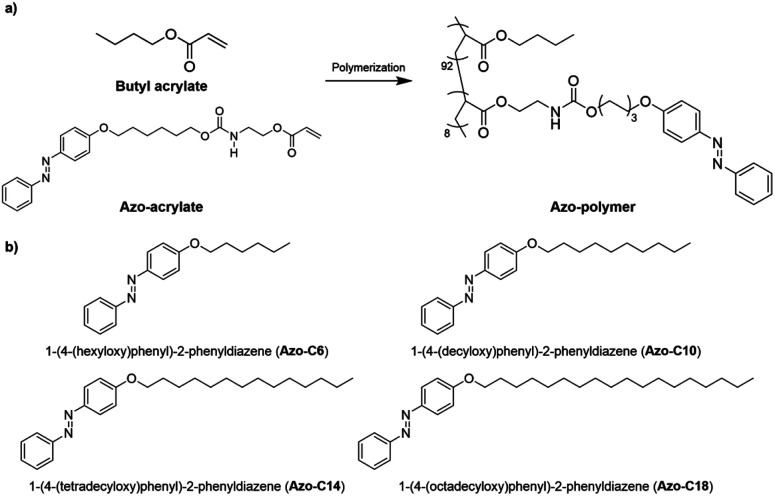
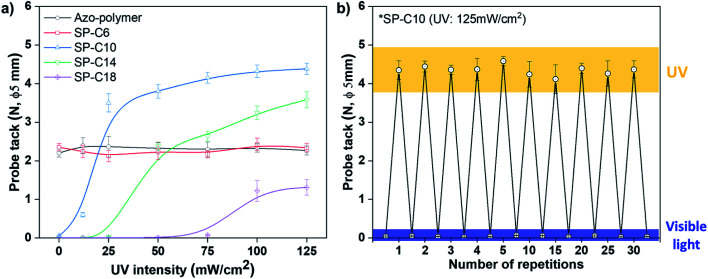
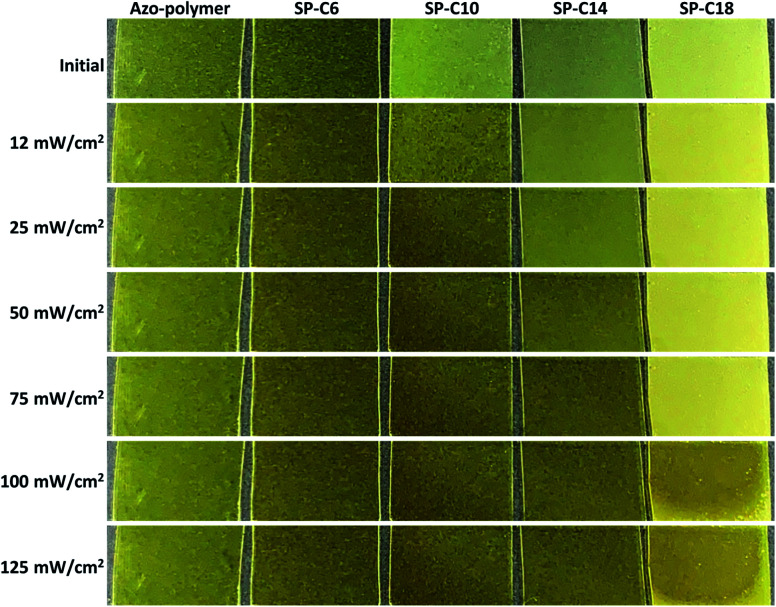
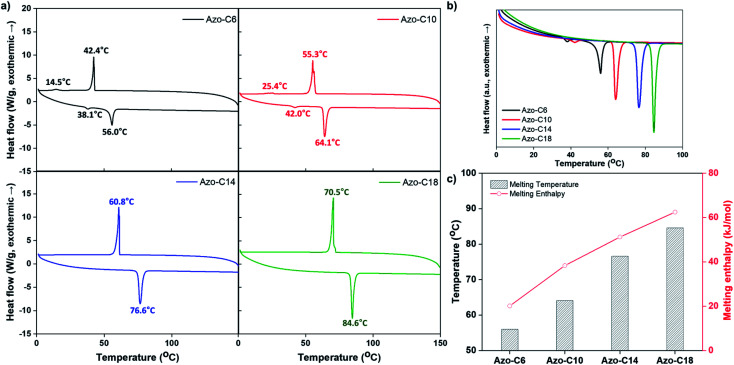
Unlike traditional adhesives with a fixed adhesive force, switchable adhesives, which have an adhesive force that can be adjusted by external stimuli, are specifically designed to be released according to user demand, or to enable the transfer of fine electronic devices. Previously developed switchable adhesives have limitations such as a slow switching rate, narrow adhesion modulation range, or the lack of reusability. Thus, we fabricated switchable pressure-sensitive adhesives (PSAs) that can overcome these limitations. The adhesive force of each switchable PSA, which comprises an azobenzene-containing acrylic polymer and low molecular weight compounds, was designed to be activated/deactivated ultraviolet (UV) and visible light irradiation. The adhesive force and UV intensity required for the switch were found to be dependent on the aliphatic chain length of the compound. The adhesive force of the SP-C10, , a switchable PSA containing a azobenzene compound with an aliphatic chain of 10 hydrocarbons, increased to 3.5 N from nearly zero in response to only 30 s of low-level (25 mW cm) UV irradiation. Additionally, SP-C10 did not lose its adhesive force even after 30 cycles of repeated adhesion switching. The mechanism of adhesion switching influenced by UV intensity and the structure of low molecular weight azobenzene compounds are also reported.
与具有固定粘合力的传统粘合剂不同,可切换粘合剂的粘合力可通过外部刺激进行调节,其专门设计用于根据用户需求释放,或实现精细电子设备的转移。先前开发的可切换粘合剂存在诸如切换速率慢、粘附调制范围窄或缺乏可重复使用性等局限性。因此,我们制备了能够克服这些局限性的可切换压敏粘合剂(PSA)。每种可切换PSA由含偶氮苯的丙烯酸聚合物和低分子量化合物组成,其粘合力设计为通过紫外线(UV)和可见光照射来激活/失活。发现切换所需的粘合力和紫外线强度取决于化合物的脂肪族链长度。SP-C10是一种可切换PSA,含有脂肪族链为10个碳氢化合物的偶氮苯化合物,仅经过30秒的低强度(25 mW/cm²)紫外线照射,其粘合力就从几乎为零增加到3.5 N。此外,即使经过30次重复的粘附切换循环,SP-C10也不会失去其粘合力。还报道了受紫外线强度和低分子量偶氮苯化合物结构影响的粘附切换机制。