Jing Guifang, Yu Fang, Xue Huandong
Department of Dermatology, Affiliated Hospital of Chifeng University, Chifeng, Inner Mongolia Autonomous Region 024005, P.R. China.
Oncol Lett. 2022 Jun;23(6):170. doi: 10.3892/ol.2022.13290. Epub 2022 Apr 13.
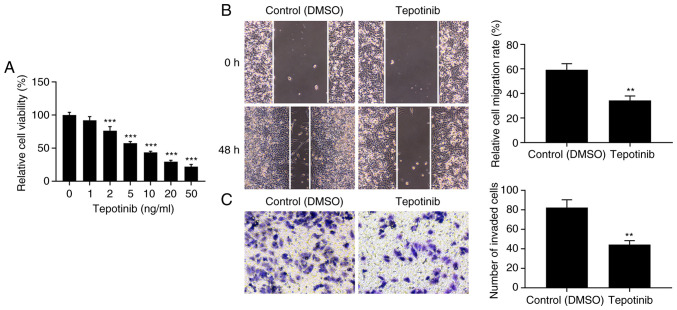
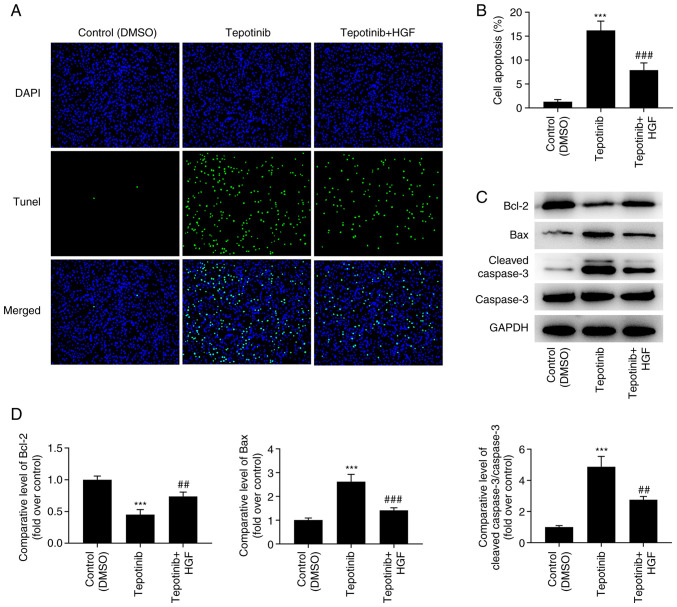
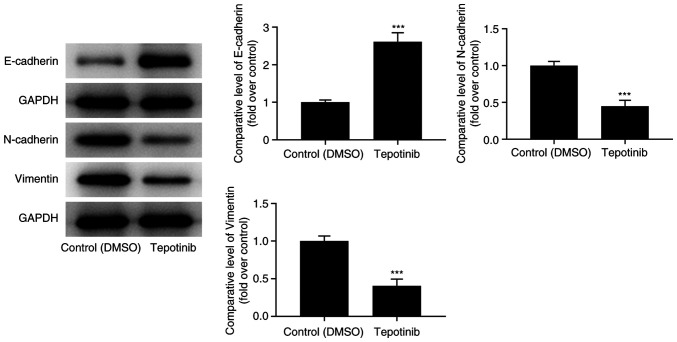
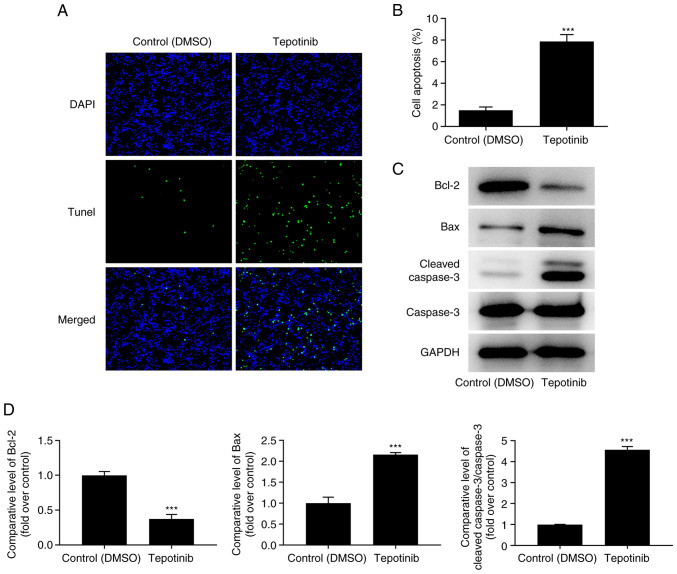
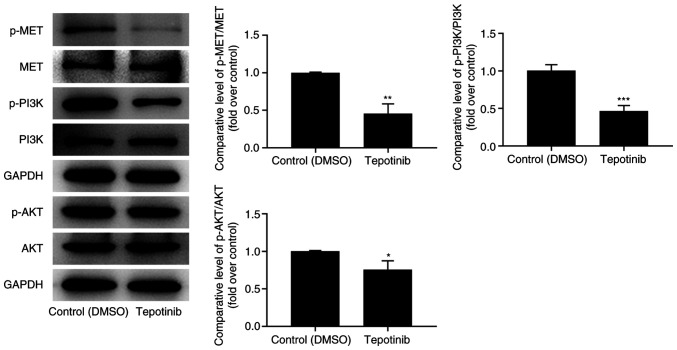
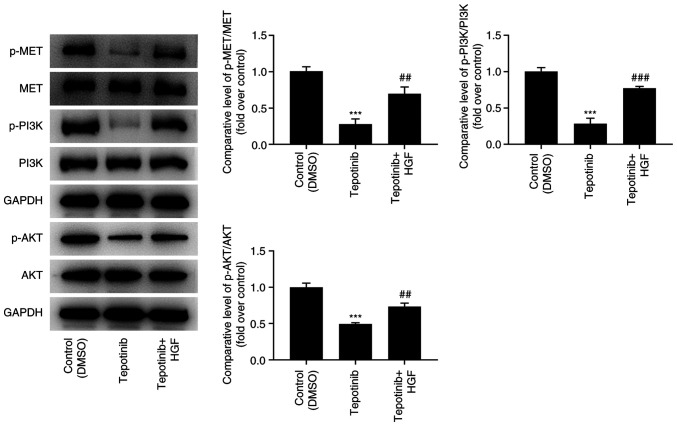
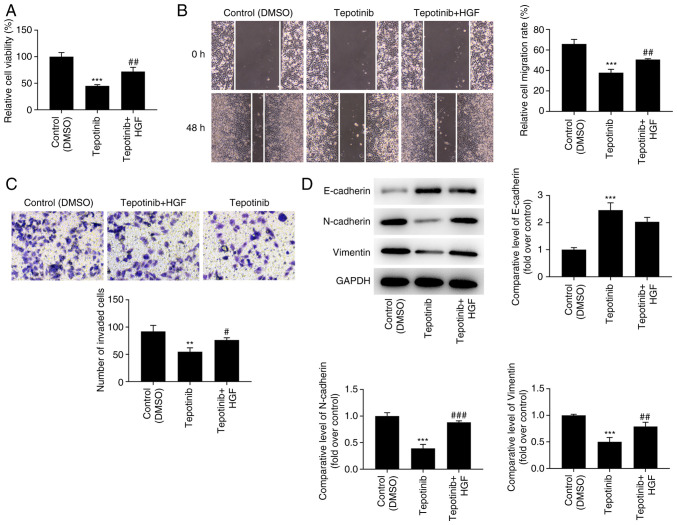
Malignant melanoma seriously threatens public health and lowers the quality of life of the affected subjects. The present study was designed to explore the effects of tepotinib, a selective tyrosine kinase inhibitor of MET proto-oncogene, receptor tyrosine kinase (MET), on the progression of melanoma. Firstly, MTT assays were used to detect the proliferation of tepotinib-treated WM451 cells. The cell invasive and migratory activities were assessed using Transwell and wound healing assays, respectively. In addition, TUNEL staining was employed to determine cell apoptosis. Western blot analysis was utilized for the evaluation of the expression levels of apoptotic and epithelial-mesenchymal transition-related proteins, as well as of proteins involved in the PI3K/AKT signaling pathway. Subsequently, hepatocyte growth factor (HGF), a natural agonist of MET, was administered to WM451 cells to unravel the detailed mechanism of action of tepotinib in melanoma. The results indicated that the proliferation of WM451 cells was significantly decreased by tepotinib treatment. The inhibitory effects of tepotinib on the proliferation of WM451 cells occurred in a concentration-dependent manner. In addition, the migratory and invasive activities of WM451 cells were significantly suppressed following tepotinib treatment. It was also shown that tepotinib exhibited promotive effects on the induction of apoptosis of WM451 cells. Moreover, activation of MET and PI3K/AKT signaling pathways may be blocked by tepotinib treatment, whereas addition of HGF to the cells reversed the effects of tepotinib treatment on the malignant progression of WM451 cells. In conclusion, the data demonstrated that tepotinib suppressed the proliferation, invasion and migration of melanoma cells, whereas it could also induce their apoptosis. This evidence may provide a new perspective for the improvement of malignant melanoma.
恶性黑色素瘤严重威胁公众健康,降低患者的生活质量。本研究旨在探讨选择性MET原癌基因受体酪氨酸激酶(MET)酪氨酸激酶抑制剂替泊替尼对黑色素瘤进展的影响。首先,采用MTT法检测替泊替尼处理的WM451细胞的增殖情况。分别使用Transwell实验和划痕实验评估细胞的侵袭和迁移活性。此外,采用TUNEL染色法检测细胞凋亡情况。利用蛋白质免疫印迹分析评估凋亡相关蛋白、上皮-间质转化相关蛋白以及PI3K/AKT信号通路相关蛋白的表达水平。随后,将MET的天然激动剂肝细胞生长因子(HGF)作用于WM451细胞,以阐明替泊替尼在黑色素瘤中的详细作用机制。结果表明,替泊替尼处理显著降低了WM451细胞的增殖。替泊替尼对WM451细胞增殖的抑制作用呈浓度依赖性。此外,替泊替尼处理后,WM451细胞的迁移和侵袭活性受到显著抑制。研究还表明,替泊替尼对WM451细胞凋亡具有促进作用。此外,替泊替尼处理可能会阻断MET和PI3K/AKT信号通路的激活,而向细胞中添加HGF可逆转替泊替尼处理对WM451细胞恶性进展的影响。总之,数据表明替泊替尼可抑制黑色素瘤细胞的增殖、侵袭和迁移,还可诱导其凋亡。这一证据可能为改善恶性黑色素瘤提供新的视角。