Wouters Femke, Gruwez Henri, Vranken Julie, Vanhaen Dimitri, Daelman Bo, Ernon Ludovic, Mesotten Dieter, Vandervoort Pieter, Verhaert David
Limburg Clinical Research Center/Mobile Health Unit, Faculty of Medicine and Life Sciences, Hasselt University, Hasselt, Belgium.
Department Future Health, Ziekenhuis Oost-Limburg, Genk, Belgium.
Front Cardiovasc Med. 2022 Apr 13;9:848914. doi: 10.3389/fcvm.2022.848914. eCollection 2022.
This paper presents the preliminary results from the ongoing REMOTE trial. It aims to explore the opportunities and hurdles of using insertable cardiac monitors (ICMs) and photoplethysmography-based mobile health (PPG-based mHealth) using a smartphone or smartwatch to detect atrial fibrillation (AF) in cryptogenic stroke and transient ischemic attack (TIA) patients.
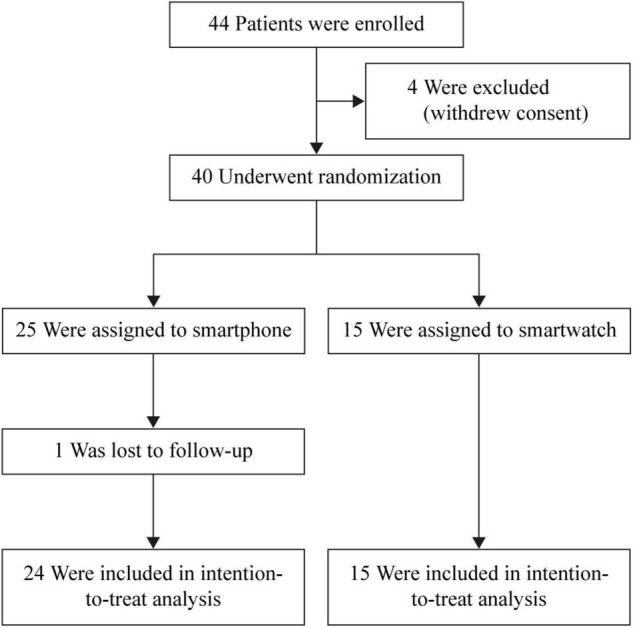
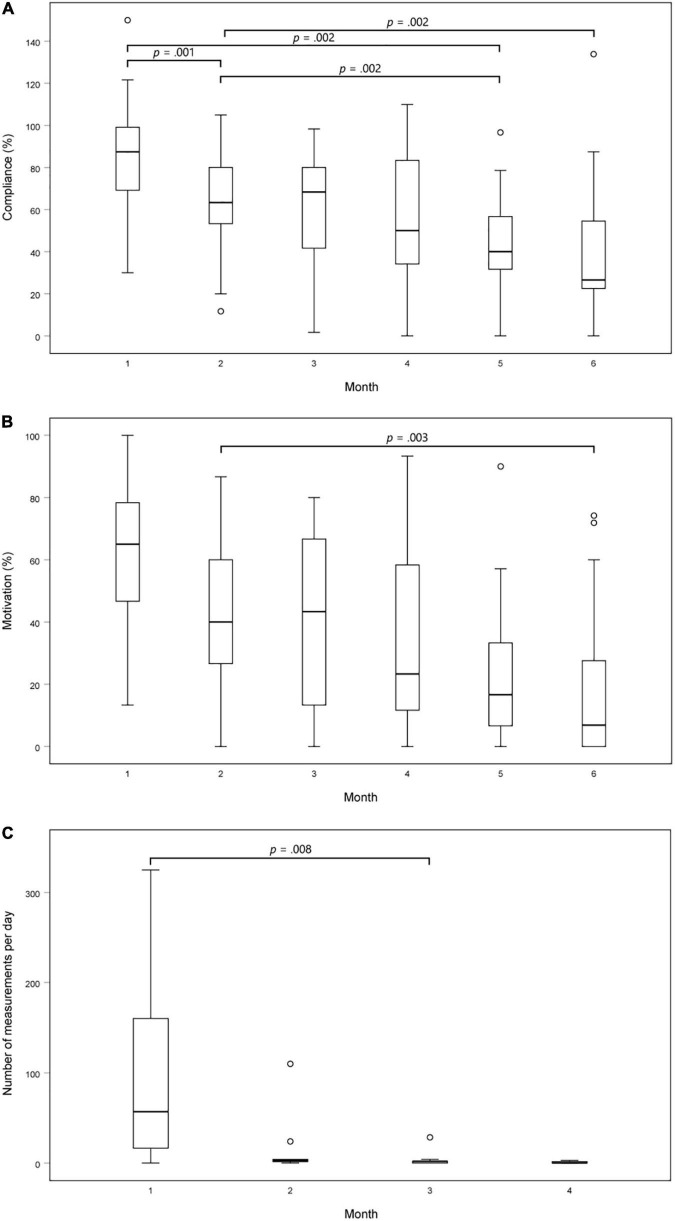
Cryptogenic stroke or TIA patients ( = 39) received an ICM to search for AF and were asked to use a blinded PPG-based mHealth application for 6 months simultaneously. They were randomized to smartphone or smartwatch monitoring. In total, 68,748 1-min recordings were performed using PPG-based mHealth. The number of mHealth recordings decreased significantly over time in both smartphone and smartwatch groups ( < 0.001 and = 0.002, respectively). Insufficient signal quality was more frequently observed in smartwatch (43.3%) compared to smartphone recordings (17.8%, < 0.001). However, when looking at the labeling of the mHealth recordings on a patient level, there was no significant difference in signal quality between both groups. Moreover, the use of a smartwatch resulted in significantly more 12-h periods (91.4%) that were clinically useful compared to smartphone users (84.8%) as they had at least one recording of sufficient signal quality. Simultaneously, continuous data was collected from the ICMs, resulting in approximately 6,660,000 min of data (i.e., almost a 100-fold increase compared to mHealth). The ICM algorithm detected AF and other cardiac arrhythmias in 10 and 19 patients, respectively. However, these were only confirmed after adjudication by the remote monitoring team in 1 (10%) and 5 (26.3%) patients, respectively. The confirmed AF was also detected by PPG-based mHealth.
Based on the preliminary observations, our paper illustrates the potential as well as the limitations of PPG-based mHealth and ICMs to detect AF in cryptogenic stroke and TIA patients in four elements: (i) mHealth was able to detect AF in a patient in which AF was confirmed on the ICM; (ii) Even state-of-the-art ICMs yielded many false-positive AF registrations; (iii) Both mHealth and ICM still require physician revision; and (iv) Blinding of the mHealth results impairs compliance and motivation.
本文展示了正在进行的REMOTE试验的初步结果。该试验旨在探索使用植入式心脏监测器(ICM)以及基于光电容积脉搏波描记法的移动健康技术(基于PPG的移动健康技术),通过智能手机或智能手表来检测隐源性卒中及短暂性脑缺血发作(TIA)患者心房颤动(AF)的机会与障碍。
隐源性卒中或TIA患者(n = 39)接受了ICM以筛查AF,并被要求同时使用一款盲法的基于PPG的移动健康应用程序,为期6个月。他们被随机分配至智能手机或智能手表监测组。总共使用基于PPG的移动健康技术进行了68748次1分钟记录。在智能手机组和智能手表组中,移动健康记录的数量均随时间显著减少(分别为P < 0.001和P = 0.002)。与智能手机记录(17.8%)相比,智能手表记录中信号质量不足的情况更频繁出现(43.3%,P < 0.001)。然而,从患者层面查看移动健康记录的标注时,两组之间的信号质量并无显著差异。此外,与智能手机用户(84.8%)相比,使用智能手表产生的具有临床意义的12小时时段显著更多(91.4%),因为智能手表用户至少有一次信号质量足够的记录。同时,从ICM收集了连续数据,产生了约6660000分钟的数据(即与移动健康技术相比增加了近100倍)。ICM算法分别在10例和19例患者中检测到AF和其他心律失常。然而,这些仅在远程监测团队判定后,分别在1例(10%)和5例(26.3%)患者中得到确认。基于PPG的移动健康技术也检测到了确诊的AF。
基于初步观察结果,本文从四个方面阐述了基于PPG的移动健康技术和ICM在检测隐源性卒中和TIA患者AF方面的潜力及局限性:(i)移动健康技术能够在ICM确诊AF的患者中检测到AF;(ii)即使是最先进的ICM也产生了许多AF假阳性记录;(iii)移动健康技术和ICM仍都需要医生审核;(iv)移动健康技术结果的盲法会损害依从性和积极性。