Schmidt Amand F, Haitjema Saskia, Sartipy Ulrik, Holzmann Martin J, Malenka David J, Ross Cathy S, van Gilst Wiek, Rouleau Jean L, Meeder Annelijn M, Baker Robert A, Shiomi Hiroki, Kimura Takeshi, Tran Lavinia, Smith Julian A, Reid Christopher M, Asselbergs Folkert W, den Ruijter Hester M
Department of Cardiology, Division Heart and Lungs, University Medical Center Utrecht, Utrecht, Netherlands.
Institute of Cardiovascular Science, Faculty of Population Health, University College London, London, United Kingdom.
Front Cardiovasc Med. 2022 Apr 13;9:768972. doi: 10.3389/fcvm.2022.768972. eCollection 2022.
Women have a worse prognosis after coronary artery bypass grafting (CABG) surgery compared to men. We sought to quantify to what extent this difference in post-CABG survival could be attributed to sex itself, or whether this was mediated by difference between men and women at the time of intervention. Additionally, we explored to what extent these effects were homogenous across patient subgroups.
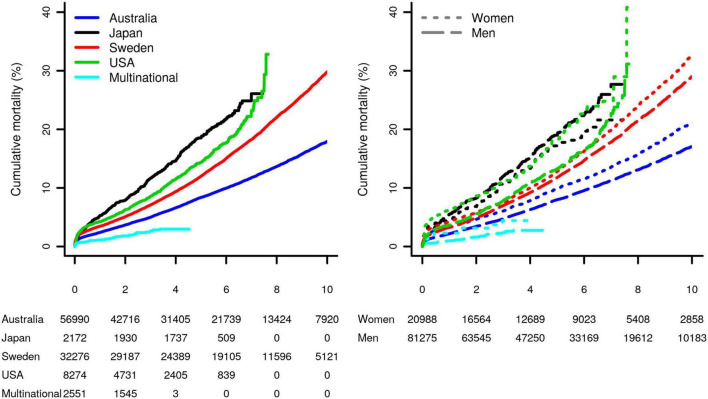
Time to all-cause mortality was available for 102,263 CABG patients, including 20,988 (21%) women, sourced through an individual participant data meta-analysis of five cohort studies. Difference between men and women in survival duration was assessed using Kaplan-Meier estimates, and Cox's proportional hazards model.
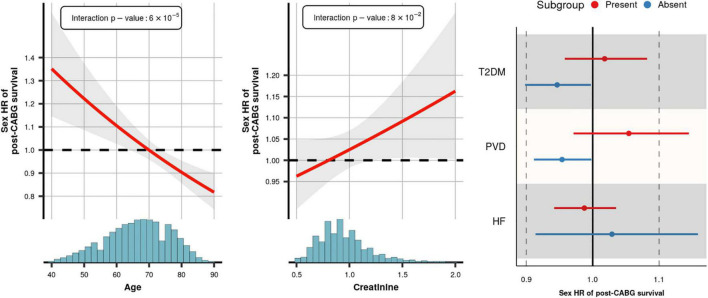
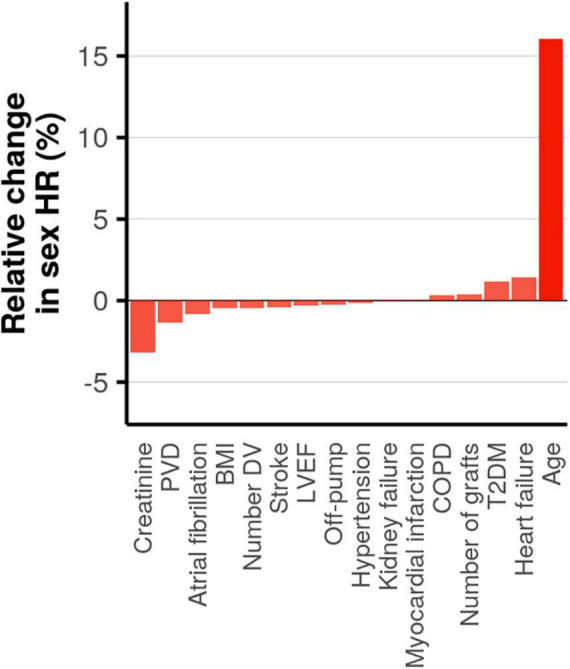
During a median follow-up of 5 years, 13,598 (13%) patients died, with women more likely to die than men: female HR 1.20 (95%CI 1.16; 1.25). We found that differences in patient characteristics at the time of CABG procedure mediated this sex effect, and accounting for these resulted in a neutral female HR 0.98 (95%CI 0.94; 1.02). Next we performed defined subgroup analyses of the five most prominent mediators: age, creatinine, peripheral vascular disease, type 2 diabetes, and heart failure. We found that women without peripheral vascular disease (PVD) or women aged 70+, survived longer than men (interaction -values 0.04 and 6 × 10, respectively), with an effect reversal in younger women.
Sex differences in post-CABG survival were readily explained by difference in patient characteristics and comorbidities. Pre-planned analyses revealed patient subgroups (aged 70+, or without PVD) of women that survived longer than men, and a subgroup of younger women with comparatively poorer survival.
与男性相比,女性冠状动脉旁路移植术(CABG)后的预后较差。我们试图量化CABG术后生存差异在多大程度上可归因于性别本身,或者这是否由干预时男女之间的差异所介导。此外,我们探讨了这些影响在患者亚组中在多大程度上是同质的。
通过对五项队列研究的个体参与者数据进行荟萃分析,获得了102263例CABG患者的全因死亡时间,其中包括20988例(21%)女性。使用Kaplan-Meier估计和Cox比例风险模型评估男女在生存时间上的差异。
在中位随访5年期间,13598例(13%)患者死亡,女性比男性更易死亡:女性风险比为1.20(95%置信区间1.16;1.25)。我们发现CABG手术时患者特征的差异介导了这种性别效应,考虑这些因素后女性风险比为中性的0.98(95%置信区间0.94;1.02)。接下来,我们对五个最突出的介导因素进行了定义亚组分析:年龄、肌酐、外周血管疾病、2型糖尿病和心力衰竭。我们发现没有外周血管疾病(PVD)的女性或70岁及以上的女性比男性存活时间更长(交互作用P值分别为0.04和6×10),而年轻女性的效应则相反。
CABG术后生存的性别差异很容易通过患者特征和合并症的差异来解释。预先计划的分析显示,女性患者亚组(70岁及以上或无PVD)的存活时间比男性长,而年轻女性亚组的存活情况相对较差。