Centre for Sustainable Ecosystem Solutions, School of Earth, Atmospheric and Life Sciences, University of Wollongong, Wollongong, NSW, Australia.
Faculty of Science, University of Technology Sydney, Ultimo, NSW, Australia.
Oecologia. 2022 May;199(1):181-191. doi: 10.1007/s00442-022-05175-y. Epub 2022 May 3.
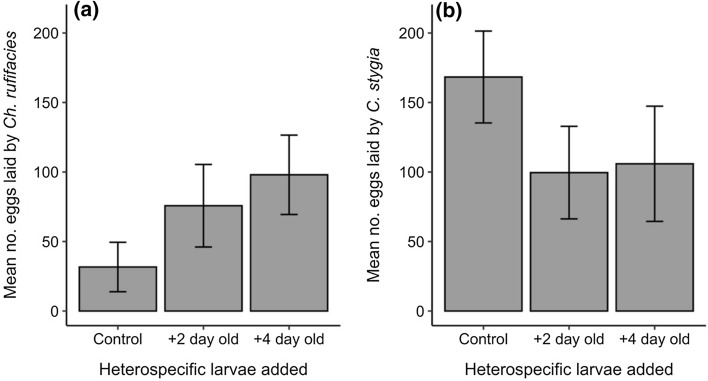
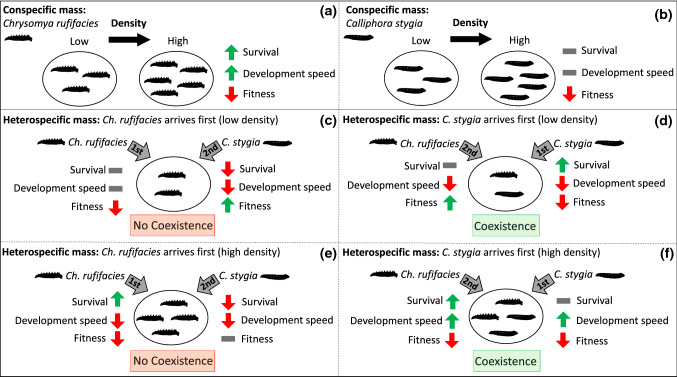
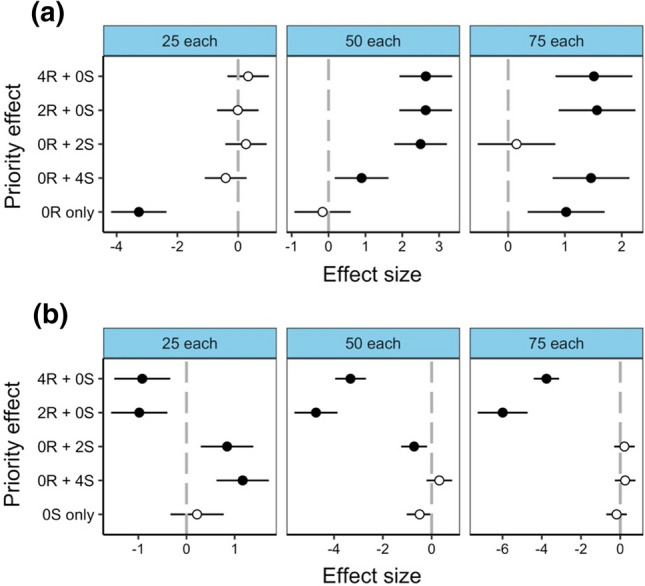
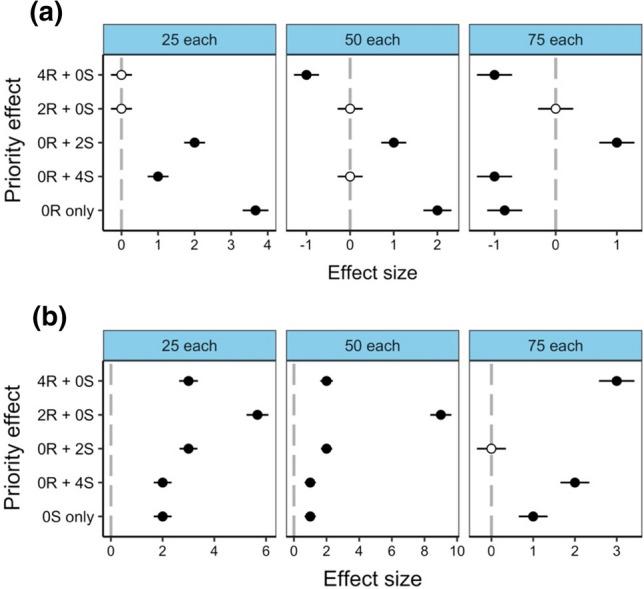
Highly competitive ephemeral resources like carrion tend to support much greater diversity relative to longer-lived resources. The coexistence of diverse communities on short-lived carrion is a delicate balance, maintained by several processes including competition. Despite this balance, few studies have investigated the effect of competition on carrion, limiting our understanding of how competition drives coexistence. We investigated how priority effects and larval density influence coexistence between two blowfly species, the facultative predator Chrysomya rufifacies and its competitor Calliphora stygia, which occupy broadly similar niches but differ in their ecological strategies for exploiting carrion. We examined how adult oviposition, larval survival, developmental duration, and adult fitness were affected by the presence of differently aged heterospecific larval masses, and how these measures varied under three larval densities. We found C. rufifacies larval survival was lowest in conspecific masses with low larval densities. In heterospecific masses, survival increased, particularly at high larval density, with priority effects having minimal effect, suggesting a dependency on collective exodigestion. For C. stygia, we found survival to be constant across larval densities in a conspecific mass. In heterospecific masses, survival decreased drastically when C. rufifacies arrived first, regardless of larval density, suggesting C. stygia is temporally constrained to avoid competition with C. rufifacies. Neither species appeared to completely outcompete the other, as they were either constrained by density requirements (C. rufifacies) or priority effects (C. stygia). Our results provide new mechanistic insights into the ecological processes allowing for coexistence on a competitively intense, ephemeral resource such as carrion.
高竞争力的短暂资源(如腐肉)往往比寿命更长的资源支持更大的多样性。短暂腐肉上多样化社区的共存是一种微妙的平衡,由包括竞争在内的几个过程维持。尽管存在这种平衡,但很少有研究调查竞争对腐肉的影响,限制了我们对竞争如何推动共存的理解。我们研究了优先效应和幼虫密度如何影响两种丽蝇物种的共存,即兼性捕食者 Chrysomya rufifacies 和其竞争者 Calliphora stygia,它们占据了广泛相似的生态位,但在利用腐肉的生态策略上存在差异。我们检查了成虫产卵、幼虫存活率、发育持续时间和成虫适应性如何受到不同年龄的同种和异种幼虫质量的影响,以及这些措施在三种幼虫密度下如何变化。我们发现 C. rufifacies 幼虫在低幼虫密度的同种幼虫质量中存活率最低。在异种幼虫质量中,存活率增加,尤其是在幼虫密度高的情况下,优先效应的影响最小,表明对集体外消化的依赖。对于 C. stygia,我们发现同种幼虫质量中,幼虫密度不变时,存活率不变。在异种幼虫质量中,无论幼虫密度如何,当 C. rufifacies 首先到达时,存活率急剧下降,这表明 C. stygia 在时间上受到限制,以避免与 C. rufifacies 竞争。由于密度要求(C. rufifacies)或优先效应(C. stygia),两种物种似乎都没有完全竞争过对方。我们的结果为理解允许在竞争激烈、短暂的资源(如腐肉)上共存的生态过程提供了新的机制见解。