Department of Midwifery, College of Health Sciences, Debretabor University, Debre Tabor, Ethiopia.
Nutrition officer, World Health Organization, Bahirdar, Ethiopia.
BMC Med Educ. 2022 May 1;22(1):334. doi: 10.1186/s12909-022-03397-5.
Problem based learning is being highly implemented in many medical schools worldwide due to its perceived advantages including improvement of problem-solving abilities, development of communication skills, creation and development of critical thinking skill, and making of individuals to be lifelong learners & responsible for their own learning process.
The study aimed to compare academic satisfaction of Problem and Lecture based learning of regular undergraduate health science students in Ethiopian Universities, 2021.
Institution based comparative cross sectional study was conducted from February 1-30, 2021. Data were collected using a pretested structured and self-administered questionnaire among 850 eligible students from two Universities. Data were entered into EPI info version 6.04 and analyzed using SPSS version 23. Binary Logistic regression model was fitted to identify factors associated with academic satisfaction considering the association to be significant p- value < 0.05.
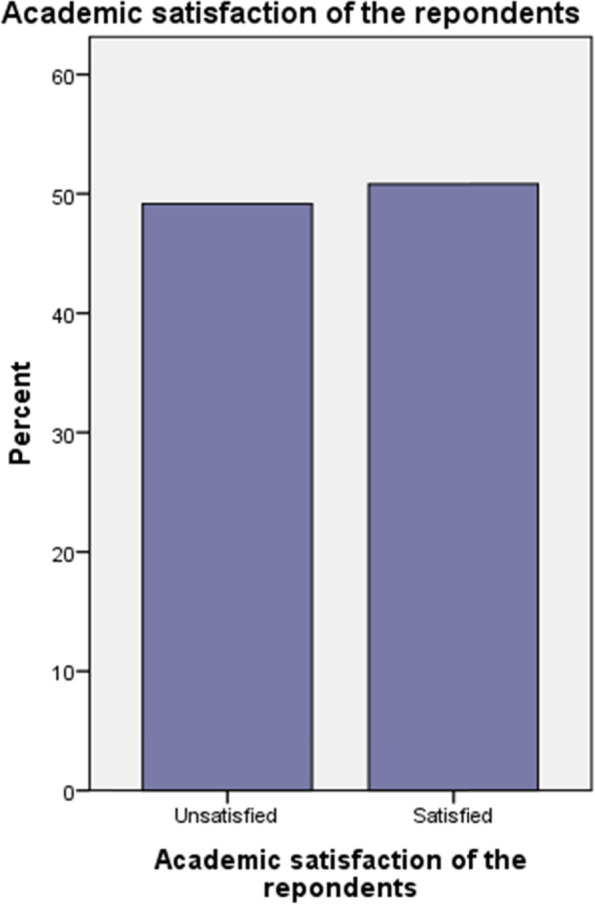
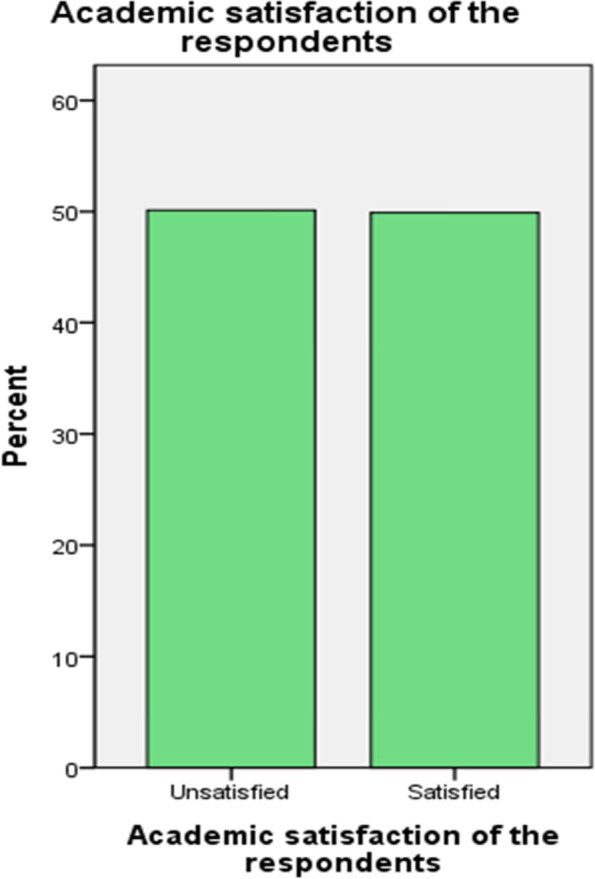
The study result revealed that the magnitude of academic satisfaction among problem based and lecture based learning students were 50.9 and 49.9% respectively. Similarly, problem based learning students were more likely to be academically satisfied than lecture based learning students in their type of curriculum with (AOR = 1.50, 95% CI = 1.02, 2.21). Experience of classroom distress (AOR = 1.93, 95% CI = 1.22, 3.06), quality of teaching (AOR = 0.54, 95% CI = 0.34, 0.86), relationship with classmates (AOR = 0.33, 95% CI = 0.13, 0.80), course content (AOR = 0.56, 95% CI = 0.33, 0.93) and accessibility of technology in the campus (AOR = 0.62, 95% CI = 0.40, 0.96) were the significant factors of academic satisfaction of problem based learning students. Year of study (AOR = 0.29, 95% CI = 0.17, 0.48), quality of teaching (AOR = 0.51, 95% CI = 0.31, 0.85), course content (AOR = 0.59, 95% CI = 0.35, 0.97) and energy & effort (AOR = 0.55, 95% CI = 0.35, 0.88) were significantly associated with academic satisfaction among lecture based learning students.
The study revealed that the academic satisfaction among problem based learning students was higher than lecture based learning students. Incorporating and implementing problem based learning as a formal instructional method in across the universities curriculum is recommended.
由于问题式学习被认为具有诸多优势,包括提高解决问题的能力、发展沟通技巧、培养批判性思维能力以及使个人成为终身学习者并对自己的学习过程负责,因此在全球许多医学院校中,问题式学习得到了广泛应用。
本研究旨在比较埃塞俄比亚大学常规本科健康科学专业学生在基于问题和基于讲座的学习中的学术满意度,时间为 2021 年。
本研究采用 2021 年 2 月 1 日至 30 日期间在两所大学进行的基于机构的比较性横断面研究。从符合条件的 850 名学生中使用经过预测试的结构化和自我管理问卷收集数据。数据录入 EPI info 版本 6.04 并使用 SPSS 版本 23 进行分析。采用二元逻辑回归模型来确定与学术满意度相关的因素,考虑到关联具有统计学意义(p 值 < 0.05)。
研究结果表明,基于问题和基于讲座的学习学生的学术满意度分别为 50.9%和 49.9%。同样,与基于讲座的学习学生相比,基于问题的学习学生在课程类型方面更有可能获得学术满意度(AOR=1.50,95%CI=1.02,2.21)。课堂困扰经历(AOR=1.93,95%CI=1.22,3.06)、教学质量(AOR=0.54,95%CI=0.34,0.86)、与同学的关系(AOR=0.33,95%CI=0.13,0.80)、课程内容(AOR=0.56,95%CI=0.33,0.93)和校园技术的可及性(AOR=0.62,95%CI=0.40,0.96)是基于问题的学习学生学术满意度的显著因素。学习年限(AOR=0.29,95%CI=0.17,0.48)、教学质量(AOR=0.51,95%CI=0.31,0.85)、课程内容(AOR=0.59,95%CI=0.35,0.97)和精力与努力(AOR=0.55,95%CI=0.35,0.88)与基于讲座的学习学生的学术满意度显著相关。
研究表明,基于问题的学习学生的学术满意度高于基于讲座的学习学生。建议在各大学的课程中纳入并实施基于问题的学习作为正式教学方法。