Wilson Melisa, Anguiano Rebekah H, Awdish Rana L A, Coons James C, Kimber Amy, Morrison Melissa, Paulus Sara, Schmit Ann, Spexarth Frank, Swetz Keith M, Verlinden Nathan J, Whittenhall Mary E, Sketch Margaret R, Broderick Meredith, Brewer Jacqueline
Advent Health Orlando Orlando Florida USA.
University of Illinois Hospital and Health Sciences System Chicago Illinois USA.
Pulm Circ. 2022 Jan 5;12(1):e12003. doi: 10.1002/pul2.12003. eCollection 2022 Jan.
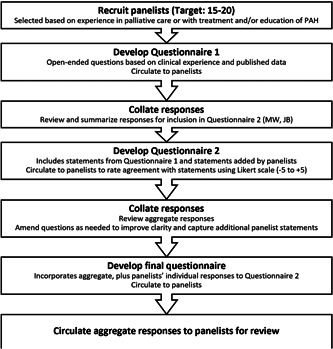
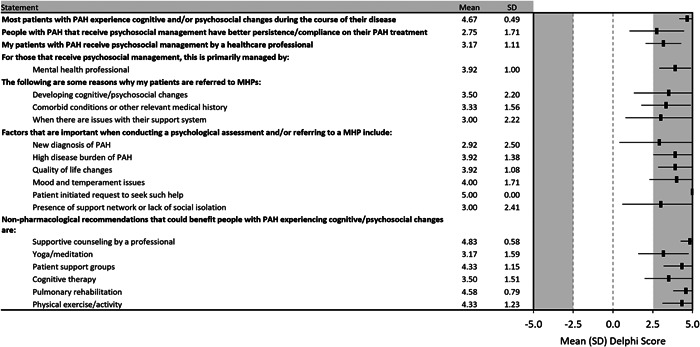
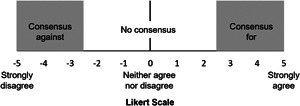
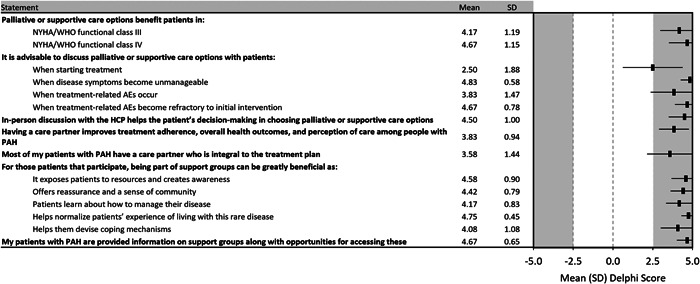
Mortality in pulmonary arterial hypertension (PAH) remains high and referral to palliative or supportive care (P/SC) specialist services is recommended when appropriate. However, access to P/SC is frequently a challenge for patients with a noncancer diagnosis and few patients living with PAH report P/SC involvement in their care. A modified Delphi process of three questionnaires completed by a multidisciplinary panel ( = 15) was used to develop expert consensus statements regarding the use of P/SC to support patients with PAH. Panelists rated their agreement with each statement on a Likert scale. There was a strong consensus that patients should be referred to P/SC when disease symptoms become unmanageable or for end-of-life care. Services that achieved consensus were pain management techniques, end-of-life care, and psychosocial recommendations. Palliative or supportive care should be discussed with patients, preferably in-person, when disease symptoms become unmanageable, when starting treatment, when treatment-related adverse events occur or become refractory to initial intervention. Care partners and patient support groups were considered important in improving a patient's overall health outcomes, treatment adherence, and perception of care. Most patients with PAH experience cognitive and/or psychosocial changes and those who receive psychosocial management have better persistence and/or compliance with their treatment. These consensus statements provide guidance to healthcare providers on the "who and when" of referral to palliative care services, as well as the importance of focusing on the psychosocial aspects of patient care and quality of life.
肺动脉高压(PAH)患者的死亡率仍然很高,建议在适当的时候转诊至姑息或支持性护理(P/SC)专科服务。然而,对于非癌症诊断的患者来说,获得P/SC服务常常是一项挑战,很少有PAH患者报告P/SC参与了他们的护理。一个多学科小组(n = 15)完成了三份问卷的改良德尔菲法流程,以制定关于使用P/SC来支持PAH患者的专家共识声明。小组成员用李克特量表对他们对每条声明的认同程度进行评分。对于在疾病症状变得难以控制或临终护理时应将患者转诊至P/SC这一点,存在强烈共识。达成共识的服务包括疼痛管理技术、临终护理和心理社会建议。当疾病症状变得难以控制、开始治疗、出现与治疗相关的不良事件或对初始干预变得难治时,应与患者讨论姑息或支持性护理,最好是面对面讨论。护理伙伴和患者支持小组被认为对改善患者的整体健康结果、治疗依从性和护理感知很重要。大多数PAH患者会经历认知和/或心理社会变化,而接受心理社会管理的患者在治疗方面具有更好的持续性和/或依从性。这些共识声明为医疗保健提供者提供了关于转诊至姑息护理服务的“对象和时机”的指导,以及关注患者护理的心理社会方面和生活质量的重要性。