Department of Radiation Oncology, Taussig Cancer Institute, Cleveland Clinic, Cleveland, Ohio, USA.
J Appl Clin Med Phys. 2022 Jul;23(7):e13629. doi: 10.1002/acm2.13629. Epub 2022 May 4.
PURPOSE/OBJECTIVES: To report our 7-year experience with a daily monitoring system to significantly reduce couch position overrides and errors in patient treatment positioning.
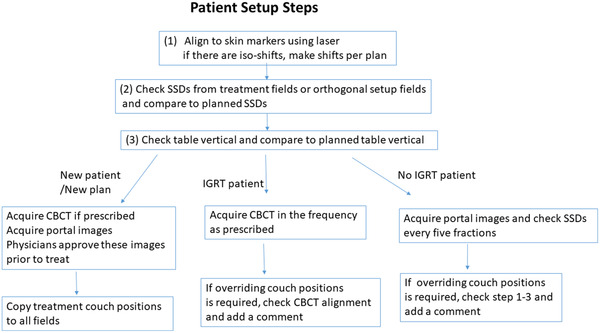
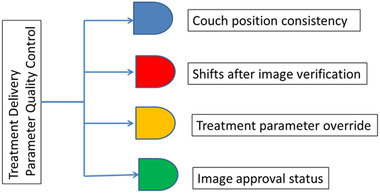
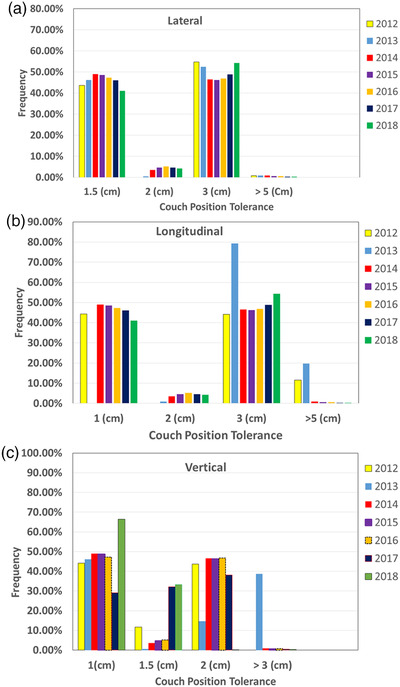
Treatment couch position override data were extracted from a radiation oncology-specific electronic medical record system from 2012 to 2018. During this period, we took several actions to reduce couch position overrides, including reducing the number of tolerance tables from 18 to 6, tightening tolerance limits, enforcing time outs, documenting reasons for overrides, and timely reviewing of overrides made from previous treatment day. The tolerance tables included treatment categories for head and neck (HN) (with/without cone beam CT [CBCT]), body (with/without CBCT), stereotactic body radiotherapy (SBRT), and clinical setup for electron beams. For the same time period, we also reported treatment positioning-related incidents that were recorded in our departmental incident report system. To verify our tolerance limits, we further examined couch shifts after daily kilovoltage CBCT (kV-CBCT) for the patients treated from 2018 to 2021.
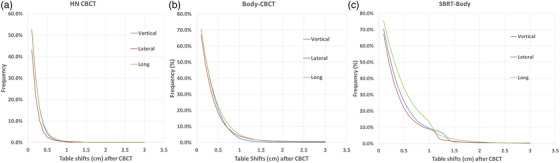
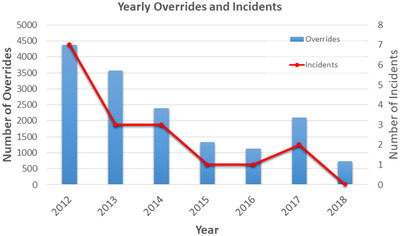
From 2012 to 2018, the override rate decreased from 11.2% to 1.6%/year, whereas the number of fractions treated in the department increased by 23%. The annual patient positioning error rate was also reduced from 0.019% in 2012, to 0.004% in 2017 and 0% in 2018. For patients treated under daily kV-CBCT guidance from 2018 to 2021, the applied couch shifts after imaging registration that exceeded the tolerance limits were low, <1% for HN, <1.2% for body, and <2.6% for SBRT.
The daily monitoring system, which enables a timely review of overrides, significantly reduced the number of treatment couch position overrides and ultimately resulted in a decrease in treatment positioning errors. For patients treated with daily kV-CBCT guidance, couch position shifts after CBCT image guidance demonstrated a low rate of exceeding the set tolerance.
报告我们在使用日常监测系统以显著减少治疗摆位时的治疗床位置覆盖和错误方面的 7 年经验。
从 2012 年至 2018 年,从特定于放射肿瘤学的电子病历系统中提取治疗床位置覆盖数据。在此期间,我们采取了多项措施来减少治疗床位置覆盖,包括将宽容表数量从 18 减少到 6,收紧宽容限制,执行超时,记录覆盖原因,并及时审查前一天治疗日的覆盖情况。宽容表包括头颈部(HN)(有/无锥形束 CT [CBCT])、身体(有/无 CBCT)、立体定向体部放射治疗(SBRT)和电子束临床设置的治疗类别。在同一时期,我们还报告了在我们部门事件报告系统中记录的与治疗定位相关的事件。为了验证我们的宽容限制,我们进一步检查了 2018 年至 2021 年期间接受每日千伏 CBCT(kV-CBCT)治疗的患者的治疗后治疗床移位情况。
从 2012 年至 2018 年,覆盖率从每年 11.2%下降至 1.6%,而部门治疗的分数增加了 23%。每年患者定位误差率也从 2012 年的 0.019%下降到 2017 年的 0.004%和 2018 年的 0%。对于 2018 年至 2021 年接受每日 kV-CBCT 引导治疗的患者,在成像注册后超出宽容限制的应用治疗床移位较低,HN 为<1%,身体为<1.2%,SBRT 为<2.6%。
日常监测系统可及时审查覆盖情况,显著减少治疗床位置覆盖次数,最终降低治疗定位误差。对于接受每日 kV-CBCT 引导治疗的患者,CBCT 图像引导后治疗床位置的变化显示出设置宽容度的低速率超出。