Diakonhjemmet Hospital, Oslo, Norway.
Diakonhjemmet Hospital and University of Oslo, Oslo, Norway.
Arthritis Rheumatol. 2022 Aug;74(8):1321-1332. doi: 10.1002/art.42153. Epub 2022 Jun 29.
Immunogenicity and safety following receipt of the standard SARS-CoV-2 vaccination regimen in patients with immune-mediated inflammatory diseases (IMIDs) are poorly characterized, and data after receipt of the third vaccine dose are lacking. The aim of the study was to evaluate serologic responses and adverse events following the standard 2-dose regimen and a third dose of SARS-CoV-2 vaccine in IMID patients receiving immunosuppressive therapy.
Adult patients receiving immunosuppressive therapy for rheumatoid arthritis, spondyloarthritis, psoriatic arthritis, Crohn's disease, or ulcerative colitis, as well as healthy adult controls, who received the standard 2-dose SARS-CoV-2 vaccination regimen were included in this prospective observational study. Analyses of antibodies to the receptor-binding domain (RBD) of the SARS-CoV-2 spike protein were performed prior to and 2-4 weeks after vaccination. Patients with a weak serologic response, defined as an IgG antibody titer of ≤100 arbitrary units per milliliter (AU/ml) against the receptor-binding domain of the full-length SARS-Cov-2 spike protein, were allotted a third vaccine dose.
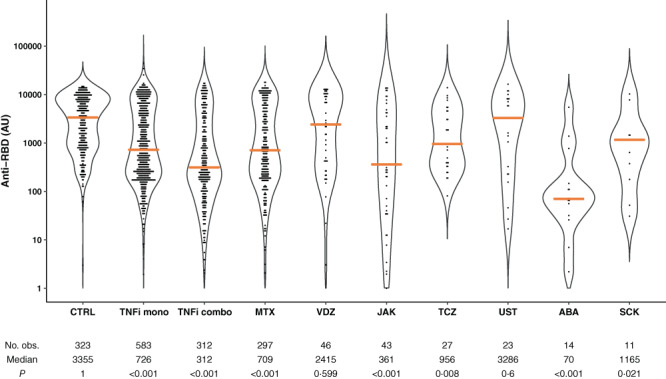
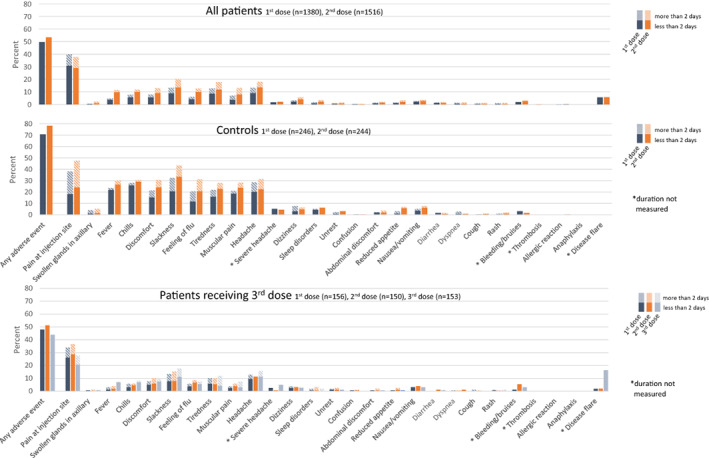
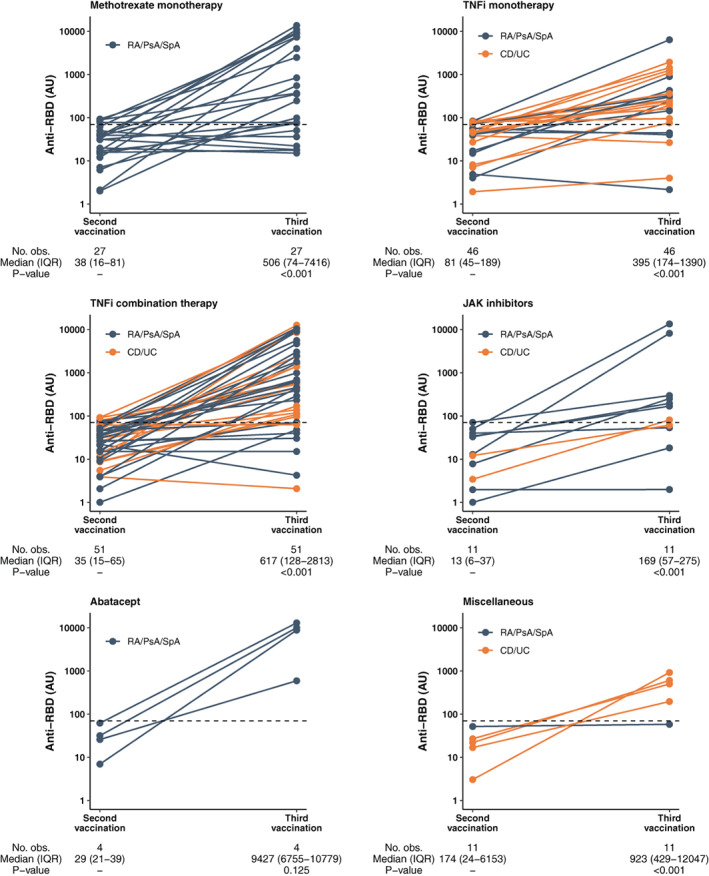
A total of 1,505 patients (91%) and 1,096 healthy controls (98%) had a serologic response to the standard regimen (P < 0.001). Anti-RBD antibody levels were lower in patients (median 619 AU/ml interquartile range [IQR] 192-4,191) than in controls (median 3,355 AU/ml [IQR 896-7,849]) (P < 0.001). The proportion of responders was lowest among patients receiving tumor necrosis factor inhibitor combination therapy, JAK inhibitors, or abatacept. Younger age and receipt of messenger RNA-1273 vaccine were predictors of serologic response. Of 153 patients who had a weak response to the standard regimen and received a third dose, 129 (84%) became responders. The vaccine safety profile among patients and controls was comparable.
IMID patients had an attenuated response to the standard vaccination regimen as compared to healthy controls. A third vaccine dose was safe and resulted in serologic response in most patients. These data facilitate identification of patient groups at risk of an attenuated vaccine response, and they support administering a third vaccine dose to IMID patients with a weak serologic response to the standard regimen.
在患有免疫介导的炎症性疾病(IMID)的患者中,接受标准的 SARS-CoV-2 疫苗接种方案后的免疫原性和安全性特征较差,并且缺乏接种第三针疫苗后的相关数据。本研究旨在评估接受免疫抑制治疗的 IMID 患者接受标准的 2 剂方案和第三剂 SARS-CoV-2 疫苗后的血清学反应和不良事件。
这项前瞻性观察性研究纳入了正在接受免疫抑制治疗类风湿关节炎、脊柱关节炎、银屑病关节炎、克罗恩病或溃疡性结肠炎的成年患者以及健康的成年对照者,他们接受了标准的 2 剂 SARS-CoV-2 疫苗接种方案。在接种前和接种后 2-4 周,对针对 SARS-CoV-2 刺突蛋白受体结合域(RBD)的抗体进行了分析。将血清学反应较弱的患者(定义为全长 SARS-CoV-2 刺突蛋白受体结合域 IgG 抗体滴度≤100 个任意单位/毫升(AU/ml))分配第三剂疫苗。
共有 1505 名患者(91%)和 1096 名健康对照者(98%)对标准方案有血清学反应(P<0.001)。与对照者(中位数 3355 AU/ml [IQR 896-7849])相比,患者的抗-RBD 抗体水平较低(中位数 619 AU/ml [IQR 192-4191])(P<0.001)。接受肿瘤坏死因子抑制剂联合治疗、JAK 抑制剂或阿巴西普治疗的患者中,应答者的比例最低。较年轻的年龄和接受信使 RNA-1273 疫苗是血清学反应的预测因素。在 153 名对标准方案血清学反应较弱且接受第三剂疫苗的患者中,有 129 名(84%)成为应答者。患者和对照者的疫苗安全性特征相似。
与健康对照者相比,IMID 患者对标准疫苗接种方案的反应减弱。第三剂疫苗是安全的,并且大多数患者的血清学反应得到了改善。这些数据有助于确定疫苗反应减弱的患者群体,并支持对标准方案血清学反应较弱的 IMID 患者接种第三剂疫苗。