Kelechi Teresa J, Mueller Martina, Madisetti Mohan, Prentice Margaret
Teresa J. Kelechi, PhD, College of Nursing, Medical University of South Carolina, Charleston.
Martina Mueller, PhD, Medical University of South Carolina, Charleston.
J Wound Ostomy Continence Nurs. 2022;49(4):365-372. doi: 10.1097/WON.0000000000000880. Epub 2022 May 4.
This aim of this study was to evaluate the clinical efficacy of a self-managed cooling intervention in individuals with recently healed venous leg ulcers (VLUs) and diabetic foot ulcers (DFUs) on pain reduction and physical activity improvement.
A 6-month longitudinal randomized controlled trial.
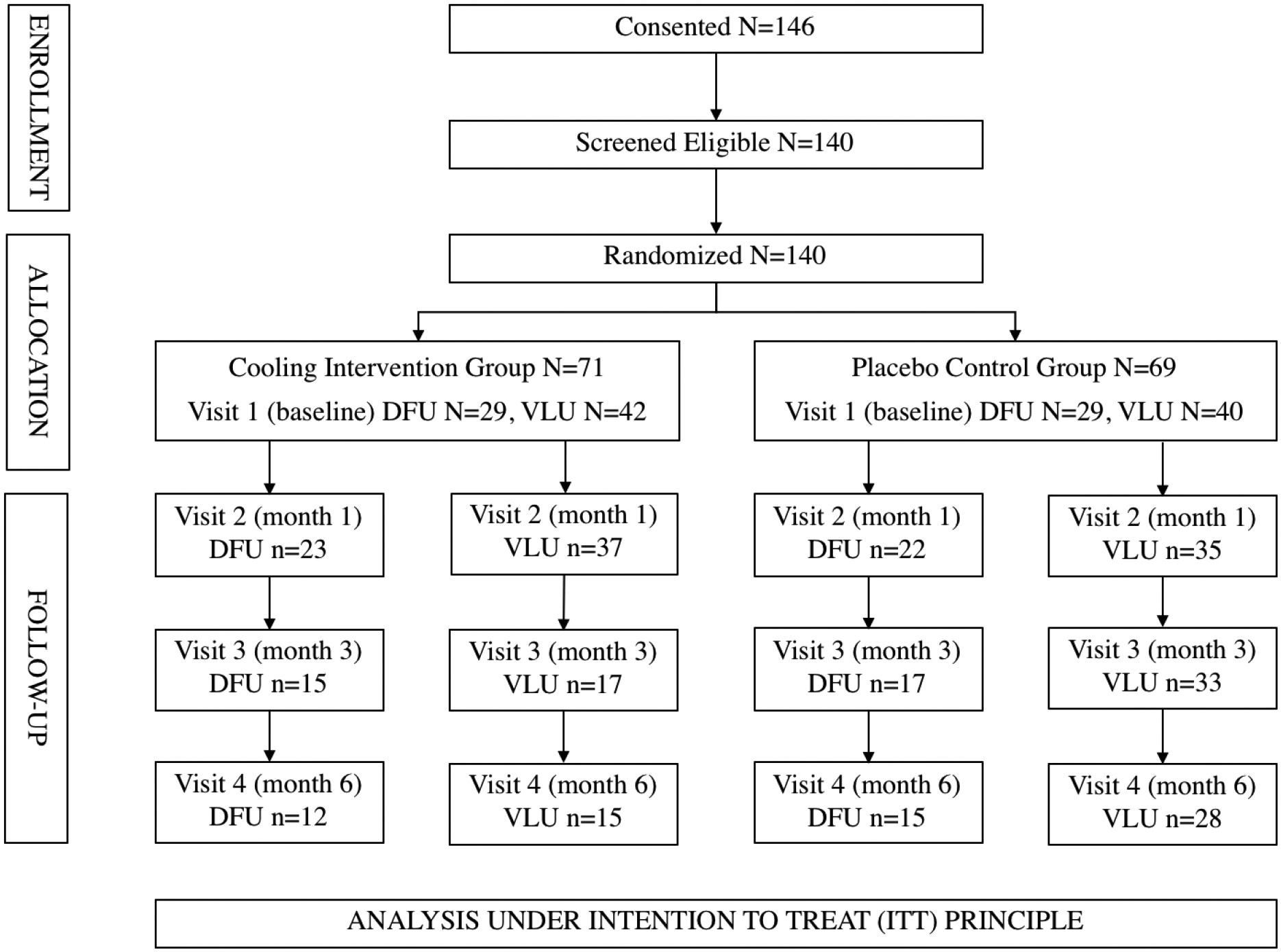
The sample comprised 140 individuals with previously healed VLU and DFU who received care in 3 outpatient wound centers in the Southeastern region of the United States. Participants were randomized to the MUSTCOOL or a placebo cooling patch intervention.
The cooling and placebo interventions comprised cooling or cotton-filled patch application to recently healed skin for 30 minutes, 3 times weekly plus standard of care including compression and leg elevation (participants with VLU) or therapeutic footwear and hygiene (participants with DFU) over a 6-month period. Pain severity and intensity were measured with the Brief Pain Inventory and physical activity with the International Physical Activity Questionnaire, which assessed metabolic equivalent of tasks (METs) in minutes per week. Minutes in walking time per week were assessed with an accelerometer. Data were descriptively analyzed for difference changes in scores from baseline to 6 months post-intervention.
Data were analyzed for 81 participants randomized to cooling and placebo groups (VLUs, n = 26/29) and DFU (n = 12/16). Slight reductions in VLU pain severity (-0.5, -0.2) and interference (-0.4, -0.5) and minimal reductions in DFU pain severity (0, -0.1) and interference (0.4/0.1) were achieved. However, pain scores were low to moderate at baseline (mean 4, 0-10 with 10 worst pain possible) in both groups. For physical activity, the MET values showed low physical activity in both groups at baseline with slight improvements noted in VLU cooling and placebo groups (73/799) and DFU (1921/225), respectively. Walking time for the VLU groups improved by 1420/2523 minutes; the DFU groups improved 135/157 minutes, respectively. Findings for outcomes were not statistically significant within or between groups.
Application of the cooling pack compared to placebo was minimally efficacious in reducing posthealing pain and improving function in this posthealed ulcer population. However for pain, scores were initially low; thus outcomes on pain, while lower, were marginal.
The study was prospectively registered with ClinicalTrials.gov on December 10, 2015 (Identifier: NCT02626156), https://clinicaltrials.gov/ct2/show/NCT02626156 .
本研究旨在评估自我管理的降温干预措施对近期愈合的下肢静脉溃疡(VLU)和糖尿病足溃疡(DFU)患者减轻疼痛和改善身体活动能力的临床疗效。
一项为期6个月的纵向随机对照试验。
样本包括140名曾患VLU和DFU且已愈合的患者,他们在美国东南部地区的3个门诊伤口中心接受治疗。参与者被随机分为接受MUSTCOOL降温干预组或安慰剂降温贴片干预组。
降温干预和安慰剂干预包括在近期愈合的皮肤上贴敷降温贴片或填充棉花的贴片30分钟,每周3次,同时在6个月期间给予标准护理,包括加压和抬高腿部(VLU患者)或治疗性鞋具和足部卫生护理(DFU患者)。使用简明疼痛量表测量疼痛严重程度和强度,使用国际体力活动问卷评估身体活动情况,该问卷评估每周以代谢当量(METs)计算的任务量,单位为分钟。使用加速度计评估每周的步行时间。对干预后6个月与基线时的得分差异变化进行描述性分析。
对随机分为降温组和安慰剂组的81名参与者(VLU患者,n = 26/29;DFU患者,n = 12/16)的数据进行了分析。VLU患者的疼痛严重程度(-0.5,-0.2)和干扰程度(-0.4,-0.5)略有降低,DFU患者的疼痛严重程度(0,-0.1)和干扰程度(0.4/0.1)略有降低。然而,两组患者基线时的疼痛评分均为低至中度(平均4分,0 - 10分,10分为最严重疼痛)。对于身体活动,两组患者基线时的MET值均显示身体活动水平较低,VLU降温组和安慰剂组(分别为73/799)以及DFU组(1921/225)略有改善。VLU组的步行时间分别增加了1420/2523分钟;DFU组分别增加了135/157分钟。组内和组间的结果差异均无统计学意义。
与安慰剂相比,在该愈合后溃疡人群中,使用降温贴对减轻愈合后疼痛和改善功能的效果甚微。然而,由于疼痛评分最初较低,因此疼痛方面的结果虽有降低,但幅度有限。
该研究于2015年12月10日在ClinicalTrials.gov上进行了前瞻性注册(标识符:NCT02626156),https://clinicaltrials.gov/ct2/show/NCT02626156 。