Zanwar Saurabh, Abeykoon Jithma P
Division of Hematology, Mayo Clinic, Rochester, MN, USA.
Assistant Professor, Division of Hematology, Mayo Clinic, 200 1st St SW, Rochester, MN 55905-0002, USA.
Ther Adv Hematol. 2022 Apr 29;13:20406207221093962. doi: 10.1177/20406207221093962. eCollection 2022.
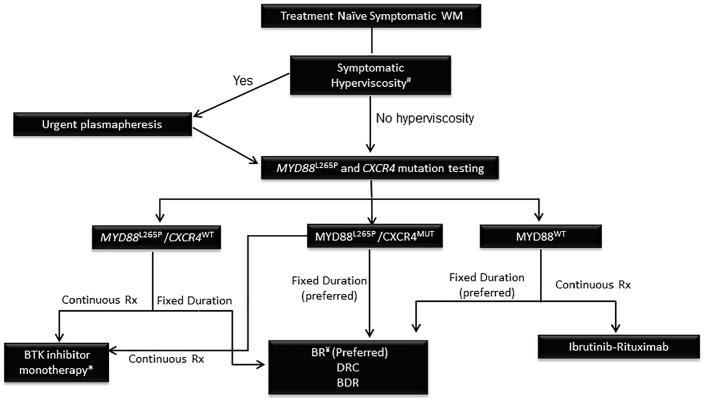
Waldenström macroglobulinemia (WM) is an indolent lymphoplasmacytic lymphoma. Recent strides made in the genomic profiling of patients with WM have led to the identification of many novel therapeutic targets. Patients with WM can present with asymptomatic disease and not all patients require treatment. When criteria for initiating systemic therapy are met, the choice of therapy depends on the tumor genotype ( and mutation status), patient preference (fixed continuous duration therapy, oral intravenous route, cost), associated medical comorbidities, and adverse effect profile of the treatment. In the absence of head-to-head comparison between chemoimmunotherapy and Bruton's tyrosine kinase inhibitors in otherwise fit patients with a mutation, our preference is fixed duration therapy with four to six cycles of chemoimmunotherapy with bendamustine-rituximab. In this review, we discuss the role of and mutation in treatment selection, and current data for frontline and salvage treatment options in patients with WM.
华氏巨球蛋白血症(WM)是一种惰性淋巴浆细胞淋巴瘤。近期在WM患者基因组分析方面取得的进展已导致许多新治疗靶点的发现。WM患者可能表现为无症状疾病,并非所有患者都需要治疗。当满足启动全身治疗的标准时,治疗方案的选择取决于肿瘤基因型(以及突变状态)、患者偏好(固定疗程与持续治疗、口服与静脉途径、费用)、相关的合并症以及治疗的不良反应情况。在其他条件适宜且存在特定突变的患者中,化疗免疫疗法与布鲁顿酪氨酸激酶抑制剂之间缺乏直接对比的情况下,我们倾向于采用苯达莫司汀-利妥昔单抗进行四至六个周期的固定疗程化疗免疫治疗。在本综述中,我们讨论了特定突变在治疗选择中的作用,以及WM患者一线和挽救治疗方案的当前数据。