Ma Kuai, Que Weitao, Hu Xin, Guo Wen-Zhi, Zhong Liang, Ueda Daisuke, Gu Er-Li, Li Xiao-Kang
Department of Gastroenterology and Hepatology, Jing'an District Central Hospital, Jing'an Branch of Huashan Hospital, Fudan University, Shanghai, China.
Division of Transplantation Immunology, National Research Institute for Child Health and Development, Tokyo, Japan.
Clin Exp Immunol. 2022 Jun 23;208(3):340-350. doi: 10.1093/cei/uxac039.
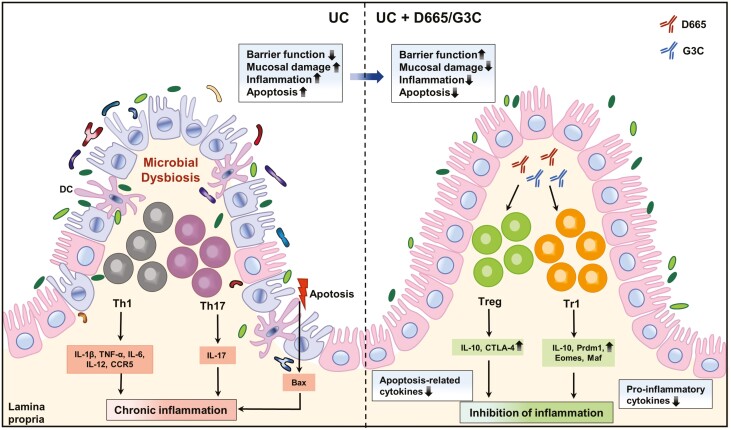
Ulcerative colitis (UC) is one of the two main forms of inflammatory bowel disease (IBD) and is an idiopathic, chronic inflammatory disease of the colonic mucosa with an unclear etiology. Interleukin (IL)-10 has been reported to play a crucial role in the maintenance of immune homeostasis in the intestinal environment. Type 1 regulatory T (Tr1) cells are a subset of CD4+Foxp3- T cells able to secrete high amounts of IL-10 with potent immunosuppressive properties. In this study, we found that the combination of anti-GITR antibody (G3c) and CD28 superagonist (D665) treatment stimulated the generation of a large amount of Tr1 cells. Furthermore, G3c/D665 treatment not only significantly relieved severe mucosal damage but also reduced the incidence of colonic shortening, weight loss, and hematochezia. Dextran sodium sulfate (DSS) upregulated the mRNA levels of IL-6, IL-1β, IL-17, IL-12, tumor necrosis factor-alpha, C-C chemokine receptor type 5, and Bax in splenic lymphocytes (SPLs) and colon tissues, while G3c/D665 treatment conversely inhibited the increase in mRNA levels of these genes. In addition, G3c/D665 treatment altered the proportion of CD4+ and CD8+ T cells and increased CD4+CD25+Foxp3+ regulatory T cells in SPLs, mesenteric lymph nodes (MLNs), and lamina propria lymphocytes (LPLs). Thus, the combination of G3c and D665 treatment showed efficacy against DSS-induced UC in mice by inducing a large amount of Tr1 cell generation via the musculoaponeurotic fibrosarcoma pathways in vivo and relieving inflammatory responses both systematically and locally.
溃疡性结肠炎(UC)是炎症性肠病(IBD)的两种主要形式之一,是一种病因不明的特发性慢性结肠黏膜炎症性疾病。白细胞介素(IL)-10已被报道在维持肠道环境免疫稳态中起关键作用。1型调节性T(Tr1)细胞是CD4 + Foxp3 - T细胞的一个亚群,能够分泌大量具有强大免疫抑制特性的IL-10。在本研究中,我们发现抗糖皮质激素诱导的肿瘤坏死因子受体(GITR)抗体(G3c)和CD28超激动剂(D665)联合治疗可刺激大量Tr1细胞的产生。此外,G3c/D665治疗不仅显著减轻了严重的黏膜损伤,还降低了结肠缩短、体重减轻和便血的发生率。葡聚糖硫酸钠(DSS)上调了脾淋巴细胞(SPL)和结肠组织中IL-6、IL-1β、IL-17、IL-12、肿瘤坏死因子-α、C-C趋化因子受体5型和Bax的mRNA水平,而G3c/D665治疗则相反地抑制了这些基因mRNA水平的升高。此外,G3c/D665治疗改变了SPL、肠系膜淋巴结(MLN)和固有层淋巴细胞(LPL)中CD4 +和CD8 + T细胞的比例,并增加了CD4 + CD25 + Foxp3 +调节性T细胞。因此,G3c和D665联合治疗通过体内肌纤维母细胞肉瘤途径诱导大量Tr1细胞产生,并系统性和局部缓解炎症反应,对DSS诱导的小鼠UC显示出疗效。