Institute of Transfusion Medicine, University Medicine Greifswald, Greifswald, Germany.
Institute of Transfusion Medicine, University Medicine Greifswald, Greifswald, Germany.
Semin Hematol. 2022 Apr;59(2):97-107. doi: 10.1053/j.seminhematol.2022.02.004. Epub 2022 Feb 23.
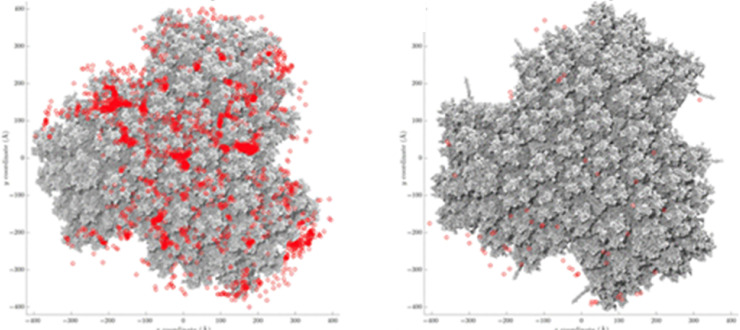
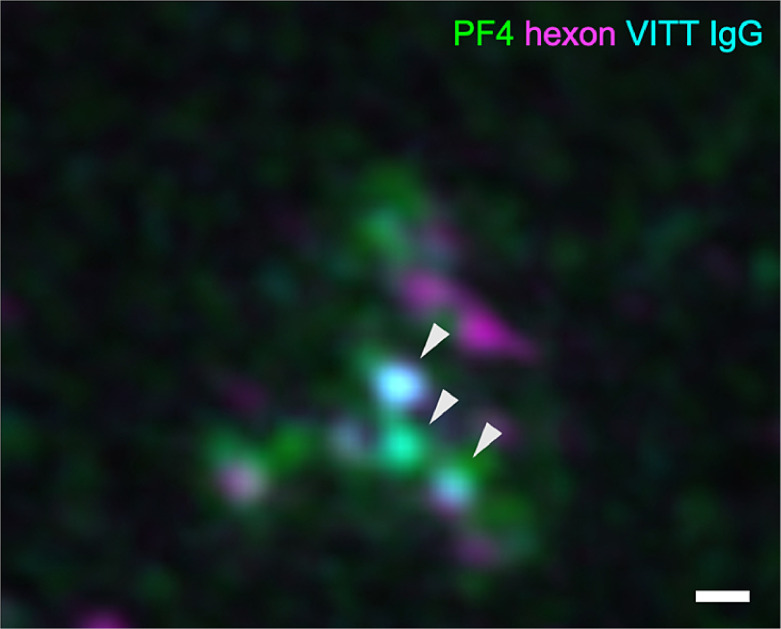
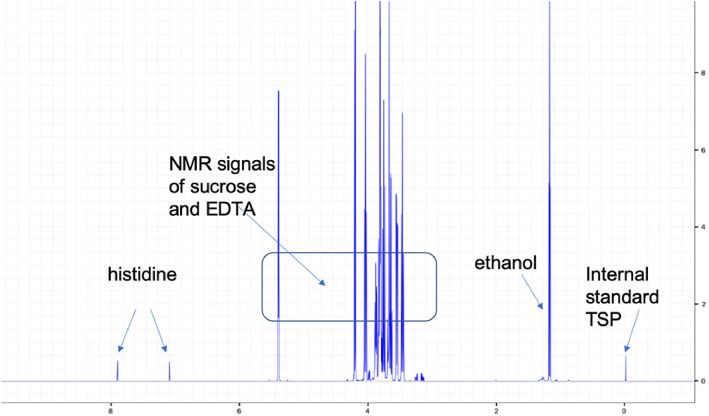
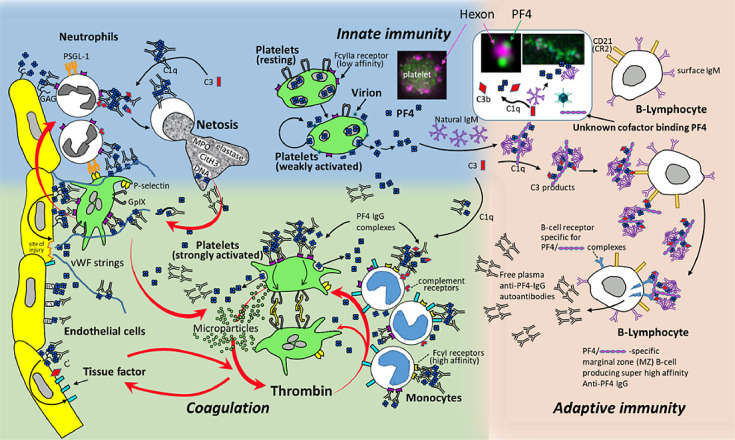
Vaccine-induced immune thrombotic thrombocytopenia (VITT; synonym, thrombosis with thrombocytopenia syndrome, is associated with high-titer immunoglobulin G antibodies directed against platelet factor 4 (PF4). These antibodies activate platelets via platelet FcγIIa receptors, with platelet activation greatly enhanced by PF4. Here we summarize the current concepts in the pathogenesis of VITT. We first address parallels between heparin-induced thrombocytopenia and VITT, and provide recent findings on binding of PF4 to adenovirus particles and non-assembled adenovirus proteins in the 2 adenovirus vector-based COVID-19 vaccines, ChAdOx1 nCoV-19 and Ad26.COV2.S. Further, we discuss the potential role of vaccine constituents such as glycosaminoglycans, EDTA, polysorbate 80, human cell-line proteins and nucleotides as potential binding partners of PF4. The immune response towards PF4 in VITT is likely triggered by a proinflammatory milieu. Human cell-line proteins, non-assembled virus proteins, and potentially EDTA may contribute to the proinflammatory state. The transient nature of the immune response towards PF4 in VITT makes it likely that-as in heparin-induced thrombocytopenia -marginal zone B cells are key for antibody production. Once high-titer anti-PF4 antibodies have been formed 5 to 20 days after vaccination, they activate platelets and granulocytes. Activated granulocytes undergo NETosis and the released DNA also forms complexes with PF4, which fuels the Fcγ receptor-dependent cell activation process, ultimately leading to massive thrombin generation. Finally, we summarize our initial observations indicating that VITT-like antibodies might also be present in rare patients with recurrent venous and arterial thrombotic complications, independent of vaccination.
疫苗诱导的免疫性血栓性血小板减少症(VITT;同义词:血栓性血小板减少性综合征)与针对血小板因子 4(PF4)的高滴度免疫球蛋白 G 抗体有关。这些抗体通过血小板 FcγIIa 受体激活血小板,PF4 极大地增强了血小板的激活。在此,我们总结了 VITT 发病机制的当前概念。我们首先讨论肝素诱导的血小板减少症与 VITT 之间的相似之处,并提供了关于 PF4 与腺病毒颗粒结合以及在 2 种基于腺病毒载体的 COVID-19 疫苗(ChAdOx1 nCoV-19 和 Ad26.COV2.S)中未组装的腺病毒蛋白结合的最新发现。此外,我们讨论了疫苗成分(如糖胺聚糖、EDTA、聚山梨醇酯 80、人细胞系蛋白和核苷酸)作为 PF4 潜在结合物的潜在作用。VITT 中针对 PF4 的免疫反应可能是由促炎环境引发的。人细胞系蛋白、未组装的病毒蛋白以及潜在的 EDTA 可能有助于促炎状态。VITT 中针对 PF4 的免疫反应是短暂的,这使得 VITT 与肝素诱导的血小板减少症一样,边缘区 B 细胞可能是产生抗体的关键。一旦在接种疫苗后 5 至 20 天形成高滴度抗 PF4 抗体,它们就会激活血小板和粒细胞。激活的粒细胞发生 NETosis,释放的 DNA 也与 PF4 形成复合物,这促进了 Fcγ 受体依赖性细胞激活过程,最终导致大量凝血酶生成。最后,我们总结了我们的初步观察结果,表明在罕见的复发性静脉和动脉血栓形成并发症患者中,也可能存在类似于 VITT 的抗体,而与疫苗接种无关。