Dargahi Abdollah, Ansari Amin, Nematollahi Davood, Asgari Ghorban, Shokoohi Reza, Samarghandi Mohammad Reza
Department of Environmental Health Engineering, School of Health, Hamadan University of Medical Sciences Hamadan Iran.
Department of Chemistry, Faculty of Chemistry, Bu-Ali-Sina University Hamadan Iran.
RSC Adv. 2019 Feb 12;9(9):5064-5075. doi: 10.1039/c8ra10105a. eCollection 2019 Feb 5.
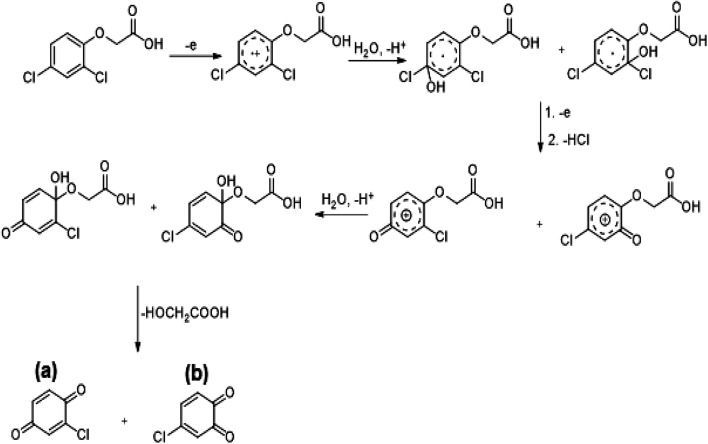
2,4-Dichlorophenoxyacetic acid (2,4-D) is one of the most commonly used herbicides in the world. In this work, the electro-catalytic degradation of 2,4-D herbicide from aqueous solutions was evaluated using three anode electrodes, , lead dioxide coated on stainless steel 316 (SS316/β-PbO), lead dioxide coated on a lead bed (Pb/β-PbO), and lead dioxide coated on graphite (G/β-PbO). The structure and morphology of the prepared electrodes were studied by X-ray diffraction (XRD), scanning electron microscopy (SEM) and energy dispersive X-ray spectroscopy (EDX). The process of herbicide degradation was monitored during constant current electrolysis using cyclic voltammetry (CV). In this study, the experiments were designed based on the central composite design (CCD) and were analyzed and modeled by response surface methodology (RSM) to demonstrate the operational variables and the interactive effect of three independent variables on 3 responses. The effects of parameters including pH (3-11), current density ( = 1-5 mA cm) and electrolysis time (20-80 min) were studied. The results showed that, at = 5 mA cm, by increasing the reaction time from 20 to 80 min and decreasing the pH from 11 to 3, the 2,4-D herbicide degradation efficiency using SS316/β-PbO, Pb/β-PbO and G/β-PbO anode electrodes was observed to be 60.4, 75.9 and 89.8%, respectively. Moreover, the results showed that the highest COD and TOC removal efficiencies using the G/β-PbO electrode were 83.7 and 78.5%, under the conditions pH = 3, electrolysis time = 80 min and = 5 mA cm, respectively. It was also found that G/β-PbO has lower energy consumption (EC) (5.67 kW h m) compared to the two other studied electrodes (SS316/β-PbO and Pb/β-PbO). The results showed a good correlation between the experimental values and the predicted values of the quadratic model ( < 0.05). Results revealed that the electrochemical process using the G/β-PbO anode electrode has an acceptable efficiency in the degradation of 2,4-D herbicide and can be used as a proper pretreatment technique to treat wastewater containing resistant pollutants, , phenoxy group herbicides (2,4-D).
2,4-二氯苯氧乙酸(2,4-D)是世界上最常用的除草剂之一。在本研究中,使用三种阳极电极评估了从水溶液中电催化降解2,4-D除草剂的效果,这三种电极分别是涂覆在316不锈钢(SS316/β-PbO)上的二氧化铅、涂覆在铅床(Pb/β-PbO)上的二氧化铅以及涂覆在石墨(G/β-PbO)上的二氧化铅。通过X射线衍射(XRD)、扫描电子显微镜(SEM)和能量色散X射线光谱(EDX)研究了制备电极的结构和形貌。在恒流电解过程中,使用循环伏安法(CV)监测除草剂的降解过程。在本研究中,实验基于中心复合设计(CCD)进行设计,并通过响应面法(RSM)进行分析和建模,以展示操作变量以及三个自变量对三个响应的交互作用。研究了包括pH值(3 - 11)、电流密度(= 1 - 5 mA/cm²)和电解时间(20 - 80分钟)等参数的影响。结果表明,在电流密度为5 mA/cm²时,通过将反应时间从20分钟增加到80分钟以及将pH值从11降低到3,使用SS316/β-PbO、Pb/β-PbO和G/β-PbO阳极电极时,2,4-D除草剂的降解效率分别为60.4%、75.9%和89.8%。此外,结果表明,在pH = 3、电解时间 = 80分钟和电流密度 = 5 mA/cm²的条件下,使用G/β-PbO电极时,最高的化学需氧量(COD)和总有机碳(TOC)去除效率分别为83.7%和78.5%。还发现,与其他两种研究电极(SS316/β-PbO和Pb/β-PbO)相比,G/β-PbO的能耗(EC)更低(5.67 kW·h/m³)。结果表明二次模型的实验值与预测值之间具有良好的相关性(P < 0.05)。结果表明,使用G/β-PbO阳极电极的电化学过程在降解2,4-D除草剂方面具有可接受的效率,并且可以用作处理含有抗性污染物(如苯氧基除草剂(2,4-D))的废水的合适预处理技术。