
用于甲烷氧化偶联的SiO@MnO @NaWO@SiO核壳衍生催化剂。
SiO@MnO @NaWO@SiO core-shell-derived catalyst for oxidative coupling of methane.
作者信息
Park La-Hee, Jo Ye Rim, Choi Jae-Wook, Suh Dong Jin, Song Kwang Ho, Ha Jeong-Myeong
机构信息
Clean Energy Research Center, Korea Institute of Science and Technology Seoul 02792 Republic of Korea
Graduate School of Energy and Environment (Green School), Korea University Seoul 02841 Republic of Korea.
出版信息
RSC Adv. 2020 Oct 13;10(62):37749-37756. doi: 10.1039/d0ra05081d. eCollection 2020 Oct 12.
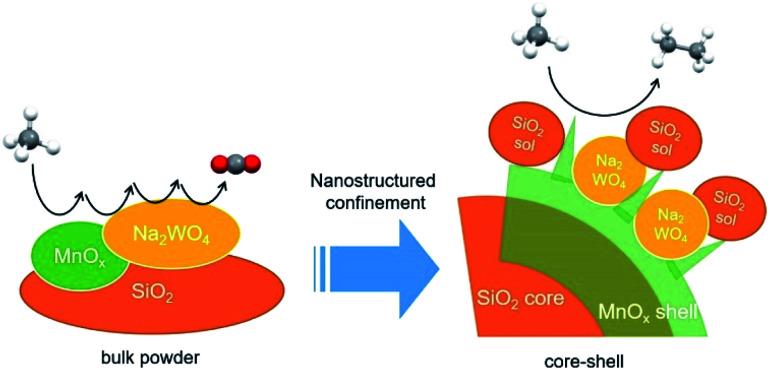
SiO@MnO @NaWO@SiO core-shell catalysts were prepared and their fabrication was confirmed using transmission electron microscopy. The formation of Mn-based nanosheets on the silica spheres is important for the deposition of nanoscopic NaWO. The SiO@MnO @NaWO@SiO core-shell catalysts were used for the oxidative coupling of methane at a temperature of 700-800 °C at which the nanostructures were completely destroyed. Although the core-shell structures did not survive the high-temperature oxidative coupling of methane, the selective production of olefins and paraffins can be attributed to highly dispersed NaWO derived from confined core-shell structures.
制备了SiO@MnO@NaWO@SiO核壳催化剂,并通过透射电子显微镜确认了其结构。二氧化硅球上锰基纳米片的形成对于纳米级NaWO的沉积很重要。SiO@MnO@NaWO@SiO核壳催化剂用于在700-800℃的温度下进行甲烷氧化偶联反应,在该温度下纳米结构被完全破坏。尽管核壳结构在甲烷的高温氧化偶联反应中无法保留,但烯烃和石蜡的选择性生成可归因于源自受限核壳结构的高度分散的NaWO。



 Zotero 插件