Ishigami Junichi, Honda Yasuyuki, Karger Amy B, Coresh Josef, Selvin Elizabeth, Lutsey Pamela L, Matsushita Kunihiro
Department of Epidemiology, Johns Hopkins Bloomberg School of Public Health, Baltimore, MD.
Department of Laboratory Medicine and Pathology, University of Minnesota, Minneapolis.
Mayo Clin Proc Innov Qual Outcomes. 2022 Apr 27;6(3):209-217. doi: 10.1016/j.mayocpiqo.2022.03.002. eCollection 2022 Jun.
To investigate longitudinal changes in the blood concentration of fibroblast growth factor 23 (FGF23) from midlife to late life and their major predictors in the general population.
In 14,444 participants of the Atherosclerosis Risk in Communities Study, we analyzed the association of 31,095 measurements of serum intact FGF23 with age using data from 3 visits (visit 2 [N=13,460; mean age, 57 years]; visit 3 [N=12,323; mean age, 60 years]; and visit 5 [N=6122; mean age, 76 years]) and a linear mixed-effects model. Among 5804 participants who had FGF23 measurements at both visits 3 and 5, we explored predictors of FGF23 change from midlife to late life using linear regression models. Prespecified risk factors were estimated glomerular filtration rate, body mass index, ever smoking, ever drinker, diabetes, hypertension, history of cardiovascular disease, total cholesterol, and high-density lipoprotein cholesterol.
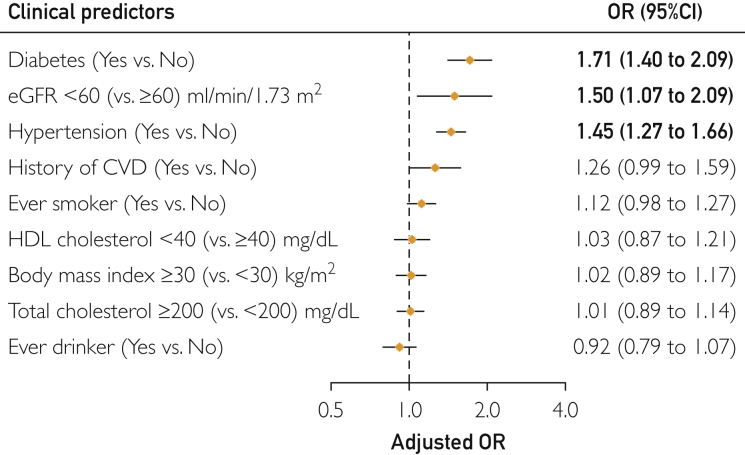
Median FGF23 concentrations were 41.9 pg/mL (interquartile interval [IQI], 33.9 to 51.8 pg/mL) at visit 2, 38.3 pg/mL (IQI, 30.6 to 48.3 pg/mL) at visit 3, and 55.0 pg/mL (IQI, 44.4 to 70.3 pg/mL) at visit 5. A linear mixed-effects model showed that the association of FGF23 with age was nonlinear, with a slight decline or no change in age 45-60 years and a monotonic increase in age greater than or equal to 65 years (FGF23, +10 to 15 pg/mL per 10 years of age). In a multivariable linear regression model, significantly greater increases in FGF23 were noted, with midlife estimated glomerular filtration rate less than 60 mL/min per 1.73 m vs more than or equal to 60 mL/min per 1.73 m (ΔFGF23, +4.4 pg/mL [95% CI, 0.9 to 8.0]), diabetes vs no diabetes (ΔFGF23, +6.2 pg/mL [95% CI, 4.1 to 8.3]), and hypertension vs no hypertension (ΔFGF23, +4.1 pg/mL [95% CI, 2.7 to 5.4]).
FGF23 did not show any major changes in midlife but increased linearly in late life. Reduced kidney function, diabetes, and hypertension were robustly associated with a greater increase in FGF23. Further investigations are needed to understand the potential mechanisms linking these conditions to an increase in FGF23 concentrations.
研究普通人群中从中年到老年成纤维细胞生长因子23(FGF23)血液浓度的纵向变化及其主要预测因素。
在社区动脉粥样硬化风险研究的14444名参与者中,我们使用3次访视(访视2 [N = 13460;平均年龄57岁];访视3 [N = 12323;平均年龄60岁];访视5 [N = 6122;平均年龄76岁])的数据和线性混合效应模型分析了31095次血清完整FGF23测量值与年龄之间的关联。在访视3和访视5均进行FGF23测量的5804名参与者中,我们使用线性回归模型探索了从中年到老年FGF23变化的预测因素。预先设定的风险因素包括估计的肾小球滤过率、体重指数、曾经吸烟、曾经饮酒、糖尿病、高血压、心血管疾病史、总胆固醇和高密度脂蛋白胆固醇。
访视2时FGF23浓度中位数为41.9 pg/mL(四分位间距[IQI],33.9至51.8 pg/mL),访视3时为38.3 pg/mL(IQI,30.6至48.3 pg/mL),访视5时为55.0 pg/mL(IQI,44.4至70.3 pg/mL)。线性混合效应模型显示,FGF23与年龄的关联是非线性的,在45 - 60岁时略有下降或无变化,在65岁及以上时呈单调增加(FGF23,每10岁增加10至15 pg/mL)。在多变量线性回归模型中,FGF23的增加显著更大,中年时估计的肾小球滤过率低于60 mL/(min·1.73 m²)与高于或等于60 mL/(min·1.73 m²)相比(ΔFGF23,+4.4 pg/mL [95% CI,0.9至8.0]),糖尿病与无糖尿病相比(ΔFGF23,+6.2 pg/mL [95% CI,4.1至8.3]),高血压与无高血压相比(ΔFGF23,+4.1 pg/mL [95% CI,2.7至5.4])。
FGF23在中年没有显示出任何重大变化,但在老年时呈线性增加。肾功能下降、糖尿病和高血压与FGF23更大幅度的增加密切相关。需要进一步研究以了解将这些情况与FGF23浓度增加联系起来的潜在机制。