Xie Rongfang, Liu Zhenzhen, Lin Zuan, Shi Peiying, Chen Bing, Li Shaoguang, Li Guangwen, Huang Liying, Lin Xinhua, Yao Hong
Department of Pharmaceutical Analysis, School of Pharmacy, Fujian Medical University Fuzhou 350122 China
Department of Traditional Chinese Medicine Resource and Bee Products, Animal Science College, Fujian Agriculture and Forestry University Fuzhou 350002 China.
RSC Adv. 2020 Oct 20;10(63):38497-38504. doi: 10.1039/d0ra07038f. eCollection 2020 Oct 15.
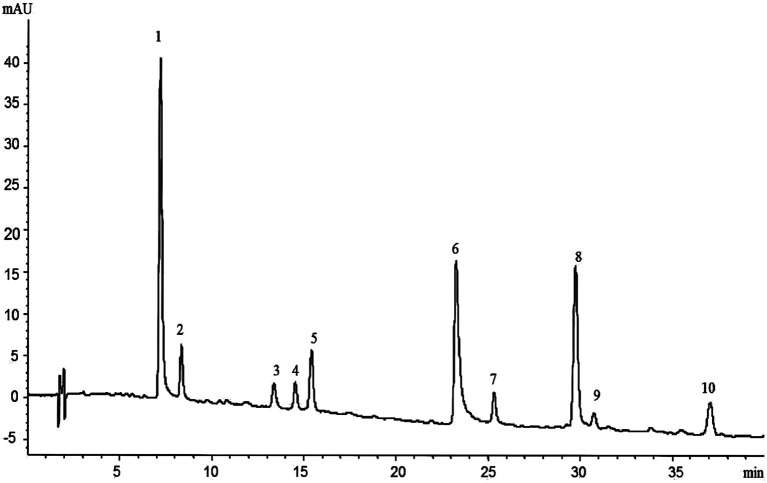
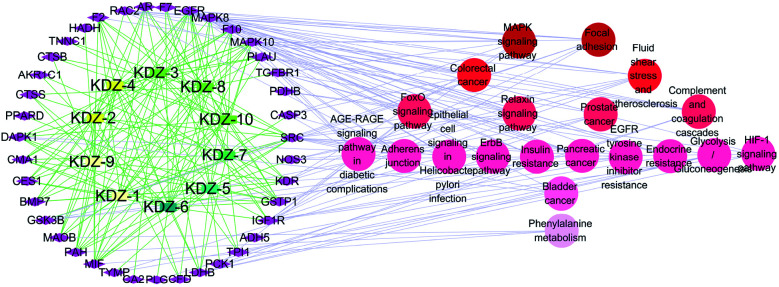
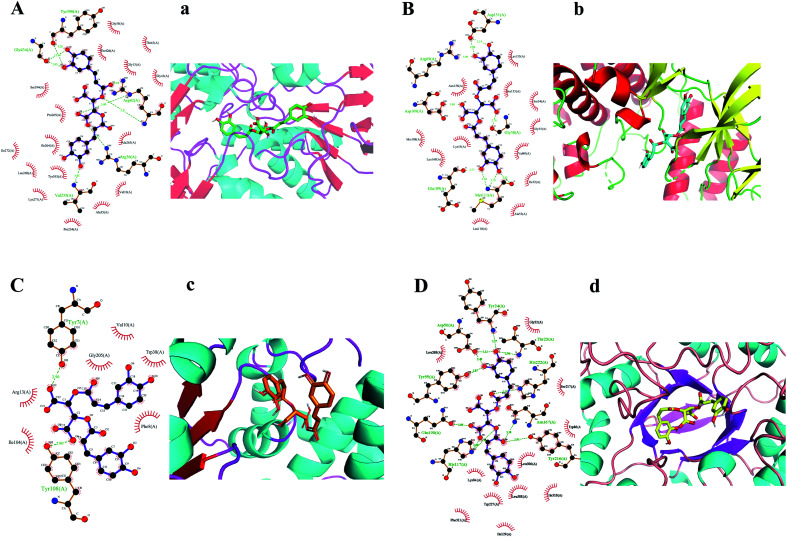
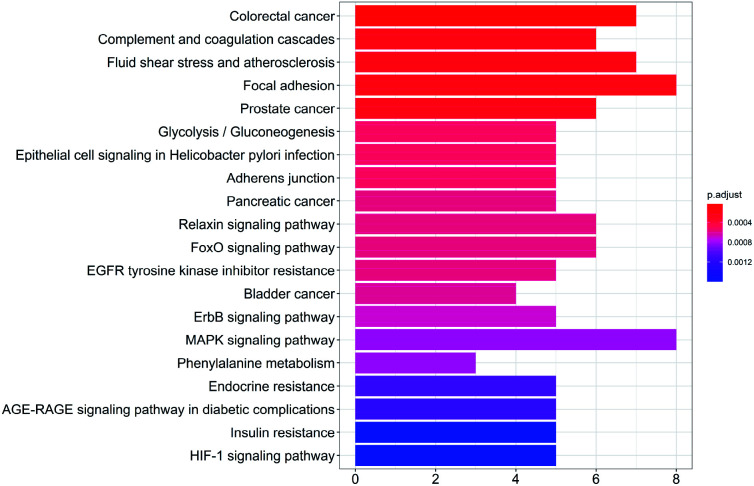
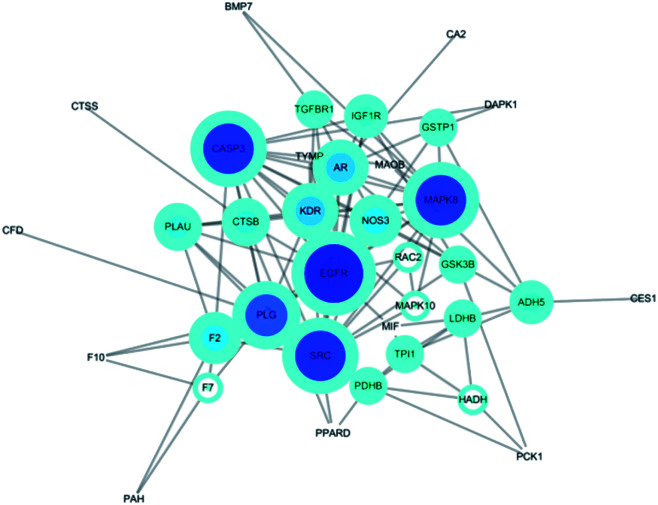
extract injection, a Chinese medicine preparation named as Kudiezi injection (KDZI) in China, has been widely used for the treatment of cardiovascular diseases (CVDs) in recent years. Owing to the component complexity of the preparation, the study on the effect mechanism of the herbal medicine against CVDs is a big challenge. In this research, HPLC-Q-TOF-MS was used to analyze the constituents of the preparation, disclosing that the KDZI mainly consists of 10 ingredients, namely 3-caffeoylquinic acid (KDZI-1), 4-caffeoylquinic acid (KDZI-2), 5-caffeoylquinic acid (KDZI-3), apigenin-7--β-d-glucuronide (KDZI-4), caffeic acid (KDZI-5), chicoric acid (KDZI-6), caftaric acid (KDZI-7), luteolin-7--β-d-gentiobioside (KDZI-8), luteolin-7--β-d-glucopyranoside (KDZI-9) and luteolin-7--β-d-glucuronide (KDZI-10). Afterwards, target fishing and an integrated systems pharmacology approach combined with molecular docking (Sybyl 1.3 and AutoDock Vina) were adopted to predict the potential targets and pathways for the main ingredients in KDZI. As results, 39 protein targets and 9 KEGG pathways, possessing high relevance to the therapeutic effects of the ingredients of KDZI against CVDs, were screened out reasonably. The integrated pharmacology analysis suggested that KDZI could exert its therapeutic effects against CVDs possibly multi-targets including EGFR, MAPK10, and SRC and multi-pathways referring to MAPK, focal adhesion, complement and coagulation cascades, . This research provides insights into understanding the comprehensive therapeutic effect and mechanism of the KDZI on CVDs.
苦碟子注射液,在中国被称为苦碟子注射液(KDZI)的一种中药制剂,近年来已被广泛用于治疗心血管疾病(CVDs)。由于该制剂成分复杂,研究该草药对心血管疾病的作用机制是一项巨大挑战。在本研究中,采用高效液相色谱-四极杆飞行时间质谱联用仪(HPLC-Q-TOF-MS)分析该制剂的成分,发现KDZI主要由10种成分组成,即3-咖啡酰奎宁酸(KDZI-1)、4-咖啡酰奎宁酸(KDZI-2)、5-咖啡酰奎宁酸(KDZI-3)、芹菜素-7-β-D-葡萄糖醛酸苷(KDZI-4)、咖啡酸(KDZI-5)、菊苣酸(KDZI-6)、咖啡酰酒石酸(KDZI-7)、木犀草素-7-β-D-龙胆二糖苷(KDZI-8)、木犀草素-7-β-D-葡萄糖吡喃糖苷(KDZI-9)和木犀草素-7-β-D-葡萄糖醛酸苷(KDZI-10)。随后,采用靶点垂钓和结合分子对接(Sybyl 1.3和AutoDock Vina)的综合系统药理学方法,预测KDZI中主要成分的潜在靶点和途径。结果,合理筛选出39个与KDZI成分对心血管疾病治疗作用高度相关的蛋白质靶点和9条KEGG途径。综合药理学分析表明,KDZI可能通过包括表皮生长因子受体(EGFR)、丝裂原活化蛋白激酶10(MAPK10)和Src在内的多靶点以及涉及丝裂原活化蛋白激酶(MAPK)、粘着斑、补体和凝血级联反应的多途径发挥其对心血管疾病的治疗作用。本研究为理解KDZI对心血管疾病的综合治疗作用和机制提供了思路。