Thomas Anoopa, Ahamed Rafiq, Prakash Muthuramalingam
Department of Chemistry, Faculty of Engineering and Technology, SRM Institute of Science and Technology SRM Nagar, Kattankulathur 603203 Chennai TN India
RSC Adv. 2020 Oct 26;10(64):39160-39170. doi: 10.1039/d0ra07927h. eCollection 2020 Oct 21.
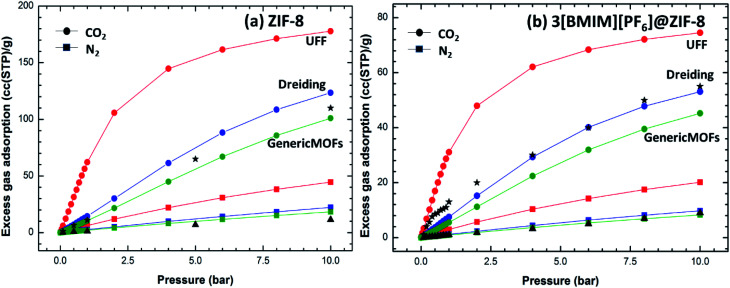
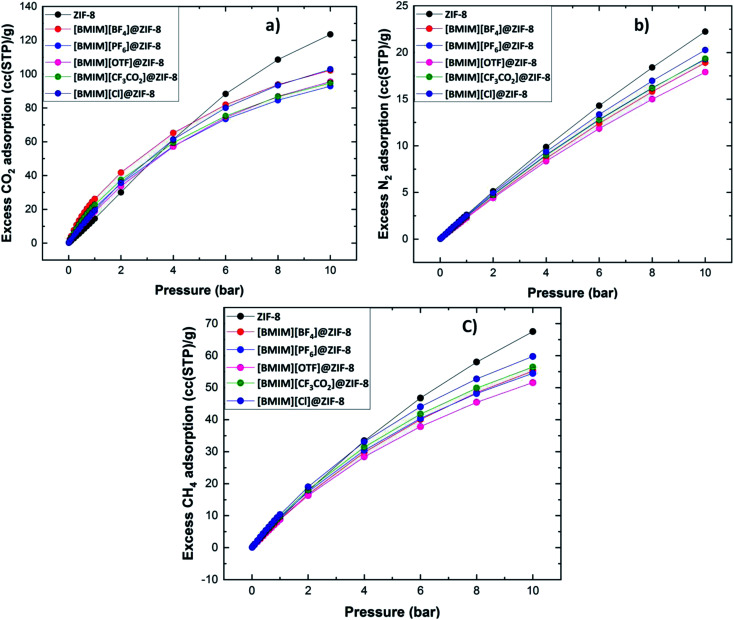
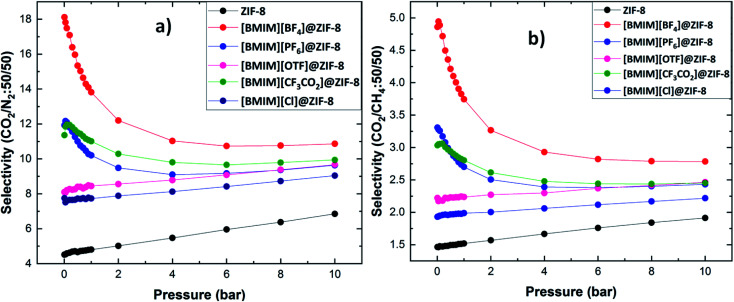
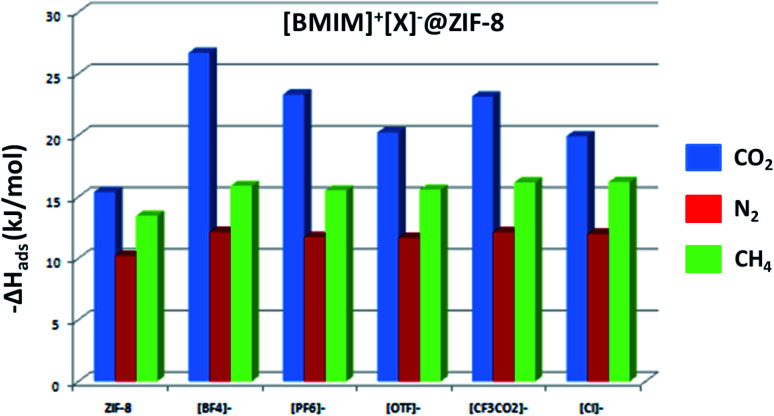
The effective capture of CO from the atmosphere is much needed to reduce its environmental impact. The design and development of CO capturing materials is getting much attention. A zeolitic imidazolate framework (ZIF) can replace many of the conventional materials in gas separation due to its stability and high performance. Here, we analyzed the effect of encapsulation of ionic liquids (ILs) into the pores of ZIF-8 for selective CO capture and separation. The [BMIM] cation with a series of anions was selected to study suitable carbon capture materials using density functional theory (DFT) approaches. Our calculations suggest that the nitrogen containing anions are not well adsorbed on the ZIF-8 surface but their gas separation performance is not affected by these interfacial interactions. This is confirmed from the CO/N and CO/CH selectivity of these composites, calculated using grand canonical Monte Carlo (GCMC) simulations. A suitable force field for the composites was identified by comparing the available force fields with the experiments. The IL@ZIF-8 composite shows better CO selectivity compared to pristine ZIF-8. Fluorinated hydrophobic anions (such as [BF], [PF] and [TfN]) in the composites show better CO adsorption and significant CO selectivity than pristine ZIF-8, especially at low pressure. The nature of the anion plays an important role in CO separation, rather than its stability at the pores of ZIF-8. Close scrutiny of the results reveal that the CO selectivity of these composite materials depends on the anion of the IL and thus through the selection of a suitable anion we can significantly enhance the CO selectivity for different flue gas mixtures. Our molecular level design shows that the selection of suitable anions in IL based composites is very important in identifying potential carbon capture materials for industrial applications.
为减少二氧化碳对环境的影响,急需从大气中有效捕获二氧化碳。二氧化碳捕获材料的设计与开发备受关注。沸石咪唑酯骨架材料(ZIF)因其稳定性和高性能,可替代许多传统气体分离材料。在此,我们分析了将离子液体(ILs)封装到ZIF-8孔中对选择性捕获和分离二氧化碳的影响。选用含一系列阴离子的[BMIM]阳离子,采用密度泛函理论(DFT)方法研究合适的碳捕获材料。我们的计算表明,含氮阴离子在ZIF-8表面吸附不佳,但它们的气体分离性能不受这些界面相互作用的影响。这通过巨正则蒙特卡罗(GCMC)模拟计算的这些复合材料的CO/N和CO/CH选择性得到证实。通过将可用力场与实验结果进行比较,确定了适合该复合材料的力场。与原始ZIF-8相比,IL@ZIF-8复合材料表现出更好的CO选择性。复合材料中的氟化疏水阴离子(如[BF]、[PF]和[TfN])比原始ZIF-8表现出更好的CO吸附性能和显著的CO选择性,尤其是在低压下。阴离子的性质在CO分离中起重要作用,而非其在ZIF-8孔中的稳定性。对结果的仔细研究表明,这些复合材料的CO选择性取决于IL的阴离子,因此通过选择合适的阴离子,我们可以显著提高对不同烟道气混合物的CO选择性。我们的分子水平设计表明,在基于IL的复合材料中选择合适的阴离子对于确定工业应用中潜在的碳捕获材料非常重要。