Wei Mingbang, Ye Yourong, Ali Muhammad Muddassir, Chamba Yangzom, Tang Jia, Shang Peng
College of Animal Science, Tibet Agriculture and Animal Husbandry College, Linzhi, China.
The Provincial and Ministerial Co-founded Collaborative Innovation Center for R&D in Tibet Characteristic Agricultural and Animal Husbandry Resources, Linzhi, China.
Front Vet Sci. 2022 Apr 19;9:850771. doi: 10.3389/fvets.2022.850771. eCollection 2022.
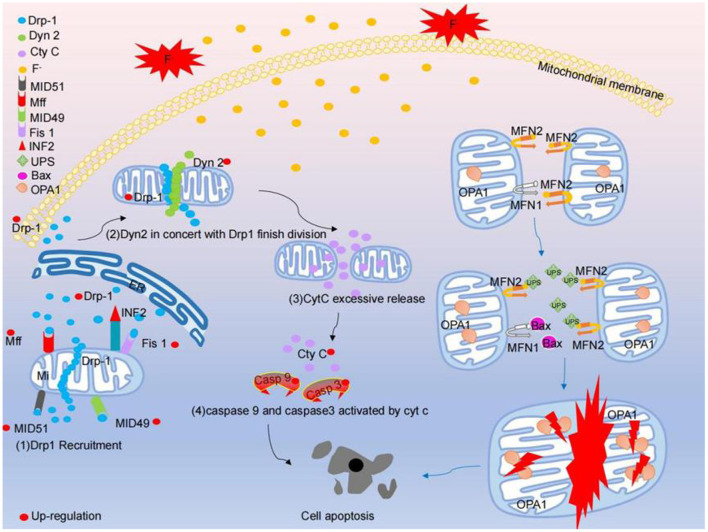
Fluoride is commonly found in the soil and water environment and may act as chronic poison. A large amount of fluoride deposition causes serious harm to the ecological environment and human health. Mitochondrial dysfunction is a shared feature of fluorosis, and numerous studies reported this phenomenon in different model systems. More and more evidence shows that the functions of mitochondria play an extremely influential role in the organs and tissues after fluorosis. Fluoride invades into cells and mainly damages mitochondria, resulting in decreased activity of mitochondrial related enzymes, weakening of protein expression, damage of respiratory chain, excessive fission, disturbance of fusion, disorder of calcium regulation, resulting in the decrease of intracellular ATP and the accumulation of Reactive oxygen species. At the same time, the decrease of mitochondrial membrane potential leads to the release of Cyt c, causing a series of caspase cascade reactions and resulting in apoptosis. This article mainly reviews the mechanism of cytotoxicity related to mitochondrial dysfunction after fluorosis. A series of mitochondrial dysfunction caused by fluorosis, such as mitochondrial dynamics, mitochondrial Reactive oxygen species, mitochondrial fission, mitochondrial respiratory chain, mitochondrial autophagy apoptosis, mitochondrial fusion disturbance, mitochondrial calcium regulation are emphasized, and the mechanism of the effect of fluoride on cytotoxicity related to mitochondrial dysfunction are further explored.
氟化物普遍存在于土壤和水环境中,可能具有慢性毒性。大量的氟化物沉积会对生态环境和人类健康造成严重危害。线粒体功能障碍是氟中毒的一个共同特征,许多研究在不同的模型系统中报道了这一现象。越来越多的证据表明,线粒体的功能在氟中毒后的器官和组织中起着极其重要的作用。氟化物侵入细胞并主要损害线粒体,导致线粒体相关酶活性降低、蛋白质表达减弱、呼吸链受损、过度分裂、融合紊乱、钙调节失调,从而导致细胞内ATP减少和活性氧积累。同时,线粒体膜电位的降低导致细胞色素c释放,引发一系列半胱天冬酶级联反应并导致细胞凋亡。本文主要综述氟中毒后与线粒体功能障碍相关的细胞毒性机制。着重阐述了氟中毒引起的一系列线粒体功能障碍,如线粒体动力学、线粒体活性氧、线粒体分裂、线粒体呼吸链、线粒体自噬凋亡、线粒体融合紊乱、线粒体钙调节等,并进一步探讨了氟化物对与线粒体功能障碍相关的细胞毒性作用机制。