Department of Reproductive Immunology, Shanghai First Maternity and Infant Hospital, School of Medicine, Tongji University, Shanghai, China.
Department of Obstetrics, Shanghai First Maternity and Infant Hospital, School of Medicine, Tongji University, Shanghai, China.
Front Endocrinol (Lausanne). 2022 Apr 19;13:874975. doi: 10.3389/fendo.2022.874975. eCollection 2022.
Adverse maternal outcomes and perinatal complications are associated with maternal hypothyroidism. However, the utility of levothyroxine (L-T4) in the treatment of pregnant women with hypothyroxinemia is unclear.
This study aimed to evaluate the effects of L-T4 on maternal and perinatal outcomes in pregnant women with hypothyroxinemia.
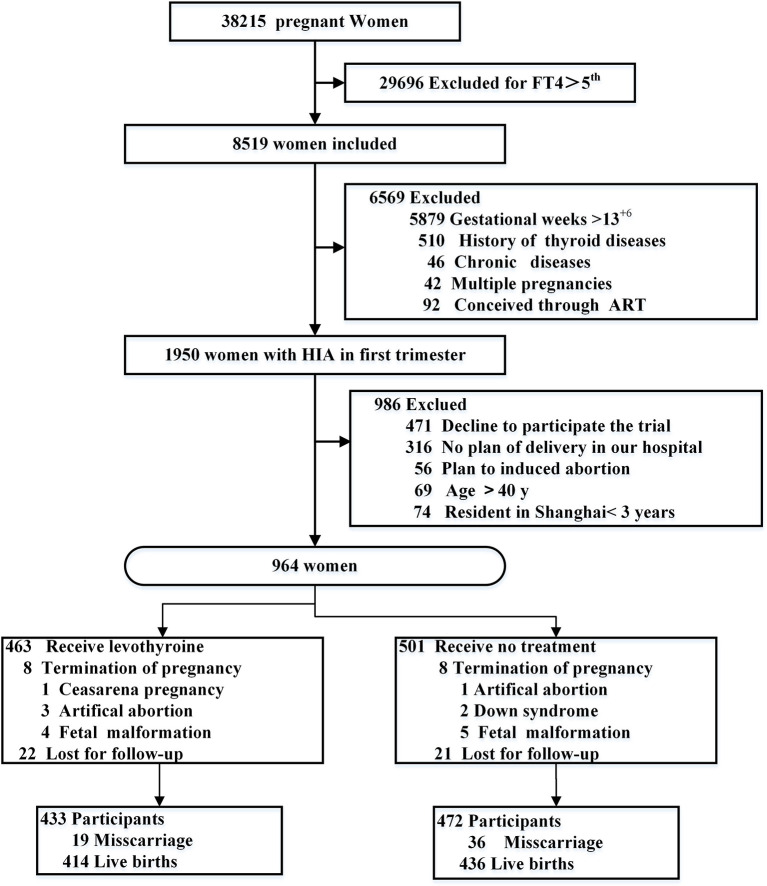
The nonrandomized interventional study was conducted at Shanghai First Maternity and Infant Hospital, Punan Hospital of Shanghai, and Beicai Community Health Center of Shanghai. The pregnant women with hypothyroxinemia from the first trimester were enrolled and divided into treatment and control groups. 463 taking L-T4 and 501 not administering L-T4 were analyzed in the study. All participants were screened for TPOAB/TGAB antibody status.
The primary outcome of the study was the hypertensive disorder of pregnancy (HDP), measured as the proportion of HDP. In addition to this primary outcome, some secondary outcomes will be measured: miscarriage, gestational diabetes mellitus, premature rupture of membranes, placental abruption, intrahepatic cholestasis of pregnancy, fetal distress, macrosomia, and neonates admitted to the neonatal intensive care unit (NICU). The effects of L-T4 on the incidence of adverse pregnancy outcomes and perinatal complications were compared.
Multivariate logistic regression analysis showed that L-T4 treatment (adjusted odds ratio = 1.78 [95% CI = 1.00-3.16], = 0.04) significantly reduced the incidence of miscarriage. Otherwise, lower neonates admitted to the NICU were strongly associated with the L-T4 group (adjusted odds ratio = 1.36 [95% CI = 1.01 - 1.83], p = 0.04). There were no significant differences in the incidence rates of other adverse maternal outcomes and perinatal complications between pregnant women with hypothyroxinemia receiving and those not receiving L-T4 treatment.
The incidence of HDP was not significantly reduced using L-T4 in pregnant women with hypothyroxinemia. The results of this study also showed that L-T4 treatment significantly reduced the miscarriages rate and the proportion of newborns admitted to the NICU.
不良母婴结局和围产期并发症与母体甲状腺功能减退有关。然而,左旋甲状腺素(L-T4)在治疗甲状腺功能减退孕妇中的作用尚不清楚。
本研究旨在评估 L-T4 对甲状腺功能减退孕妇母婴结局的影响。
这是一项非随机干预研究,在上海第一妇婴保健院、上海浦南医院和上海市北蔡社区卫生服务中心进行。招募了患有甲状腺功能减退的早孕期孕妇,并将其分为治疗组和对照组。本研究共分析了 463 例服用 L-T4 和 501 例未服用 L-T4 的患者。所有参与者均筛查甲状腺过氧化物酶抗体/甲状腺球蛋白抗体状态。
本研究的主要结局是妊娠高血压疾病(HDP),以 HDP 的比例来衡量。除了这个主要结局外,还将测量一些次要结局:流产、妊娠期糖尿病、胎膜早破、胎盘早剥、妊娠肝内胆汁淤积症、胎儿窘迫、巨大儿和新生儿入住新生儿重症监护病房(NICU)。比较 L-T4 对不良妊娠结局和围产儿并发症发生率的影响。
多变量逻辑回归分析显示,L-T4 治疗(调整后的优势比=1.78[95%置信区间=1.00-3.16],p=0.04)显著降低了流产的发生率。相反,新生儿入住 NICU 的比例较低与 L-T4 组密切相关(调整后的优势比=1.36[95%置信区间=1.01-1.83],p=0.04)。甲状腺功能减退孕妇接受和未接受 L-T4 治疗的不良母婴结局和围产儿并发症发生率无显著差异。
在甲状腺功能减退孕妇中使用 L-T4 并未显著降低 HDP 的发生率。本研究结果还表明,L-T4 治疗显著降低了流产率和新生儿入住 NICU 的比例。