Dong Xufeng, Zhang Jingying, Pang Lu, Chen Junting, Qi Min, You Shijie, Ren Nanqi
School of Materials Science and Engineering, Dalian University of Technology Dalian 116024 China
Medical College of Dalian University Dalian 116024 China.
RSC Adv. 2019 Mar 28;9(17):9838-9844. doi: 10.1039/c9ra00846b. eCollection 2019 Mar 22.
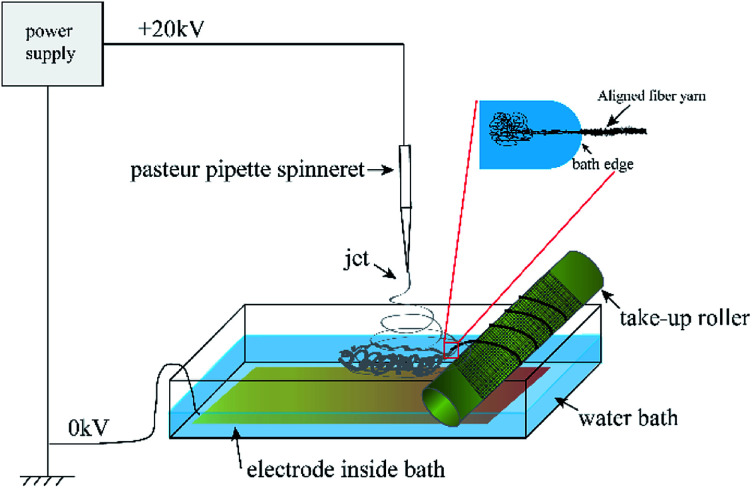
Although the electrospinning method has been developed to prepare nanofibrous scaffolds, their isotropic structure, low porosity and small pore size prevents them from wide application, especially for anisotropic tissues. In this study, a modified electrospinning receiving system with a rotating mandrel and a water bath is developed. Compared with the nanofibrous scaffold prepared by the common electrospinning system, the micro/nanofibrous polylactide/polycaprolactone (PLA/PCL) hybrid scaffold obtained with the modified system presents anisotropic structure, promotes porosity and enlarged pore size. The hybrid scaffold consists of oriented microfibers and random nanofibers. SEM images demonstrate its anisotropic 3D structure. Tensile testing results confirm that the hybrid scaffold has anisotropic mechanical properties. Compared with the nanofibrous scaffold, human osteoblast-like MG-63 cells protrude more on the surface of the hybrid scaffold. Actin fluorescence staining confirms that the cells form more actin filaments inside the hybrid scaffold. HE staining indicates that more cells enter the interior of the micro/nanofibrous hybrid scaffold. The CCK-8 activity test shows an enhanced proliferation activity of cells on the surface of the hybrid scaffold. In conclusion, the novel micro/nanofibrous hybrid scaffold has an anisotropic structure and better biocompatibility than common nanofibrous scaffolds, indicating a promising future for use in anisotropic tissue engineering.
尽管已经开发出静电纺丝法来制备纳米纤维支架,但其各向同性结构、低孔隙率和小孔径阻碍了它们的广泛应用,尤其是在用于各向异性组织时。在本研究中,开发了一种带有旋转心轴和水浴的改进型静电纺丝接收系统。与通过普通静电纺丝系统制备的纳米纤维支架相比,用改进系统获得的微/纳米纤维聚乳酸/聚己内酯(PLA/PCL)混合支架呈现出各向异性结构,孔隙率增加且孔径增大。该混合支架由取向微纤维和无规纳米纤维组成。扫描电子显微镜图像展示了其各向异性的三维结构。拉伸测试结果证实该混合支架具有各向异性的力学性能。与纳米纤维支架相比,人成骨样MG-63细胞在混合支架表面的突出程度更高。肌动蛋白荧光染色证实细胞在混合支架内部形成了更多的肌动蛋白丝。苏木精-伊红染色表明更多细胞进入了微/纳米纤维混合支架内部。CCK-8活性测试显示混合支架表面的细胞增殖活性增强。总之,新型微/纳米纤维混合支架具有各向异性结构,并且比普通纳米纤维支架具有更好的生物相容性,表明其在各向异性组织工程中的应用前景广阔。