Chen Jianxin, Li Pengtao, Lin E Emily
State Key Laboratory of Solidification Processing, MOE Key Laboratory of Materials Physics and Chemistry in Extraordinary Conditions, Northwestern Polytechnical University Xi'an 710072 China
School of Engineering and Materials Science, Queen Mary University of London Mile End Road London E14NS UK.
RSC Adv. 2020 Nov 3;10(66):40084-40091. doi: 10.1039/d0ra07831j. eCollection 2020 Nov 2.
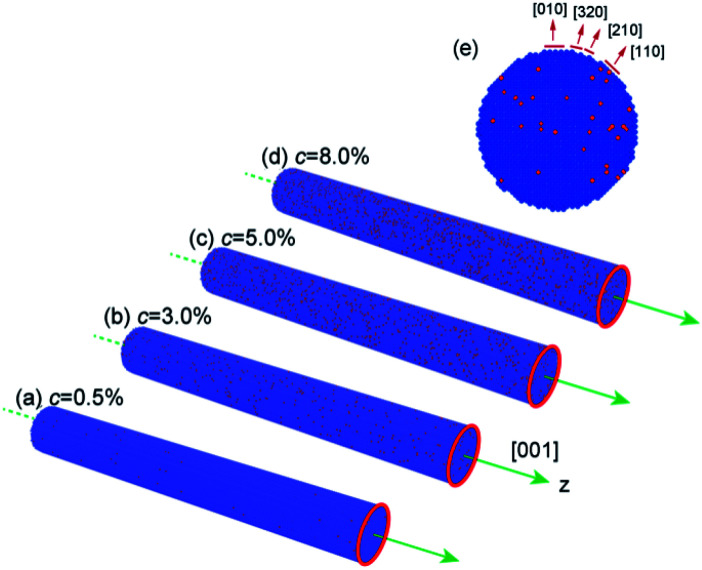
Fe-Ni alloy nanowires are widely used in high-density magnetic memories and catalysts due to their unique magnetic and electrochemical properties. Understanding the deformation mechanism and mechanical property of Fe-Ni alloy nanowires is of great importance for the development of devices. However, the detailed deformation mechanism of the alloy nanowires at different temperatures is unclear. Herein, the deformation mechanism of Fe-Ni alloy nanowires and their mechanical properties were investigated the molecular dynamics simulation method. It was found that the local atomic pressure fluctuation of the Fe-Ni alloy nanowire surface became more prominent with an increase in the Ni content. At low temperature conditions (<50 K), the plastic deformation mechanism of the Fe-Ni alloy nanowires switched from the twinning mechanism to the dislocation slip mechanism with the increase in the Ni content from 0.5 at% to 8.0 at%. In the temperature range of 50-800 K, the dislocation slip mechanism dominated the deformation. Simulation results indicated that there was a significant linear relationship between the Ni content, temperature, and ultimate stress in the temperature range of 50-800 K. Our research revealed the association between the deformation mechanism and temperature in Fe-Ni alloy nanowires, which may facilitate new alloy nanowire designs.
铁镍合金纳米线因其独特的磁性和电化学性能而被广泛应用于高密度磁存储器和催化剂中。了解铁镍合金纳米线的变形机制和力学性能对于器件的开发具有重要意义。然而,合金纳米线在不同温度下的详细变形机制尚不清楚。在此,采用分子动力学模拟方法研究了铁镍合金纳米线的变形机制及其力学性能。研究发现,随着镍含量的增加,铁镍合金纳米线表面的局部原子压力波动变得更加明显。在低温条件下(<50K),随着镍含量从0.5at%增加到8.0at%,铁镍合金纳米线的塑性变形机制从孪生机制转变为位错滑移机制。在50-800K的温度范围内,位错滑移机制主导变形。模拟结果表明,在50-800K的温度范围内,镍含量、温度和极限应力之间存在显著的线性关系。我们的研究揭示了铁镍合金纳米线变形机制与温度之间的关联,这可能有助于新型合金纳米线的设计。