Nephrology and Dialysis Unit, ASST Fatebenefratelli Sacco, Milano, Italy.
School of Nephrology, Università di Milano, Milano, Italy.
J Nephrol. 2022 Jun;35(5):1497-1503. doi: 10.1007/s40620-022-01329-6. Epub 2022 May 6.
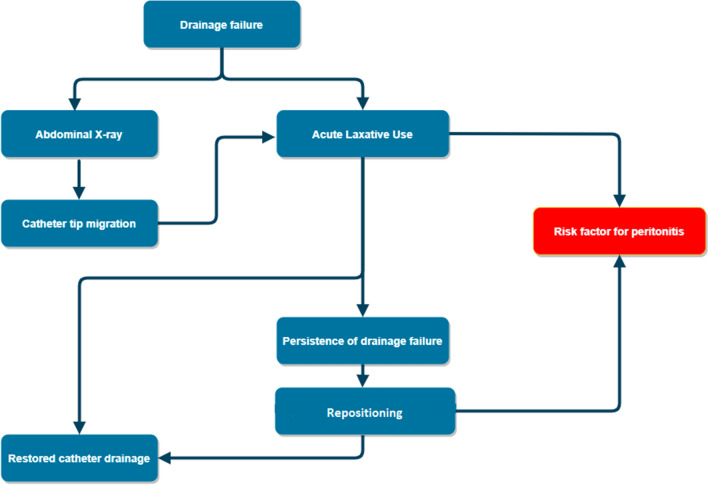
There is currently no consensus regarding the optimal type of peritoneal dialysis (PD) catheter. Although few studies showed that weighted catheters result in lower complication rates and superior long-term outcomes than non-weighted catheters, there are no studies on the use of laxatives linked to catheter malfunction, a patient-related outcome potentially affecting the quality of life. Thus, we compared the burden of acute and chronic laxative use in a cohort of PD patients having either weighted or non-weighted catheters.
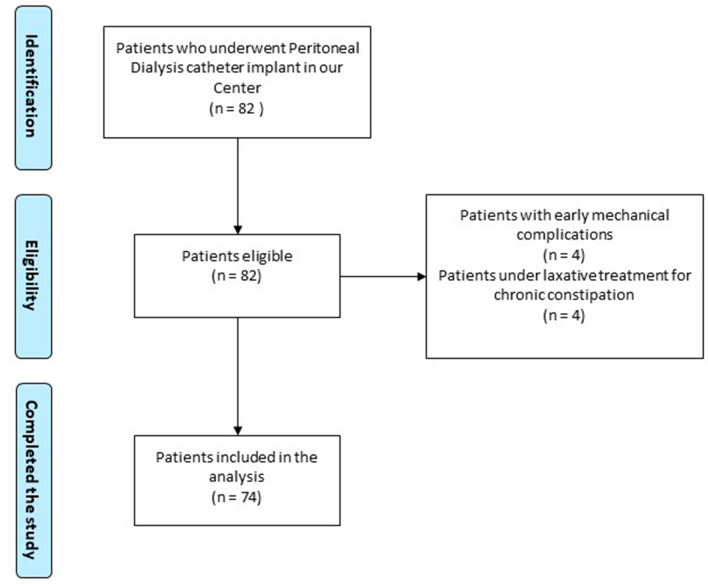
We performed a single-center, retrospective, observational study in two renal units, comparing acute and chronic laxative therapy related to catheter drainage failure in a cohort of 74 PD patient,s divided by peritoneal dialysis catheter type. In addition, we evaluated the number of patients who experienced minor and major dislocations, catheter-related infection rate, hospitalization for catheter malfunctioning, episodes of catheter repositioning, and dropout from PD.
Laxative use was significantly more common among patients in the non-weighted catheter group (acute: 30.3% vs. 9.8%, p = 0.03; chronic: 36.4% vs. 12.2%; p≤0.02). Furthermore, weighted catheters were superior to non-weighted catheters for all the secondary outcomes (dislocations: 12.2% vs. 45.5%; p = 0.001).
Weighted self-locating catheters have lower drainage failure, thus reducing the need and burden of acute and chronic laxative use among PD patients.
目前对于最佳腹膜透析(PD)导管类型尚未达成共识。虽然少数研究表明,与非重量型导管相比,重量型导管可降低并发症发生率和提高长期预后,但目前尚无关于通便剂与导管功能障碍相关的研究,而导管功能障碍可能会影响患者的生活质量。因此,我们比较了使用重量型和非重量型导管的 PD 患者中急性和慢性通便剂使用的负担。
我们在两个肾脏科室进行了一项单中心、回顾性、观察性研究,比较了 74 例 PD 患者队列中与导管引流失败相关的急性和慢性通便治疗,这些患者按腹膜透析导管类型分组。此外,我们还评估了经历轻微和严重导管移位、导管相关感染率、因导管故障住院、导管重新定位次数以及退出 PD 治疗的患者人数。
非重量型导管组的通便剂使用率明显更高(急性:30.3%比 9.8%,p=0.03;慢性:36.4%比 12.2%,p≤0.02)。此外,对于所有次要结局,重量型导管均优于非重量型导管(移位:12.2%比 45.5%,p=0.001)。
重量型自定位导管的引流失败率较低,从而降低了 PD 患者使用急性和慢性通便剂的需求和负担。