Adaptation Physiology Group, Wageningen University and Research, Wageningen, The Netherlands.
Adaptation Physiology Group, Wageningen University and Research, Wageningen, The Netherlands.
Poult Sci. 2022 Jul;101(7):101907. doi: 10.1016/j.psj.2022.101907. Epub 2022 Apr 6.
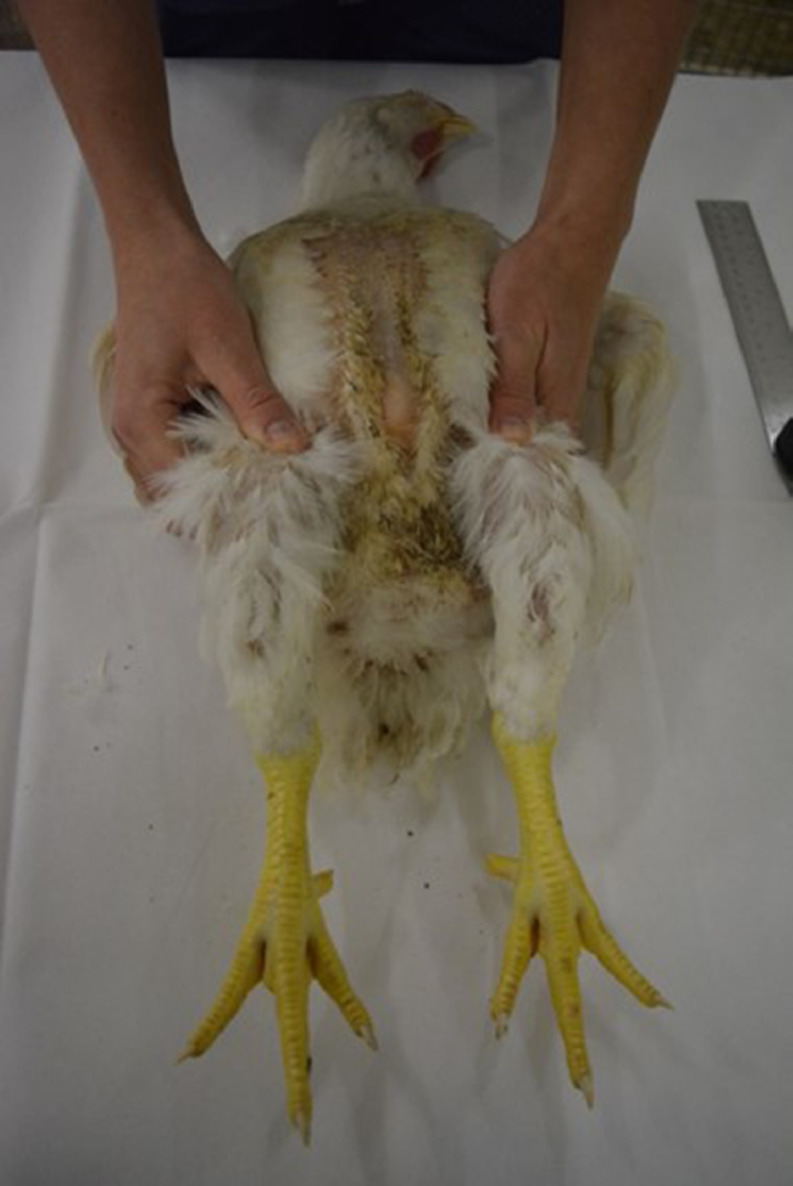
Valgus-varus deformity (VVD) is one of the leg disorders affecting health and welfare of broiler chickens. In research, several protocols are used to determine the prevalence and/or severity of VVD. This study aimed to investigate effects of five different protocols on the angulation of the tibiotarsal-tarsometatarsal joint. Angulation was determined (1) in living chickens with fixation at the femorotibiotarsal joint; (2) in dead chickens without fixation; (3) in dead chickens with fixation; (4) in dissected legs, including muscles, but without skin; (5) in dissected legs, without muscles, but with intact joints. Fixation of the leg at the femorotibiotarsal joint largely reduced the angulation of the tibiotarsal-tarsometatarsal joint. When fixation was used, no differences in angulation were found when broilers were live, dead or legs were dissected, but when no fixation was used, angulation was considerably higher, due to a large lateral deviation of the leg. It can be concluded that in intact chickens, fixation of the femorotibiotarsal joint is essential to determine VVD angulation in an appropriate way.
外翻-内翻畸形(VVD)是一种影响肉鸡健康和福利的腿部疾病。在研究中,使用了几种方案来确定 VVD 的流行率和/或严重程度。本研究旨在研究五种不同方案对跗跖关节角度的影响。通过以下五种方法确定角度:(1)在固定股骨-胫骨关节的活鸡中;(2)在未固定的死鸡中;(3)在固定的死鸡中;(4)在包括肌肉但没有皮肤的解剖腿中;(5)在没有肌肉但关节完整的解剖腿中。腿在股骨-胫骨关节处的固定大大降低了跗跖关节的角度。当使用固定时,无论是活鸡、死鸡还是腿部解剖,角度都没有差异,但当不使用固定时,由于腿部的外侧明显偏离,角度会高得多。可以得出结论,在完整的鸡中,股骨-胫骨关节的固定对于以适当的方式确定 VVD 的角度是必不可少的。