Department of Cardiothoracic Surgery, Nanjing University Medical School Affiliated Nanjing Drum Tower Hospital, Nanjing, Jiangsu, China.
Graduate School of Peking Union Medical College, Chinese Academy of Medical Sciences & Peking Union Medical College, Beijing, Beijing, China.
BMJ Open. 2022 May 6;12(5):e056264. doi: 10.1136/bmjopen-2021-056264.
Heart failure (HF) is a growing global public health burden. However, due to the very limited regenerative capacity of mature cardiomyocytes in the adult mammalian heart, conventional treatments can only improve the symptoms of HF but fail to restore cardiac function. Heart transplantation is limited by a severe shortage of donors. Cell-based transplantation for the treatment of HF has become a promising strategy. Human-induced-pluripotent stem cell-derived cardiomyocytes (hiPSC-CMs) have been tested in animal models to assess safety and efficacy. This study aims at evaluating the safety and efficacy of epicardial injection of hiPSC-CMs in patients with advanced HF during coronary artery bypass grafting (CABG) surgery.
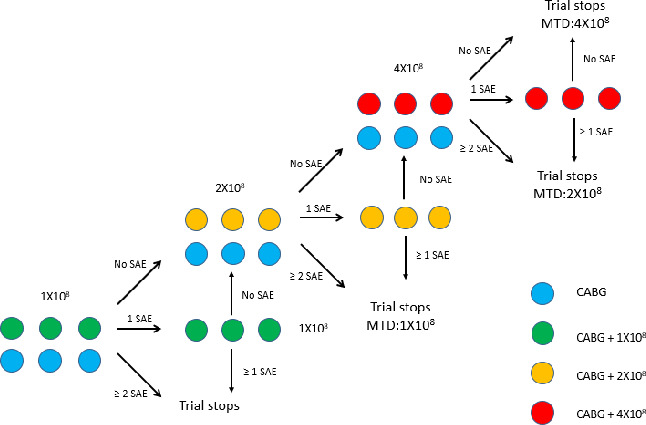
This study is a dose-escalation, placebo-controlled, single-centre phase I/IIa clinical trial. Dose escalation will be guided by a modified 3+3 design for three doses (1×10, 2×10 and 4×10 cells, sequentially). Patients with advanced heart failure will be enrolled and randomly allocated to receive epicardial injection of hiPSC-CMs during CABG surgery or CABG surgery alone, followed by a 12-month follow-up investigation. The primary endpoint is to assess the safety of hiPSC-CMs transplantation, including haemodynamic compromised sustained ventricular arrhythmias and newly formed tumours during 6 months postoperatively. The secondary endpoint is to evaluate the efficacy of epicardial injection of hiPSC-CMs and CABG surgery combination by comparison with CABG surgery alone.
The study protocol has been approved by the Institutional Ethical Committee of Nanjing Drum Tower Hospital (No. SC202000102) and approved by National Health Commission of the PRC (MR-32-21-014649). Findings will be disseminated to the academic community through peer-reviewed publications and presentation at national and international meetings.
NCT03763136.
心力衰竭(HF)是一个日益严重的全球公共卫生负担。然而,由于成年哺乳动物心脏中成熟心肌细胞的再生能力非常有限,传统治疗方法只能改善 HF 的症状,而不能恢复心脏功能。心脏移植受到供体严重短缺的限制。基于细胞的移植治疗 HF 已成为一种很有前途的策略。人诱导多能干细胞衍生的心肌细胞(hiPSC-CMs)已在动物模型中进行测试,以评估安全性和疗效。本研究旨在评估在冠状动脉旁路移植术(CABG)期间,经心外膜注射 hiPSC-CMs 治疗晚期 HF 患者的安全性和疗效。
这是一项剂量递增、安慰剂对照、单中心的 I/IIa 期临床试验。将根据改良的 3+3 设计指导剂量递增,分为三个剂量(1×10、2×10 和 4×10 个细胞,依次递增)。将招募晚期心力衰竭患者,并随机分配接受 CABG 手术期间经心外膜注射 hiPSC-CMs 或仅接受 CABG 手术,然后进行 12 个月的随访调查。主要终点是评估 hiPSC-CMs 移植的安全性,包括术后 6 个月内的血液动力学受损持续性室性心律失常和新形成的肿瘤。次要终点是通过与单独 CABG 手术比较,评估 hiPSC-CMs 经心外膜注射与 CABG 手术联合的疗效。
该研究方案已获得南京鼓楼医院机构伦理委员会(No. SC202000102)的批准,并获得中华人民共和国国家卫生健康委员会的批准(MR-32-21-014649)。研究结果将通过同行评议的出版物和在国内外会议上的报告传播给学术界。
NCT03763136。